
Don’t Let Legal Fees Be Your Disability: Top ADA Lawsuit Prevention Services
Don’t Let Legal Fees Be Your Disability: Top ADA Lawsuit Prevention Services
Why ADA Lawsuit Prevention Services Are No Longer Optional for Business Owners
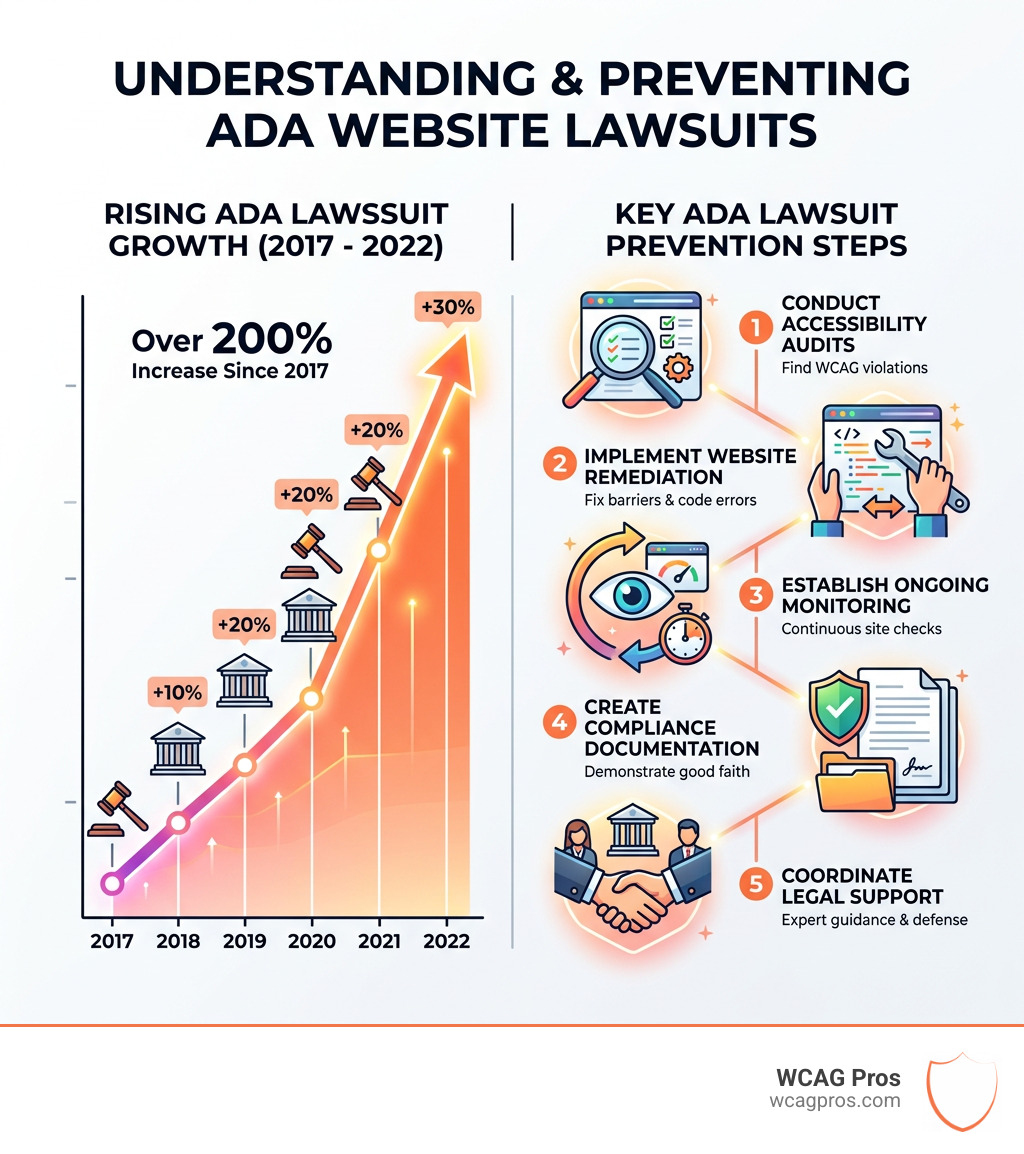
ADA lawsuit prevention services are professional solutions that help businesses avoid costly legal action by making their websites accessible to people with disabilities. Here is a quick overview of what they typically include:
- Accessibility audits to find WCAG violations before plaintiffs do
- Website remediation to fix broken code, missing alt text, and navigation barriers
- Ongoing monitoring to catch new issues as your site changes
- Compliance documentation to demonstrate good-faith efforts in court
- Legal coordination support when a demand letter arrives
The numbers are hard to ignore. Over 3,225 ADA website accessibility lawsuits were filed in federal court in 2022 alone, a 12% jump from the year before. Since 2017, digital accessibility lawsuits have risen by more than 200%. These are not just big-brand problems. Retailers, restaurants, SaaS companies, schools, and small e-commerce stores are all being targeted.
What makes this especially urgent is that fixing your website after a lawsuit is filed does not make the case go away. Courts can still require settlements and award damages even if you remediate quickly. The only reliable strategy is getting ahead of the problem.
I’m Matthew Post, a web developer and accessibility specialist with nearly 30 years of experience building and auditing websites, and as co-founder of WCAG Pros, I have focused this work specifically on ADA lawsuit prevention services that go far beyond automated scans to deliver real, defensible compliance. In the sections below, I will walk you through exactly what puts businesses at risk, what violations matter most, and how to build a protection strategy that holds up.
The Rising Tide of Digital Accessibility Litigation

The digital world has become the new frontier for civil rights litigation. For years many business owners thought the Americans with Disabilities Act only applied to physical ramps and wide doorways. That changed as courts began to view websites as places of public accommodation. Today if your website has barriers that prevent someone with a disability from buying a product or reading information you are essentially locking your front door to a huge portion of the population.
This shift has led to a massive surge in legal filings. In 2022 we saw a 12% increase in federal website accessibility lawsuits. This trend shows no signs of slowing down. Serial litigants often file dozens of cases in a single week using automated tools to find easy targets. They look for common errors like missing image descriptions or buttons that cannot be clicked using a keyboard.
The financial impact is heavy. While a typical settlement might range from a few thousand dollars to twenty thousand dollars the hidden costs are much higher. You have to pay your own attorneys and the plaintiff’s legal fees and then you still have to pay to fix the website. In extreme cases like the famous Target lawsuit the settlement reached 6 million dollars because the barriers were so widespread. Even the The Real Costs of Ignoring Website Accessibility show that proactive protection is always cheaper than a courtroom battle.
The Domino’s Pizza case is another landmark example that every business owner should know. A blind man sued because he could not order a pizza through their website or app using screen reading software. Domino’s fought the case all the way toward the Supreme Court but they lost. The court ruled that their digital presence must be accessible because it had a connection to their physical stores. This case sent a clear message that convenience for some cannot come at the cost of exclusion for others.
High Risk Industries and Targets
While no website is completely safe from a lawsuit some industries are under a microscope. If your business depends on public interaction you are likely on the radar of serial litigants.
- E-commerce: This is the number one target. If a customer cannot complete a checkout because of an inaccessible form the legal risk is immediate.
- SaaS and Software: Digital tools that businesses or individuals rely on must be usable by everyone.
- Education and Government: Public entities have strict deadlines. For example state and local governments face ADA Title II deadlines in April 2026 and 2027.
- Small Business: Many owners think they are too small to be noticed but lawsuits against small businesses have increased by 120% in the last two years.
- Hospitality and Healthcare: Booking a room or accessing medical records are essential services that must be barrier-free.
Technical Standards and Common Website Violations
To protect your business you need to understand the yardstick that courts use to measure accessibility. This yardstick is called the Web Content Accessibility Guidelines (WCAG). These guidelines are not just suggestions. They are the global gold standard for digital inclusion.
WCAG is built on four main principles known as POUR.
- Perceivable: Users must be able to see or hear the information.
- Operable: Users must be able to navigate the site using different tools like a mouse or a keyboard.
- Understandable: The content and navigation must be clear and logical.
- Robust: The site must work well with assistive technologies like screen readers.
Most ada lawsuit prevention services focus on meeting WCAG 2.1 or 2.2 at the Level AA standard. This level strikes a balance between high accessibility and technical feasibility.
Common Violations That Trigger Lawsuits
You do not need to be a coding genius to understand why some sites get sued. Most lawsuits are triggered by a handful of recurring issues.
- Missing Alt Text: Screen readers describe images to blind users. If an image has no “alt text” the user just hears “image” or a long string of random numbers.
- Keyboard Navigation Barriers: Many people cannot use a mouse. If your menus or buttons only work with a mouse click you are excluding them.
- Poor Color Contrast: If your text is light gray on a white background someone with low vision will find it impossible to read.
- Missing Form Labels: When a blind user tabs into a text box the screen reader needs to say “First Name” or “Email.” If the label is missing they have no idea what to type.
- Inaccessible PDFs: Many businesses forget that documents like menus or manuals also need to be accessible.
| WCAG Level | Goal | Lawsuit Risk |
|---|---|---|
| Level A | Minimum accessibility | Very High Risk |
| Level AA | Standard for most businesses | Low Risk (Legal Target) |
| Level AAA | Highest specialized level | Extremely Low Risk |
Strategic Steps for Effective ADA Lawsuit Prevention Services
If you want to truly protect your business you cannot just check a box and forget it. Real prevention requires a strategy. We believe that a comprehensive approach is the only way to sleep soundly at night.
The first step is always a WCAG Audit. At WCAG Pros we perform page-by-page audits covering all 54 points of the WCAG guidelines. We do not just give you a list of errors. We provide the actual code fixes that your developers need to implement. This removes the guesswork and ensures the job is done right the first time.
Once the audit is complete the next phase is WCAG Remediation. This is where the heavy lifting happens. We fix the broken links and add the missing labels and ensure the keyboard focus is visible. Remediation is about turning a liability into an asset.
Ongoing maintenance is just as important. Websites are living things. Every time you add a new blog post or a new product you might accidentally create a new accessibility barrier. Regular monitoring ensures that your compliance does not slip over time.
The Limitations of Accessibility Widgets and Overlays
There is a major trap in ada lawsuit prevention services that you must avoid. You have probably seen ads for “one-click” accessibility widgets or overlays. These companies claim that adding a single line of code will make your site compliant instantly.
It sounds too good to be true because it is. These tools are often ineffective and can even make the experience worse for people using screen readers. In fact over 1,000 companies have been sued despite having these widgets installed. The FTC even fined one major overlay provider 1 million dollars for misleading claims.
Automated tools can only catch about 30% of accessibility issues. They cannot tell if your alt text actually describes the image accurately or if your navigation logic makes sense to a human. True compliance requires manual verification by experts who understand how people with disabilities actually interact with the web.
Documenting Compliance for Legal Defense
If you ever find yourself in a courtroom your best friend will be your paper trail. Courts look for “good faith efforts.” If you can show that you have been actively working on accessibility you are in a much stronger position.
We recommend keeping a detailed log of every audit and every fix. You should also have a public accessibility statement on your website that tells users how they can report an issue if they find one. This shows that you care about your users and are taking your responsibilities seriously. If you have already been Sued for ADA Noncompliance this documentation becomes even more critical for your defense.
Frequently Asked Questions about ADA Compliance
Can small businesses afford ada lawsuit prevention services?
Many small business owners in Norco and beyond worry about the cost. However the return on investment is significant. There are over 60 million Americans with disabilities. By making your site accessible you are opening your doors to a massive market with billions of dollars in spending power.
Furthermore the cost of a professional audit is a fraction of the cost of a single lawsuit. Think of it like insurance for your digital presence. We have designed our services to be accessible for businesses of all sizes because we believe everyone deserves a fair shot at success without the fear of predatory litigation. Our ADA Compliance for Small Businesses in 2025: A Complete Guide provides more details on how to manage these costs effectively.
How do ada lawsuit prevention services handle demand letters?
Receiving a demand letter is scary but it is not the end of the world. The worst thing you can do is ignore it. You should immediately contact legal counsel and an accessibility professional.
We help businesses respond by quickly identifying the issues mentioned in the letter. We then create a remediation timeline that shows the plaintiff and the court that you are taking immediate action. This can often lead to a much lower settlement or even a dismissal if handled correctly. Proactive steps taken before a letter arrives are always best but rapid response is the next best thing.
Why doesn’t fixing my website after a lawsuit dismiss the case?
This is a common point of confusion. You might think that if you fix the problem the lawsuit should go away. Unfortunately the law does not always work that way. A plaintiff can claim they suffered “past damages” because they could not access your site when they needed to.
Courts also want to ensure that you will keep the site accessible in the future. They may issue a mandate that requires you to undergo regular audits for several years. This is why being proactive is so much better than being reactive. If the site is already accessible when the plaintiff visits they have no grounds to sue you in the first place.
Conclusion
The digital landscape is changing and the risks for business owners are real. But you do not have to navigate this alone. At WCAG Pros we are dedicated to helping you build a more inclusive web while protecting your hard-earned business from legal threats.
Our comprehensive ada lawsuit prevention services offer more than just a scan. We provide a deep dive into all 54 WCAG points and deliver actual code fixes and grant compliance badges that show the world you are doing the right thing. Whether you are an e-commerce giant or a local shop in Norco we have the expertise to get you compliant and keep you there.
Do not wait for a demand letter to land on your desk. Take the first step toward total digital protection today. You can learn more about our process by visiting our WCAG Audit page. Let us help you turn accessibility from a legal burden into a business strength. Making the web better for everyone is not just good for your legal health but it is also the right thing to do.
Read more website accessibility articles
Get Help With Your Website
We'll follow up with info about:
- The process
- Cost
- Timeline
We promise to respect your privacy, and never abuse the information you provide. We will not sell or rent your information to any third party.
By submitting this form, you consent to receive SMS messages and/or emails from SEM Dynamics LLC, dba WCAG Pros. To unsubscribe, follow the instructions provided in our communications. Msg & data rates may apply for SMS. Your information is secure and will not be sold to third parties.