
The No-Lawsuit Guide to Website Remediation
The No-Lawsuit Guide to Website Remediation
Understanding Website ADA Compliance Remediation and Its Importance
When we talk about website ADA compliance remediation, we are talking about more than just a technical checklist. We are talking about a fundamental shift in how we view the digital world. At its core, this process is about civil rights. Just as a physical store must have a ramp for wheelchair users, a digital storefront must be navigable for someone using a screen reader or a keyboard instead of a mouse.
The primary driver for this is the Americans with Disabilities Act, specifically Title III. While the ADA was written in 1990 before the modern web existed, the Department of Justice (DOJ) and the courts have been very clear: the law applies to the digital spaces of private businesses. If your business is open to the public, your website is considered a place of public accommodation.
Why is this so important? First, there is the human element. Over 15% of the global population lives with some form of disability. When a site is inaccessible, it is a form of digital discrimination. Second, there is the legal reality. We have seen a massive “cottage industry” of plaintiffs’ law firms emerge. These firms use automated scanners to find easy targets, then file thousands of lawsuits annually.
If you are wondering, does my website have to be ADA compliant, the answer for almost every business in the US is a resounding yes. Remediation is the shield that protects you from these predatory lawsuits while simultaneously opening your doors to a wider audience. It is about moving from a state of vulnerability to a state of inclusivity.
Legal Requirements and Technical Standards for Digital Accessibility
Navigating the legal landscape can feel like trying to read a map in a different language. However, the standards are becoming much clearer. While the ADA itself does not list specific technical requirements for websites, the World Wide Web Consortium created the Web Content Accessibility Guidelines (WCAG), which have become the gold standard.
There are three levels of WCAG conformance:
- Level A: The bare minimum. Without these fixes, the site is essentially unusable for many people with disabilities.
- Level AA: The standard used by most courts and the DOJ. This is the target for most website ADA compliance remediation projects.
- Level AAA: The highest, most specialized level of accessibility.
| Feature | Level A (Minimum) | Level AA (Standard) | Level AAA (Optimal) |
|---|---|---|---|
| Captions | Required for pre-recorded video | Required for live video | Sign language interpretation |
| Color Contrast | No specific ratio | 4.5:1 ratio for text | 7:1 ratio for text |
| Navigation | Basic keyboard access | Consistent navigation across site | Section headings used to organize |
| Images | Alt text for all images | No images of text | Context-sensitive help |
In addition to the ADA, there is Section 508, which applies to federal agencies and any business that does work with the government. More recently, the DOJ published a new rule under Title II that sets a strict deadline for state and local governments to meet WCAG 2.1 Level AA standards by 2026 or 2027, depending on their size.
If you have already been sued ADA noncompliance, you know that settlements almost always require you to reach Level AA. By being proactive, you can meet these global standards on your own terms rather than under the pressure of a court order.
Key Steps in the Website ADA Compliance Remediation Process

Remediation is not a “one and done” task. It is a lifecycle. At WCAG Pros, we follow a rigorous process to ensure nothing is missed. You cannot simply flip a switch and become compliant. It requires a deep dive into your site’s DNA.
The process begins with a WCAG audit. This is the diagnostic phase where we identify every barrier. Once the audit is complete, we move into the actual fixing of the code and content. Finally, we validate the work to ensure the fixes actually work for real users.
Phase One: Auditing for Website ADA Compliance Remediation
A common mistake is relying solely on automated scans. While tools like WAVE or Google Lighthouse are great for a quick check, they only catch about 25% of accessibility issues. They cannot tell you if your alt text is actually descriptive or if a keyboard trap makes a checkout form impossible to finish.
A truly comprehensive WCAG audit must include:
- Manual Technical Review: An expert looks at the underlying code to find issues like missing ARIA labels or improper heading structures.
- Keyboard Navigation Testing: We put the mouse away and attempt to use every feature of the site using only the “Tab” and “Enter” keys.
- Screen Reader Testing: We use software like NVDA or JAWS to “listen” to the site, ensuring the reading order makes sense.
- Identifying Keyboard Traps: This is a major legal trigger where a user can get “stuck” in a menu or pop-up and cannot get back to the main content.
Phase Two: Executing Technical and Content Fixes
Once we have the roadmap from the audit, we start the WCAG remediation work. This is where the heavy lifting happens. We aren’t just changing colors; we are often rebuilding how elements interact with the browser.
Key technical fixes include:
- Semantic HTML: Using the correct tags (like
, and) so browsers and assistive tech understand the page structure. - ARIA Labels: Adding “Accessible Rich Internet Applications” attributes to complex elements like sliders or accordions that HTML alone cannot describe.
- Alt Text: Writing meaningful descriptions for images so visually impaired users get the same information as everyone else.
- Color Contrast: Adjusting the brightness and hue of text and backgrounds to ensure readability for those with low vision or color blindness.
Common Accessibility Failures and Legitimate Solutions
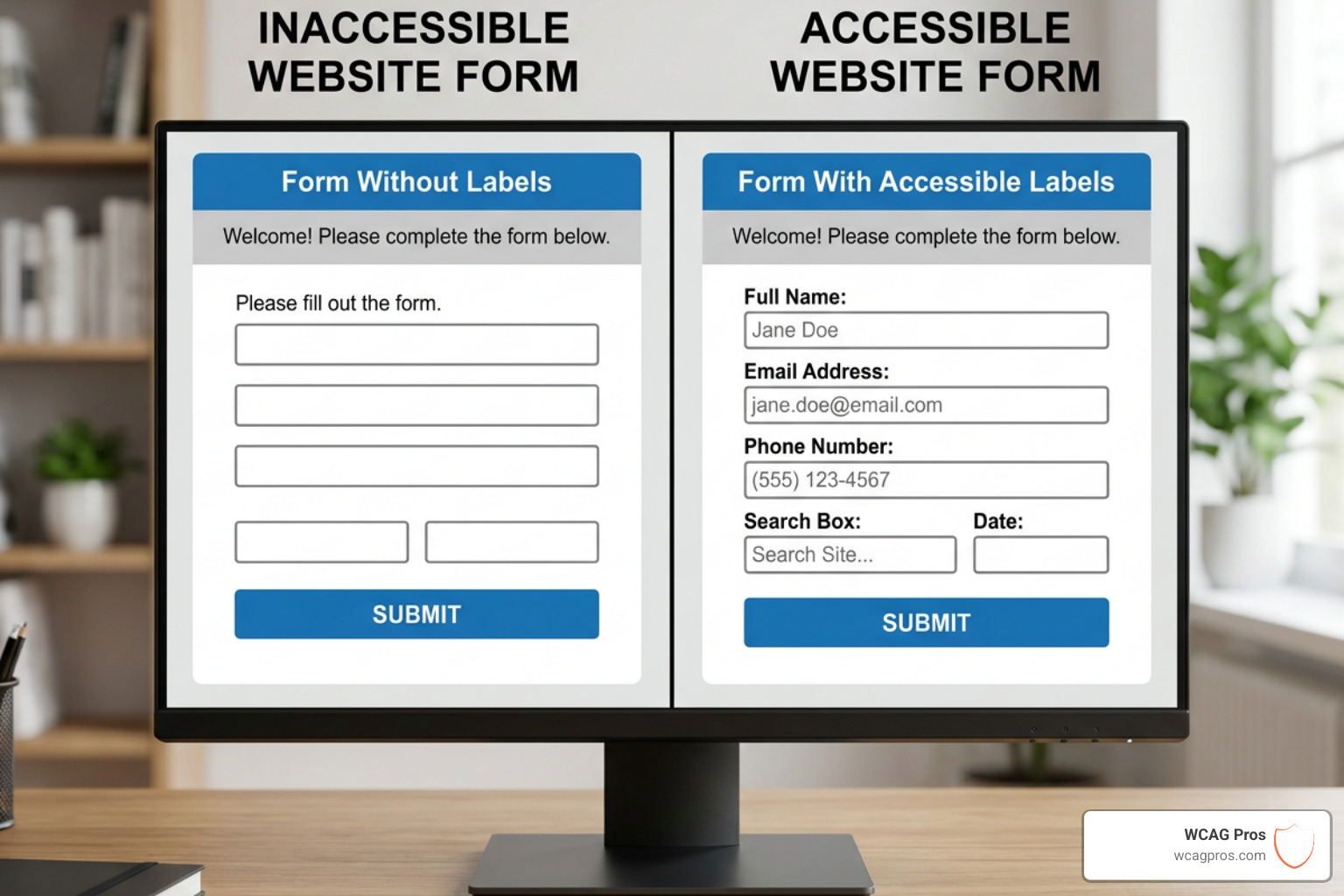
In our years of experience, we see the same “usual suspects” over and over again. These are the issues that most frequently lead to demand letters and lawsuits. The good news is that they are all fixable with the right expertise.
Our ADA website compliance 2025 accessibility checklist highlights these high-priority items:
- Missing Form Labels: If a screen reader user encounters a “Search” box without a label, they won’t know what it is for.
- Auto-playing Media: Video or audio that starts automatically can interfere with screen readers, making it impossible for the user to hear their own navigation software.
- Poor Focus Indicators: When you tab through a site, a “halo” or outline should show you where you are. If this is hidden, keyboard users are effectively flying blind.
Avoiding Ineffective Website ADA Compliance Remediation Tools
In the rush to avoid lawsuits, many business owners fall for “quick fix” solutions known as accessibility overlays or widgets. These are small snippets of code that add a toolbar to your site, promising “instant compliance” with AI.
Here is the truth: hundreds of accessibility professionals have spoken against them. Overlays do not fix the underlying source code. In many cases, they actually make the site harder to use for people with disabilities by interfering with their existing assistive software.
Even worse, they don’t stop lawsuits. In fact, approximately 20% of digital accessibility lawsuits last year were filed against companies that were already using an overlay. If you want real protection, you need top ADA lawsuit prevention services that address the root cause of the problem through manual code remediation.
Frequently Asked Questions about Digital Compliance
How much does ADA website remediation typically cost?
This is the most common question we get, and the answer is that it depends on the “surface area” of your site. A five-page brochure site is much simpler to remediate than a 500-page e-commerce store with complex filtering and checkout systems.
The cost is generally split between the initial audit and the subsequent development hours. A manual audit for most websites usually falls between $1,250 and $2,750. The remediation costs vary based on how “broken” the original code is. If you are curious about your current status, you can learn how to tell your website is ADA compliant by performing a few simple manual tests yourself.
Who is required to comply with ADA standards?
The short answer is: almost everyone. Businesses that are open to the public are the primary targets under Title III. This includes retail, restaurants, hotels, healthcare providers, and private schools.
Public entities (like city governments and public universities) must comply under Title II. Non-profits are also required to comply, as they are generally considered public accommodations. Even if your business is small, if you have 15 or more employees, you are also subject to Title I, which covers employment and ensures your internal portals and job application pages are accessible.
How long does the remediation process take?
A thorough website ADA compliance remediation project usually takes between two to four months. It can be faster for very small sites, but the process cannot be rushed if you want a compliance certificate that actually holds up.
We typically work in a staging environment so your live site remains active while we perform the fixes. Once the fixes are validated, we push them live. However, the work doesn’t stop there. Because websites are living things, you should use an ultimate website accessibility testing checklist for 2026 to ensure that new blog posts, products, or plugins don’t break your compliance in the future.
Conclusion
At the end of the day, website ADA compliance remediation is about more than just checking boxes to avoid a lawyer’s letter. It is an investment in your brand’s reputation and its future. By making your digital presence accessible, you are telling 25% of the population that their business matters to you.
At WCAG Pros, we take the stress out of this process. Our comprehensive page-by-page audits cover all 54 WCAG success criteria. We don’t just give you a list of problems; we provide the code fixes and perform free re-audits to ensure you reach the finish line. We even provide a compliance badge that acts like a security sign in your front yard, deterring frivolous lawsuits by showing that you take accessibility seriously.
Don’t wait for a demand letter to arrive in your inbox. Start your website ADA compliance remediation today and build a more inclusive, legally sound digital home for your business.
Read more website accessibility articles
Get Help With Your Website
We'll follow up with info about:
- The process
- Cost
- Timeline
We promise to respect your privacy, and never abuse the information you provide. We will not sell or rent your information to any third party.
By submitting this form, you consent to receive SMS messages and/or emails from SEM Dynamics LLC, dba WCAG Pros. To unsubscribe, follow the instructions provided in our communications. Msg & data rates may apply for SMS. Your information is secure and will not be sold to third parties.