
How to Make Your Small Business ADA Friendly Without Losing Your Mind
How to Make Your Small Business ADA Friendly Without Losing Your Mind
Understanding ADA Compliance for Small Businesses
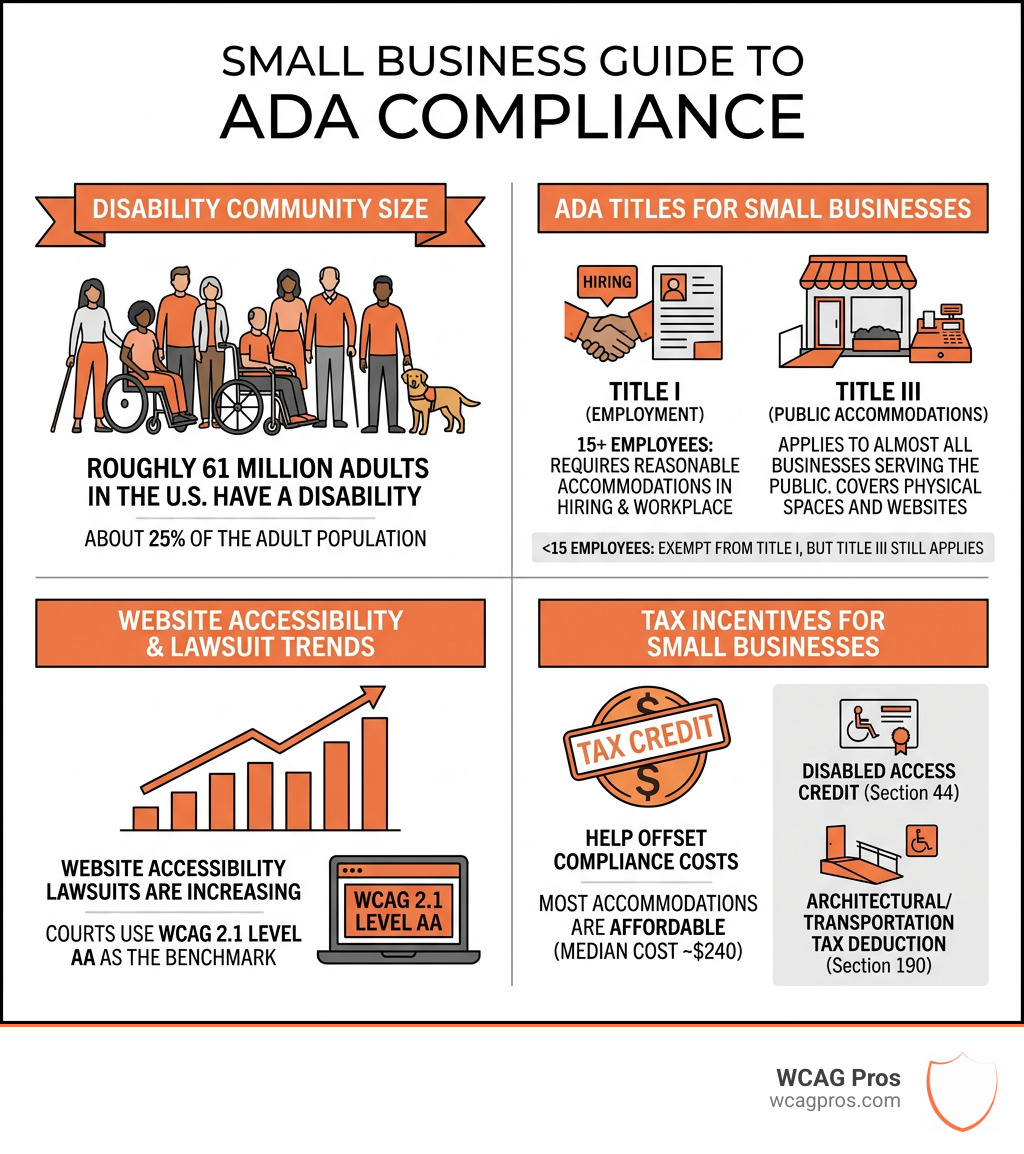
ADA compliance for small businesses is a legal requirement that applies to nearly every business that serves the public, regardless of size. Here is a quick overview of what you need to know:
ADA Compliance for Small Businesses: Quick Summary
| Area | What It Means for You |
|---|---|
| Title I (Employment) | Applies if you have 15 or more employees. Requires reasonable accommodations in hiring and the workplace. |
| Title III (Public Accommodations) | Applies to almost all businesses serving the public, regardless of size. Covers physical spaces and websites. |
| Website Accessibility | Your website must be accessible to people with disabilities. Courts use WCAG 2.1 Level AA as the benchmark. |
| Physical Access | Remove barriers when “readily achievable.” Think ramps, accessible parking, and wide aisles. |
| Size Exemptions | Businesses with fewer than 15 employees are exempt from Title I employment rules. But Title III still applies. |
| Cost | Most accommodations are affordable. The median cost is around $240, and tax credits are available. |
Roughly 61 million adults in the United States have a disability. That is about 25% of the adult population. Every one of them is a potential customer. The ADA was signed into law in 1990 as a civil rights law designed to make sure people with disabilities can participate fully in everyday life, including shopping, dining, and browsing the web. For small business owners, ignoring ADA compliance is not just a missed opportunity. It is a growing legal risk.
I’m Matthew Post, a web developer and accessibility specialist with nearly three decades of experience, and co-founder of WCAG Pros, where I help businesses navigate ADA compliance for small businesses through careful audits and hands-on remediation. This guide will walk you through everything you need to know to protect your business and serve every customer well.
The Americans with Disabilities Act is a landmark piece of legislation. It ensures that people with disabilities have the same rights and opportunities as everyone else. For a small business owner, this law is divided into different sections called titles. Each title covers a different part of your business operations.
Title I focuses on employment. It makes sure that you do not discriminate against qualified individuals with disabilities during the hiring process or while they are working for you. This title generally applies to private employers who have 15 or more employees.
Title III is where most small business owners need to pay the most attention. It covers public accommodations. This includes almost any private business that is open to the public. If you own a restaurant, a retail shop, a doctor’s office, or even a private school, you are likely running a place of public accommodation. Under Title III, you must provide equal access to your goods and services. This means your physical building and your digital presence must be accessible.
Many people ask us Does My Website Have to Be ADA Compliant? and the answer is a resounding yes. The Department of Justice has made it clear that websites are considered places of public accommodation. If a customer cannot navigate your site because they use a screen reader or cannot use a mouse, you might be in violation of the law.
Determining if Your Business Qualifies for Exemptions
There is a common myth that being a “small” business automatically exempts you from the ADA. This is not true. While there are some size exemptions, they are very specific.
The 15 employee threshold only applies to Title I employment rules. If you have 10 employees, you are not legally required by the federal ADA to provide reasonable accommodations for staff. However, you are still required to follow Title III rules for your customers. This means your shop still needs a ramp and your website still needs to work for everyone.
There are a few other exceptions. Religious organizations and private clubs are generally exempt from Title III. Additionally, businesses that operate for fewer than 20 weeks per year might have different requirements. However, legal precedents are constantly evolving. Most courts now lean toward inclusivity. Even if you think you might be exempt, it is often better for your brand and your bottom line to be accessible anyway.
Physical and Digital Accessibility Standards
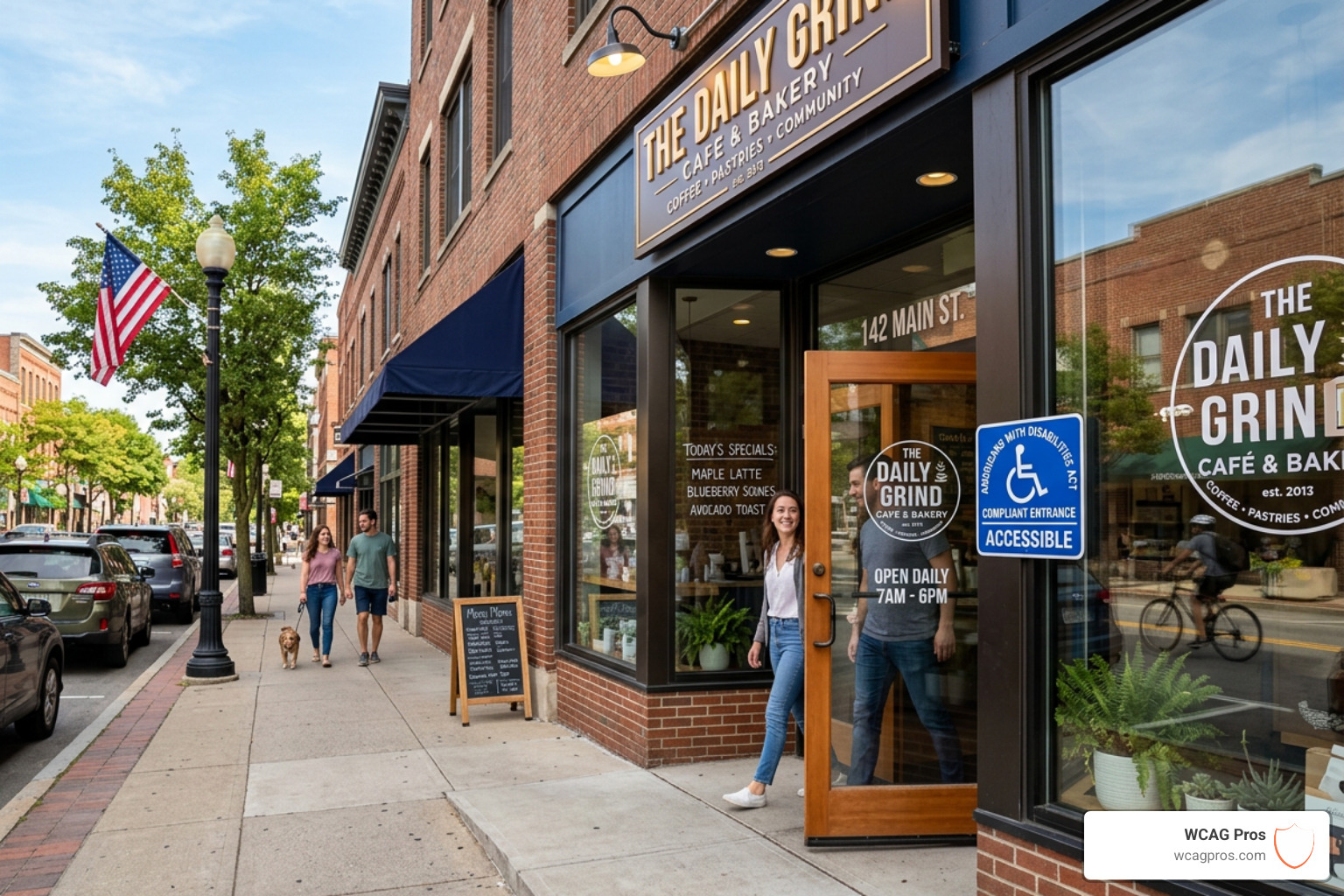
When it comes to your physical location, the ADA uses a phrase called “readily achievable.” This means you must remove architectural barriers if doing so is easy to accomplish without much difficulty or expense. We are not talking about tearing down your whole building. We are talking about simple fixes.
Common physical requirements include:
- Accessible parking spaces that are close to the entrance.
- Ramps or level entrances for people who use wheelchairs.
- Wide aisles that allow for easy movement.
- Restrooms with grab bars and enough space to turn a wheelchair around.
The ADA 2010 Revised Requirements updated the standards for how these features should be built. For example, a van accessible parking space needs an access aisle that is at least eight feet wide. If you built your shop before 2010, you might be protected by a “safe harbor” rule. This means if your elements complied with the 1991 standards, you do not have to change them until you decide to do a renovation or alteration.
Another big part of physical access involves service animals. Under the ADA, a service animal is a dog that is individually trained to do work or perform tasks for a person with a disability. You must allow these dogs into your business even if you have a “no pets” policy. One important thing to remember is that They are not required to be certified. You cannot ask for papers or a vest. You can only ask if the dog is required because of a disability and what task it has been trained to perform.
Effective communication is also a requirement. You might need to use auxiliary aids to help a customer. This could be as simple as writing notes back and forth with a deaf customer or reading a menu out loud to a blind customer. For more complex needs, you can check out our ADA Website Compliance 2025 Accessibility Checklist to see how these concepts translate to the digital world.
Common Web Issues in ADA Compliance for Small Businesses
Digital accessibility is just as important as a physical ramp. The ADA requires that businesses provide full and equal enjoyment of their services. If your website is broken for a user with a disability, they are being excluded.
We see the same mistakes over and over again. These are often called 5 Common Accessibility Issues on Small Business Websites and How to Fix Them. Here are the big ones:
- Missing Alt Text: Images need a text description so screen readers can tell a blind user what is on the screen.
- Poor Color Contrast: If your text color is too similar to the background color, people with low vision cannot read it.
- Keyboard Navigation: Some users cannot use a mouse. Your website must be fully functional using only the “Tab” and “Enter” keys.
- Unlabeled Forms: If your “Contact Us” form doesn’t have clear labels, a screen reader user won’t know where to type their name or email.
The best way to find these issues is through a professional WCAG Audit. Once you know what is wrong, you can begin WCAG Remediation to fix the code. At WCAG Pros, we believe in fixing the actual code rather than using “overlays” or widgets that often make the experience worse for people who use assistive technology.
Employment Practices and Financial Incentives
If you have 15 or more employees, ADA Title I is your guide for the workplace. The goal here is simple. You should hire the best person for the job regardless of their disability.
You are required to provide reasonable accommodations for qualified employees. Think of these as productivity enhancers rather than special treatment. For example, an ergonomic chair might help an employee with back pain work more comfortably. A screen magnifier might help an employee with low vision process data faster.
You do not have to provide an accommodation if it causes “undue hardship.” This means the cost or difficulty is so high that it would hurt your business operations. However, for most small businesses, accommodations are very cheap. Statistics show that 20% of accommodations cost nothing at all. More than half cost less than $500.
There is also a huge business case for this. Research shows that businesses that focused on disability inclusion grew their profits 4.1 times faster than other companies. When you make your workplace accessible, you tap into a loyal and talented workforce. You can learn more about the financial benefits in our article on The ROI of Accessibility for Small Businesses.
To help with the costs, the government offers two major tax incentives:
- The Disabled Access Credit: This is for small businesses with $1 million or less in revenue or 30 or fewer employees. You can get a tax credit of up to $5,000 per year for accessibility expenses like website fixes or building a ramp.
- The Architectural Barrier Removal Tax Deduction: This is available to businesses of any size. You can deduct up to $15,000 per year for the cost of removing physical barriers.
Hiring Do’s and Don’ts for ADA Compliance for Small Businesses
The hiring process is a common place where small businesses accidentally break the law. You have to be very careful about the questions you ask.
Hiring Do’s:
- Focus on the essential functions of the job. Ask “Can you perform the duties of this role with or without an accommodation?”
- Keep all medical information confidential. Store it in a separate file from the regular personnel file.
- Provide accommodations for the interview itself if requested. This might mean choosing an accessible location or providing a sign language interpreter.
Hiring Don’ts:
- You cannot ask an applicant if they have a disability before you make a job offer.
- You cannot ask about their medical history or how many sick days they took at their last job.
- an employer cannot reject an applicant because of their disability. You can only reject them if they are not qualified for the job.
The ADA has specific exceptions for safety. If an employee poses a “direct threat” to the health or safety of others, you might have grounds for a different decision. But this must be based on objective evidence and not stereotypes. Also, make sure your application tests do not require use of a person’s impaired skill unless that skill is what you are actually testing for.
Frequently Asked Questions
Many business owners are worried about the legal side of things. It is a valid concern. Plaintiffs filed 3,225 website accessibility lawsuits in federal court in 2022. This was a 12% increase from the year before. Most of these lawsuits target small and medium businesses.
If you receive a demand letter, do not panic. The first step is to get an audit to see if the claims are true. Being proactive is much cheaper than paying a settlement. A lawsuit can cost tens of thousands of dollars in legal fees. Fixing your website or building a ramp is usually a fraction of that cost.
What are the policies for service animals in small businesses?
You must allow service animals in all areas where the public is allowed. This includes dining rooms in restaurants and exam rooms in clinics. You cannot charge a “pet fee” for a service animal. If the animal is out of control or not housebroken, you can ask the owner to remove it. But you must still offer the owner the chance to get your goods or services without the animal present.
How can small businesses communicate effectively with customers who have disabilities?
Effective communication depends on the situation. For a simple transaction like buying a coffee, exchanging written notes is usually fine. For a complex transaction like signing a loan or discussing a medical procedure, you might need a qualified sign language interpreter. You should also make sure your documents are available in accessible formats like large print or digital files that work with screen readers.
What tax credits and deductions are available for ADA-related improvements?
As mentioned earlier, the Disabled Access Credit (IRS Section 44) can cover 50% of your eligible expenses up to $10,250. This means a maximum credit of $5,000. The Barrier Removal Tax Deduction (IRS Section 190) allows you to deduct up to $15,000 for physical changes. You can often use both of these incentives in the same year if you qualify. This makes ada compliance for small businesses much more affordable.
Conclusion
Making your small business ADA friendly doesn’t have to be a nightmare. It is about taking small, consistent steps toward inclusion. Start by looking at your front door and your website. If you can fix one barrier a month, you are already ahead of the curve.
At WCAG Pros, we are here to help you get it right the first time. We don’t use shortcuts or bandaids. We provide deep, code-level audits and remediation to make sure your digital presence is truly welcoming to everyone. If you are ready to protect your business and reach a wider audience, please Contact Us today. For a deeper dive into these topics, check out our ADA Compliance for Small Businesses in 2025: A Complete Guide. We look forward to helping you build a more accessible future.
Read more website accessibility articles
Get Help With Your Website
We'll follow up with info about:
- The process
- Cost
- Timeline
We promise to respect your privacy, and never abuse the information you provide. We will not sell or rent your information to any third party.
By submitting this form, you consent to receive SMS messages and/or emails from SEM Dynamics LLC, dba WCAG Pros. To unsubscribe, follow the instructions provided in our communications. Msg & data rates may apply for SMS. Your information is secure and will not be sold to third parties.