
Is Your Business Open to Everyone or Just a Lawsuit
Is Your Business Open to Everyone or Just a Lawsuit
Is Your Business Actually Open to Everyone? What Public Accommodation Examples Tell Us About ADA Risk
Public accommodation examples include a wide range of businesses and facilities open to the general public. Here is a quick overview:
| Category | Examples |
|---|---|
| Lodging | Hotels, motels, inns |
| Food and drink | Restaurants, bars, cafeterias |
| Entertainment | Movie theaters, concert halls, sports stadiums |
| Retail and sales | Grocery stores, clothing stores, gas stations |
| Healthcare | Doctors’ offices, pharmacies, hospitals |
| Education | Private schools, daycare centers, testing centers |
| Recreation | Gyms, golf courses, zoos, amusement parks |
| Services | Banks, barber shops, insurance offices |
| Social services | Homeless shelters, food banks, senior centers |
Almost every business that serves the public falls under this umbrella. And that matters because under U.S. law, each one carries real legal obligations.
The ADA was designed so that people with disabilities can fully participate in everyday life. That includes your business, regardless of its size or how old your building is. Ignore that, and you are not just leaving customers out. You are also leaving the door open to lawsuits, penalties, and reputational damage.
I’m Matthew Post, co-founder of WCAG Pros and a web developer with over 20 years of experience helping businesses understand and meet their accessibility obligations, including navigating public accommodation examples under the ADA. In the sections below, I’ll walk you through exactly what the law covers, what it requires, and what you need to do about it.
Defining the Legal Scope of Public Accommodation Examples
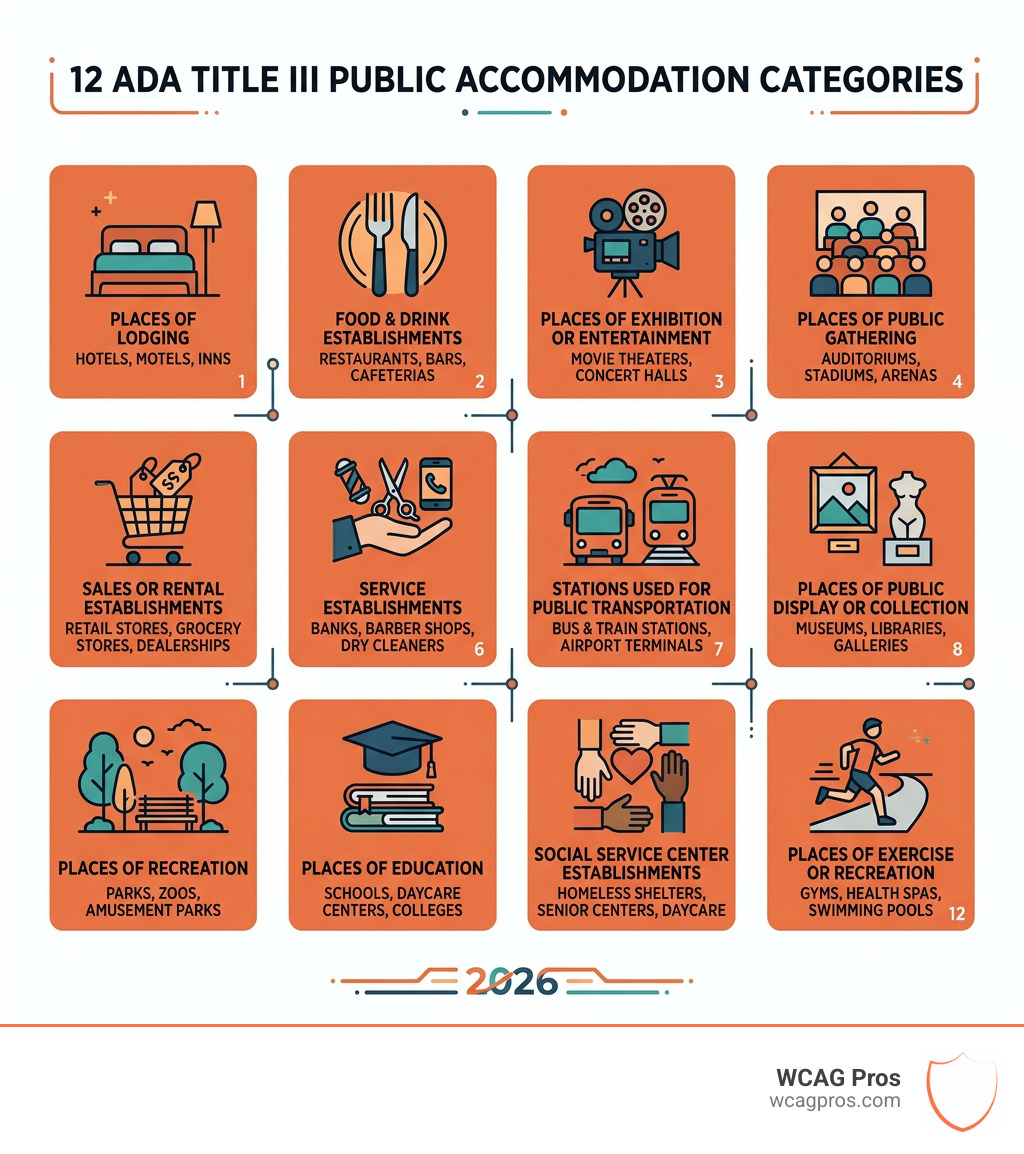
When we talk about the ADA, we often focus on the physical world. However, the legal definition of a public accommodation is quite broad. Under Title III of the ADA, a place of public accommodation is a facility operated by a private entity whose operations affect commerce and fall into at least one of twelve specific categories.
The ADA Title III Technical Manual provides these categories to help business owners understand if they are covered. These categories include everything from places of lodging to social service center establishments. If your business invites the public in to buy goods or use services, you are likely running a public accommodation.
It is important to distinguish between different parts of the ADA. Title II covers state and local government entities. Title III covers private businesses. While both require accessibility, the rules for how you achieve it can differ.
| Feature | Title II | Title III |
|---|---|---|
| Entity Type | State and local governments | Private businesses and nonprofits |
| Examples | Public libraries, city halls, DMV | Restaurants, retail stores, hotels |
| Digital Rule | Strict WCAG 2.1 Level AA mandate | Broad nondiscrimination requirement |
| Funding | Public tax dollars | Private revenue |
In California, we also have the Unruh Civil Rights Act. This state law is even broader than the federal ADA. It protects people from discrimination by all business establishments in California. This includes discrimination based on sex, race, color, religion, ancestry, national origin, disability, medical condition, genetic information, marital status, sexual orientation, citizenship, primary language, or immigration status. Because we are based in Norco, CA, we pay special attention to how these state laws overlap with federal requirements.
Common Public Accommodation Examples in Daily Life
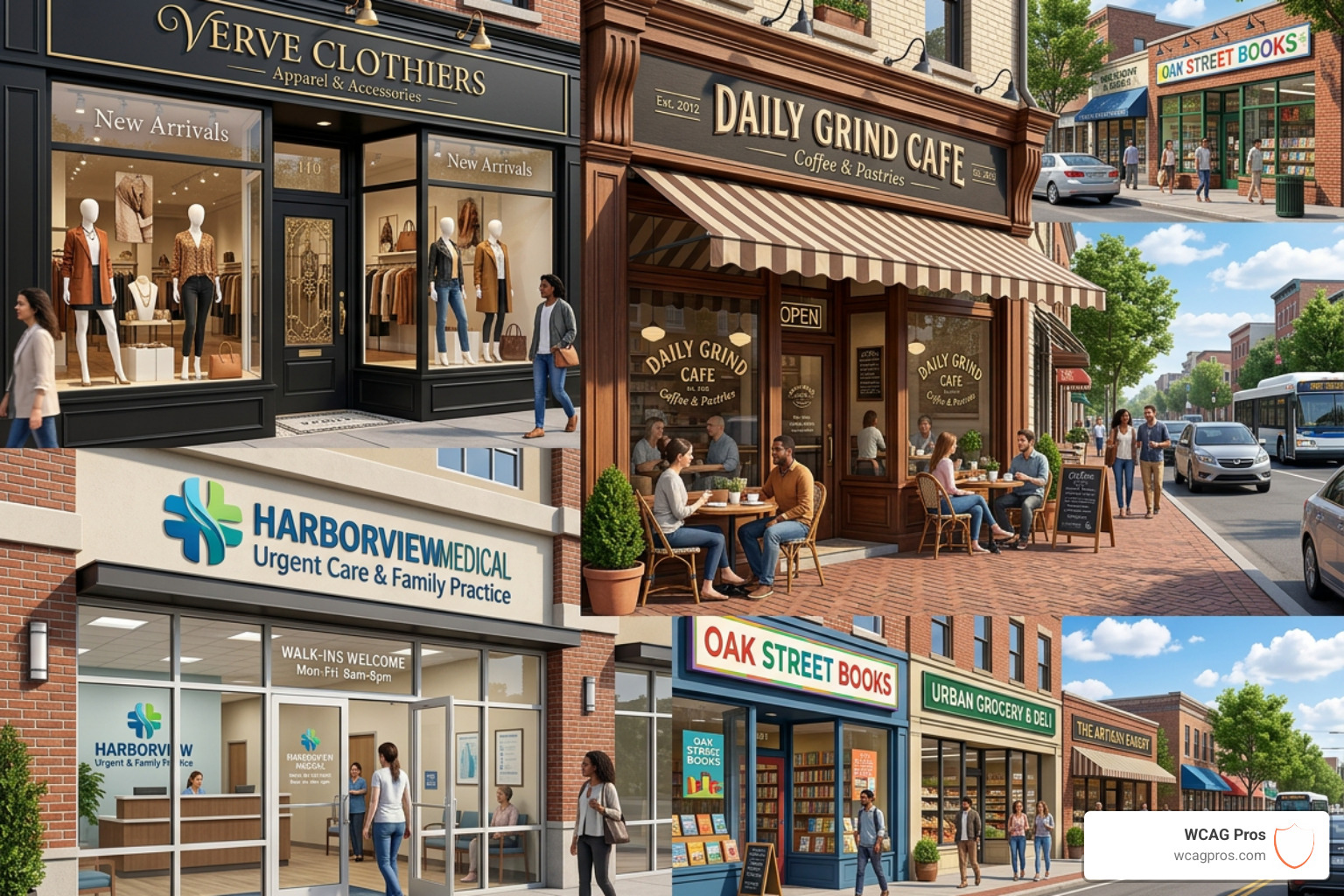
We encounter public accommodation examples every time we leave our homes. When you go to a movie theater to see the latest blockbuster, you are in a place of public accommodation. The theater must ensure that there are accessible seating options and that the path to the popcorn stand is clear for someone using a wheelchair.
Recreational facilities are another major category. This includes gyms, bowling alleys, and even golf courses. If a private health club sponsors a basketball league, they cannot deny participation to a person who uses a wheelchair unless there is a legitimate safety issue that cannot be mitigated. Even then, the law requires an individualized assessment rather than a blanket ban.
Places of education also fall under Title III if they are privately operated. This includes nursery schools, elementary schools, and even postgraduate private schools. If a private school offers a testing program, they must provide accommodations. For instance, a student with dyslexia might be granted extended time to take an admissions exam. You can find more details about providing testing accommodations through official federal resources.
Service and Sales Establishment Public Accommodation Examples
Retail stores are perhaps the most visible public accommodation examples. Whether it is a giant grocery store or a small boutique clothing shop, these businesses must be accessible. This means keeping aisles clear and ensuring that at least one checkout counter is at a height usable by someone in a wheelchair.
Service establishments are also covered. This group is diverse and includes:
- Banks and credit unions
- Barber shops and beauty salons
- Gas stations
- Funeral parlors
- Laundromats
- Insurance offices
Healthcare providers are a critical sub-category. Doctors, dentists, and psychologists must ensure their offices are accessible. This includes the waiting room, the exam rooms, and even the restrooms. If a doctor runs a practice out of a portion of their home, that specific area is considered a public accommodation and must meet ADA standards.
Essential Requirements for ADA Title III Compliance
Compliance is not just about having a ramp at the front door. It involves a continuous commitment to non-discrimination. One of the most important concepts for existing buildings is barrier removal. The ADA requires businesses to remove architectural barriers in existing facilities when it is readily achievable to do so.
What does readily achievable mean? It means the change is easy to accomplish without much difficulty or expense. This is a flexible standard that depends on the resources of the business. For a large corporation, installing an elevator might be readily achievable. For a small mom and pop shop, it might only be readily achievable to install a portable ramp or rearrange shelves to widen an aisle.
Reasonable modifications are another core requirement. This means changing your policies or procedures to accommodate a person with a disability. For example, a “no pets” policy must be modified to allow service animals. Under the ADA, a service animal is specifically a dog or a miniature horse that is trained to do work or perform tasks for a person with a disability.
Effective communication is also vital. Businesses must provide auxiliary aids and services when necessary to ensure they communicate effectively with people who have vision, hearing, or speech disabilities. This could be as simple as a waiter writing down menu options for a deaf customer or as complex as providing a sign language interpreter for a detailed medical consultation.
For those looking for a deep dive, we recommend checking out our ADA Compliance for Small Businesses in 2025: A Complete Guide. It breaks down these requirements in a way that is easy for busy owners to digest.
When a business engages in new construction or alterations, the rules get stricter. Any facility built for first occupancy after January 26, 1993, must be fully accessible according to the ADA Standards for Accessible Design. If you are altering a primary function area, such as the dining room of a restaurant, you may also need to ensure the path of travel to that area is accessible. The law generally says you do not have to spend more than 20% of the total alteration cost on the path of travel, which helps keep costs predictable for businesses.
Digital Accessibility and the Modern Public Square
Your website is often the front door to your business. This is where the concept of public accommodation examples gets really interesting. For years, courts have debated whether a website counts as a place of public accommodation.
In California, the answer is increasingly clear. Courts here have ruled that websites and mobile apps are business establishments under the Unruh Act. If your website is a gateway to the goods and services you provide at a physical location, it absolutely must be accessible. Even for online only businesses, there is massive pressure to comply with accessibility standards to avoid discrimination claims.
Common digital barriers include:
- Images without alt text for screen reader users
- Videos without captions for people who are deaf
- Websites that cannot be navigated using only a keyboard
- Poor color contrast that makes text hard to read
We see these issues across all industries. For example, Website ADA Compliance Hotels often struggle with accessible room descriptions and booking flows. Similarly, Website ADA Compliance Restaurants frequently have menus that are just image files, which are invisible to screen readers. Even Website ADA Compliance Ecommerce Sites face risks if their checkout process is not fully accessible.
The gold standard for digital accessibility is the Web Content Accessibility Guidelines, or WCAG. Most legal settlements and new regulations, like the DOJ rule for Title II, point to WCAG 2.1 Level AA as the target. At WCAG Pros, we help businesses reach this target through detailed audits and manual code fixes.
Frequently Asked Questions about Public Accommodations
What businesses are exempt from ADA Title III?
While the ADA is broad, it does not cover everything. Private clubs and religious organizations are generally exempt from Title III. A private club must be a truly selective membership organization to qualify. Religious entities, including churches, temples, and mosques, are exempt even if they operate a day care center or a school that is open to non-members.
There is also the “Mrs. Murphy” exemption. This applies to owner-occupied lodging establishments that rent out five or fewer rooms. If you live in your large historic home and rent out two rooms as a bed and breakfast, you are likely exempt from the lodging requirements of Title III.
How does the Civil Rights Act of 1964 differ from the ADA?
Title II of the Civil Rights Act of 1964 was the first major federal law to address public accommodations. It prohibits discrimination based on race, color, religion, or national origin. However, its definition of public accommodation is narrower than the ADA. It primarily focuses on lodging, food service, and entertainment venues.
The ADA, passed in 1990, built on this foundation but focused specifically on disability. It covers a much wider range of businesses, including all retail stores and service providers. While the Civil Rights Act focuses on equal treatment, the ADA often requires active changes, like removing physical barriers or modifying policies, to ensure equal access.
What are the penalties for ADA violations?
Violating the ADA can be expensive. In a lawsuit brought by the Department of Justice, the Attorney General can seek civil penalties. For a first violation, the fine can be up to $55,000. For subsequent violations, that amount can jump to $110,000.
Private individuals can also sue for injunctive relief. This means a court can order you to fix the accessibility issues and pay the plaintiff’s attorney fees. In California, under the Unruh Act, plaintiffs can also seek statutory damages, which often start at $4,000 per encounter. This is why being proactive is so much better than waiting for a demand letter.
Conclusion
Understanding public accommodation examples is the first step toward protecting your business and serving your entire community. Whether you run a boutique in Norco or a massive ecommerce platform, accessibility is a legal and moral necessity.
Ignoring these rules does not make them go away. It only increases your risk of a costly legal battle. On the flip side, making your business accessible has a great return. You can read more about The ROI of Accessibility for Small Businesses to see how it opens you up to a massive, loyal market of customers with disabilities.
If you are worried about your digital presence, you are not alone. We have identified 5 Common Accessibility Issues on Small Business Websites and How to Fix Them to help you get started.
At WCAG Pros, we specialize in taking the guesswork out of compliance. We provide manual, page-by-page audits and actual code fixes to ensure your site meets the highest standards. Don’t wait for a lawsuit to find out your website is closed to a huge portion of the public. Get your WCAG remediation started with us today and make sure your business is truly open to everyone.
Read more website accessibility articles
Get Help With Your Website
We'll follow up with info about:
- The process
- Cost
- Timeline
We promise to respect your privacy, and never abuse the information you provide. We will not sell or rent your information to any third party.
By submitting this form, you consent to receive SMS messages and/or emails from SEM Dynamics LLC, dba WCAG Pros. To unsubscribe, follow the instructions provided in our communications. Msg & data rates may apply for SMS. Your information is secure and will not be sold to third parties.