
VPATs and ACRs for People Who Hate Acronyms
VPATs and ACRs for People Who Hate Acronyms
What You Need to Know About ADA VPAT Accessibility Reports
An ADA VPAT accessibility report is a standardized document that shows how well a digital product meets accessibility standards like WCAG, Section 508, and the ADA.
Quick answer:
- VPAT stands for Voluntary Product Accessibility Template. It is the blank template created by the Information Technology Industry Council (ITI).
- ACR stands for Accessibility Conformance Report. It is the completed document you get after filling out the VPAT for a specific product.
- The two terms are often used interchangeably, but technically the VPAT is the template and the ACR is the finished report.
- VPATs are used by vendors to show buyers how accessible their product is, using conformance levels like Supports, Partially Supports, and Does Not Support.
- They are not a certification. They are a self-assessment and disclosure tool used in procurement decisions.
Who needs one?
- Software and SaaS vendors selling to U.S. federal agencies (required under Section 508)
- Businesses selling to large enterprises or educational institutions
- Any vendor whose buyers ask for proof of accessibility before purchasing
Most assessments take one to two weeks depending on product complexity. The latest version is VPAT 2.5Rev (April 2025), available in four editions: 508, WCAG, EU, and INT.
I’m Matthew Post, co-founder of WCAG Pros and a web developer with over 10 years of experience auditing websites for ADA VPAT accessibility report compliance and WCAG conformance. I’ve helped businesses across industries navigate accessibility requirements to reduce legal risk and meet procurement demands. Let’s break down exactly how VPATs work and how to get one done right.
What is a VPAT and How Does it Differ from an ACR
In digital accessibility, we use a lot of shorthand. It can feel like alphabet soup. To clear the air, let’s look at the two most common terms you will encounter: the VPAT and the ACR.
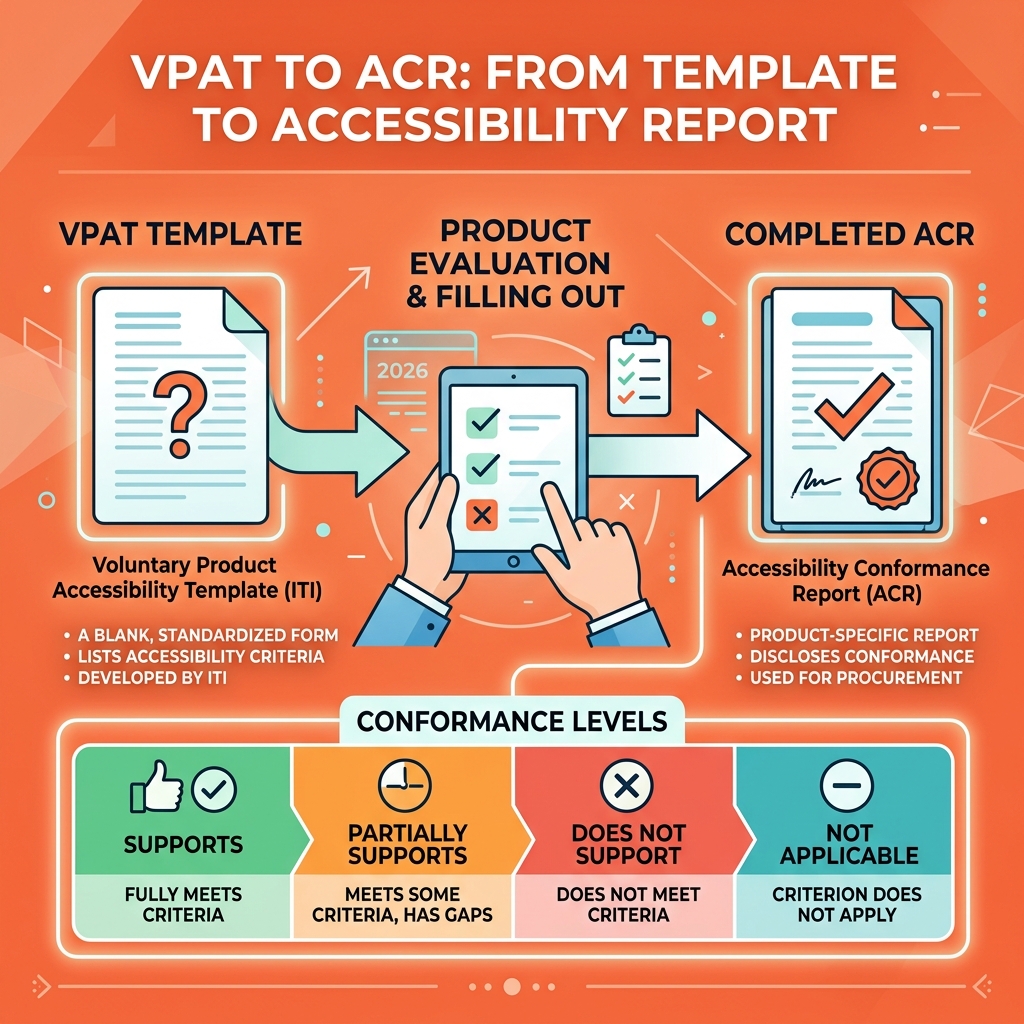
The Voluntary Product Accessibility Template (VPAT) is a free, standardized form developed by the Information Technology Industry Council (ITI). Think of it as a blank exam paper. It lists out all the accessibility requirements a product should meet, but it does not have any answers filled in yet.
Once a company takes that blank template and fills it out with data from an actual audit of their software or website, it becomes an Accessibility Conformance Report (ACR). This is the “graded” paper that tells a buyer exactly how the product performs. While people often say they need an ADA VPAT accessibility report, what they are usually asking for is the completed ACR.
The ITI maintains these templates to ensure that everyone is speaking the same language. By using a consistent format, a government procurement officer or a corporate buyer can compare two different software products side-by-side to see which one is more inclusive.
It is a self-assessment tool. This means the vendor is responsible for the accuracy of the information. Because it is used to satisfy Section 508 of the Rehabilitation Act, providing an inaccurate report can lead to significant legal and contractual headaches. If you want to see what a professional report looks like, you can review existing ACRs from major software providers to get a feel for the level of detail required.

Why Your Business Needs an ADA VPAT Accessibility Report
You might be wondering why you should go through the trouble of creating this report if it is “voluntary.” The truth is that for many businesses, it is only voluntary until a big client asks for it.
If you want to sell your digital product to the U.S. federal government, an ACR is essentially mandatory. Under Section 508, agencies must buy the most accessible product available that meets their business needs. If you do not have a report, you might be disqualified before the conversation even starts.
Beyond the government, large enterprises and educational institutions are increasingly requiring an ADA VPAT accessibility report as part of their standard procurement process. They have their own internal diversity and inclusion goals, and they also want to avoid the legal risks associated with inaccessible software.
Having a clear, honest ACR gives you a massive competitive advantage. It shows that you are transparent and that you care about all your users, including those with disabilities. It is a sign of a mature, professional product. For smaller companies, this can be the difference between winning a contract or losing it to a larger competitor. You can learn more about how this fits into the bigger picture in our ADA Compliance for Small Businesses in 2025: A Complete Guide.
For a deeper dive into the federal side of things, NASA provides an excellent resource titled Demystifying Section 508: An Industry Guide to Understanding Section 508 of the Rehabilitation Act, which explains how these reports facilitate the buying process.
Navigating VPAT Versions and Conformance Levels
When you open a VPAT template, you will see tables where you must record a “Conformance Level” for every single accessibility criterion. These levels are standardized so that buyers know exactly what you mean.
Here is a breakdown of the four main levels:
- Supports: The product meets the requirement without any known defects.
- Partially Supports: Some parts of the product meet the requirement, but there are some exceptions or bugs. This used to be called “Supports with Exceptions.”
- Does Not Support: The majority of the product fails the requirement.
- Not Applicable: The requirement does not apply to the product (for example, asking about captions for a product that has no video).
There is also a “Not Evaluated” level, but that is generally only used for the very strict WCAG AAA standards.
It is vital to be honest here. If you mark something as “Partially Supports,” you must provide a detailed explanation in the “Remarks” column. This transparency helps buyers understand if the “failure” is a deal-breaker for them or something they can work around. Modern reports now incorporate the latest WCAG 2.2 standards and international requirements like EN 301 549.
Choosing the Right ADA VPAT Accessibility Report Edition
Not all VPATs are created equal. There are four different editions of the template, and choosing the wrong one can make your report useless to your target buyer.
- VPAT 508: This is specifically for the U.S. federal market. It covers Section 508 standards, which include WCAG 2.0.
- VPAT WCAG: This edition focuses strictly on the Web Content Accessibility Guidelines. It is often used by private companies or for products that are purely web-based.
- VPAT EU: This is tailored for the European market and follows the EN 301 549 standard.
- VPAT INT: This is the “International” version. It is a massive document that combines all of the above. This is the best choice if you sell your product globally.
If you are unsure which standards apply to you, it helps to start with More info about WCAG audits to see where your product currently stands.
The Three Step Process for Compliance
Creating an ADA VPAT accessibility report does not have to be a nightmare. We like to break it down into three manageable steps. You cannot simply guess your way through the form because you need data to back up your claims.
First, you must select your testing standard. Most modern businesses aim for WCAG 2.1 or 2.2 Level AA. Once you know the target, the real work begins with a comprehensive audit. This audit should use a mix of three testing methods:
- Automated Tools: These can quickly find “low-hanging fruit” like missing alt text or poor color contrast.
- Manual Review: An expert needs to check things that machines cannot, like whether the tab order makes sense or if a screen reader’s description of a button is actually helpful.
- Assistive Technology Testing: This involves actually using the product with screen readers like JAWS or NVDA, and navigating with only a keyboard.
For a detailed look at how these audits work, check out our Expert Website WCAG Audit Guide for Businesses.
Steps to Generate an ADA VPAT Accessibility Report
Once the audit is finished, you have to turn that raw data into the final report.
- Select the Standard: Choose the VPAT edition (508, WCAG, EU, or INT) that matches your business needs.
- Perform the Audit: Document every success and failure. If you find issues, you might want to look into WCAG Remediation to fix them before you publish the report.
- Publish Results: Fill out the template and post it on your website or include it in your sales proposals.
To make the actual writing part easier, the government provides an ACR Editor tool that helps you generate machine-readable reports.
Frequently Asked Questions
Is a VPAT a certification of compliance
No. A VPAT is a self-disclosure document. There is no official “VPAT Certification” or government seal of approval. It is a statement of fact about your product’s current state. While you can hire a third-party expert like us at WCAG Pros to perform the audit and fill out the report to increase its credibility, it remains a voluntary disclosure tool used to help buyers make informed decisions.
How often should VPAT reports be updated
You should update your ADA VPAT accessibility report whenever you make a significant change to your product. If you release a new version, add major features, or fix a bunch of accessibility bugs, your old report is effectively obsolete. At a minimum, many companies choose to review and update their reports annually to ensure they still reflect the current state of the software.
Do vendors have to provide VPATs
Technically, providing a VPAT is voluntary for the vendor. However, if a buyer makes it a condition of the sale, then you “have” to provide it if you want the contract. For government contracts, while the template itself is voluntary, providing an ACR (by any method) is often a legal requirement for the agency to even consider your product. In the enterprise world, it has become a standard “check the box” item for risk management teams.
Conclusion
At WCAG Pros, we believe that accessibility should be transparent and straightforward. An ADA VPAT accessibility report is more than just a compliance hurdle. It is a tool for building trust with your customers and opening doors to new business opportunities in the government and enterprise sectors. Our reporting goes even further with remediation recommendations for elements that do not satisfy WCAG guidelines.
Whether you are selling a complex SaaS platform or a simple web app, knowing where you stand is the first step. If you are not sure if your site is ready for a report, you can read our guide on How to Tell Your Website is ADA Compliant.
Ready to take the next step toward total transparency? Our team can handle the heavy lifting of the audit and documentation process for you. Start your WCAG Audit today and let us help you turn accessibility into your brand’s competitive advantage.
Read more website accessibility articles
Get Help With Your Website
We'll follow up with info about:
- The process
- Cost
- Timeline
We promise to respect your privacy, and never abuse the information you provide. We will not sell or rent your information to any third party.
By submitting this form, you consent to receive SMS messages and/or emails from SEM Dynamics LLC, dba WCAG Pros. To unsubscribe, follow the instructions provided in our communications. Msg & data rates may apply for SMS. Your information is secure and will not be sold to third parties.