
Five ways to stop an ADA lawsuit in its tracks
Five ways to stop an ADA lawsuit in its tracks
Why ADA Website Lawsuit Prevention Can’t Wait in 2026
ADA website lawsuit prevention comes down to five core actions every business website owner should take right now:
- Conduct a manual WCAG 2.2 AA audit to find real barriers, not just what automated tools catch
- Fix your source code to remove accessibility barriers at their root
- Publish an accessibility statement so users and courts see your commitment
- Test with real assistive technology users to validate your fixes in the real world
- Set up ongoing monitoring so new content does not undo your progress
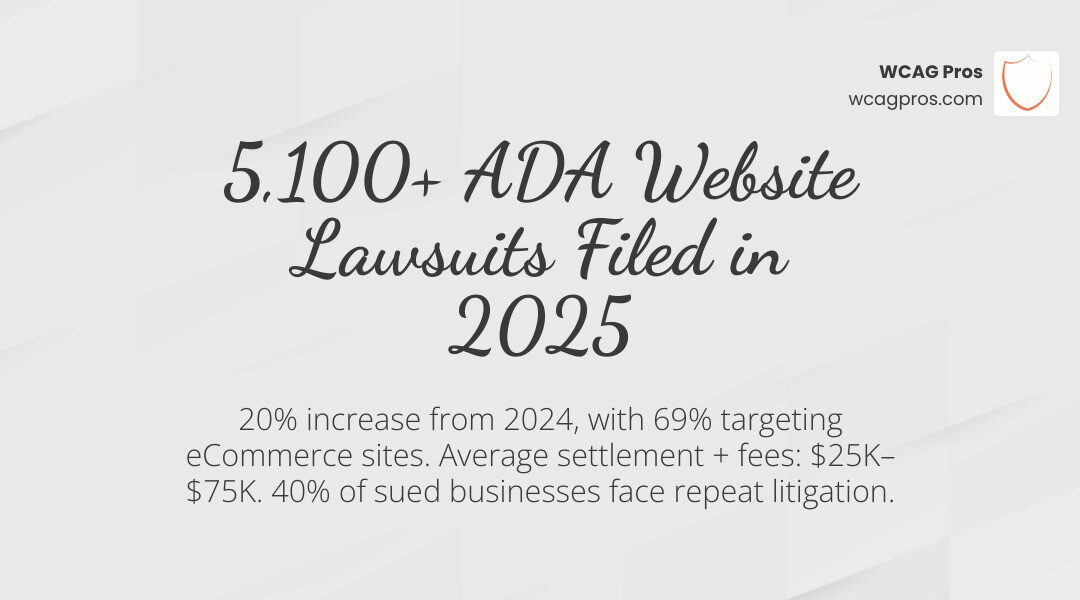
More than 5,100 digital accessibility lawsuits were filed in 2025 alone. That is a 20% jump from 2024. And 69% of those cases targeted eCommerce sites.
If your website is not accessible to people with disabilities, you are not just missing customers. You are a target.
The financial stakes are real. A single ADA lawsuit costs businesses between $25,000 and $75,000 on average when you add up settlements, legal fees, and remediation. And over 40% of companies that get sued once get sued again because they did not fix the underlying problems.
The good news is that this risk is largely preventable. Businesses that take proactive steps to meet WCAG 2.2 AA standards dramatically reduce their exposure.
I’m Matthew Post, co-founder of WCAG Pros and a web developer with over 20 years of experience in accessibility audits and WCAG remediation. Helping businesses understand and act on ADA website lawsuit prevention is at the core of what I do every day. Let’s walk through exactly what works.
The Legal Framework for ADA Website Lawsuit Prevention
Understanding the law is the first step toward protecting your business. The Americans with Disabilities Act (ADA) was passed in 1990 long before the modern internet existed. However the Department of Justice (DOJ) and federal courts have consistently ruled that Title III of the ADA applies to websites. Title III prohibits discrimination on the basis of disability in “places of public accommodation.” In 2026 it is widely accepted that a website is a digital storefront that must be just as accessible as a physical one.
A major milestone occurred with the DOJ 2024 Final Rule. While this rule specifically mandated WCAG 2.2 AA compliance for state and local governments under Title II it set a powerful legal benchmark for private businesses. When a court looks at your site today they use WCAG 2.2 as the “gold standard” for what is considered accessible. If you aren’t meeting those standards you are essentially leaving your front door locked to millions of users.
For a deeper dive into what happens when these standards aren’t met you can read our guide on being Sued Ada Noncompliance. The Guidance on Web Accessibility and the ADA from the DOJ further clarifies that businesses must provide “effective communication” to all users regardless of their ability.

The Financial Impact of ADA Website Lawsuit Prevention
Let’s talk about the “hidden” costs of doing nothing. Many business owners think a settlement is just a small check and a handshake. In reality a typical settlement ranges from $5,000 to $20,000 just for the plaintiff and their attorneys. But that is only the beginning. You also have to pay your own legal defense fees which can easily double that number.
Furthermore almost every settlement agreement requires you to perform full remediation within a strict timeframe. This means you end up paying for the accessibility fixes anyway but under the pressure of a court order. Total costs frequently climb to the $25,000 to $75,000 range. You can find more details on these financial risks in this article on How To Make A Website Accessible And ADA Compliant.
Scaling ADA Website Lawsuit Prevention for Small Business
We know that small businesses in places like Norco CA often feel targeted by “serial litigants.” These are individuals who use automated tools to scan hundreds of sites a day looking for easy targets. For a small business with limited resources the best approach is risk mitigation. You don’t have to fix everything in one afternoon but you must show a good faith effort.
By prioritizing high traffic pages like your homepage contact form and checkout process you can eliminate the most common “tripwires” that lead to lawsuits. We discuss how to manage these costs effectively in our guide: Dont Let Legal Fees Be Your Disability Top Ada Lawsuit Prevention Services.
Five Proven Strategies to Stop Litigation
If you want to move from being a target to being protected you need a concrete plan. ADA website lawsuit prevention is not about magic software. It is about following the POUR principles: Perceivable, Operable, Understandable, and Robust. These four pillars form the foundation of WCAG 2.2.

Strategy 1: Conduct a Comprehensive Manual Audit
Automated scans are a great starting point but they only catch about 25% to 40% of actual accessibility issues. A computer can tell if an image is missing alt text but it cannot tell if that alt text actually describes the image accurately for a blind user.
A manual audit involves testing your site with screen readers like NVDA or JAWS and ensuring every single element can be reached using only a keyboard. At WCAG Pros we perform a Wcag Audit that looks at all 54 success criteria. This level of detail is what creates a truly defensible position. For a complete roadmap check out our Ada Site Wide Audit Your Roadmap To Total Compliance.
Strategy 2: Implement Source Code Remediation
Once you know what is broken you have to fix the code. This is called source code remediation. Many businesses try to use “overlays” or “widgets” to hide their errors but these rarely hold up in court. True ADA website lawsuit prevention requires fixing the underlying HTML.
This includes:
- Adding descriptive alt text to all meaningful images.
- Ensuring a color contrast ratio of at least 4.5:1 for normal text.
- Labeling all form fields so screen readers know what information to enter.
- Using proper heading structures (H1, H2, H3) so users can navigate easily.
You can learn about our Wcag Remediation process or explore Professional Ada Remediation Services You Can Trust to see how these code changes work.
Strategy 3: Publish a Conspicuous Accessibility Statement
An accessibility statement is a public document that tells the world you care about inclusion. It should explain what standards you are aiming for (WCAG 2.2 AA) and provide a clear way for users to contact you if they encounter a barrier.
A well written statement can sometimes prevent a lawsuit before it starts. If a user has a problem and sees a phone number or email specifically for accessibility they are more likely to call you than a lawyer. See The No Lawsuit Guide To Website Remediation for tips on drafting this.
Strategy 4: Perform User Testing with Assistive Technology
Nothing beats real world validation. Hiring professionals with disabilities to test your “user flows” like buying a product or signing up for a newsletter is the ultimate proof of compliance. It shows that your site isn’t just “technically” compliant but actually usable. This is a key part of The Ada Web Consultation Your Roadmap To Digital Inclusion.
Strategy 5: Establish Ongoing Compliance Maintenance
Accessibility is not a “one and done” project. Every time you add a new blog post or product page you run the risk of introducing a new barrier. You need a governance policy that includes regular monitoring and staff training. This prevents you from becoming part of the 40% of businesses that face repeat lawsuits. Is your business staying open to everyone or Is Your Business Open To Everyone Or Just A Lawsuit?
Why Accessibility Overlays Fail Legal Tests
In ADA website lawsuit prevention there is a dangerous shortcut: the accessibility overlay. These are small widgets that you “copy and paste” onto your site. They claim to use AI to fix your problems instantly.
The truth is that over 1,000 lawsuits in the last two years targeted sites that were using these widgets. In 2025 the FTC even issued a $1 million fine to a major overlay provider for making false claims about their legal protection. Overlays often make the experience worse for screen reader users by interfering with their existing software. For more on this read Preventing ADA Website Accessibility Lawsuits.
The Myth of Automated Protection
Plaintiffs’ lawyers actually love overlays because they act like a “flag” that says your website has underlying code issues. They use tools like WAVE to find errors that the overlay is trying to hide. If the automated tool finds an error you are instantly at risk. You can read more about why these fail in our article on being Sued Ada Noncompliance.
Responding to a Demand Letter or Lawsuit
If you receive a demand letter do not panic but do not ignore it. Most of these letters give you a 30 to 60 day window to respond. You should contact an ADA experienced attorney within 48 hours.
The first thing they will ask for is your record of compliance efforts. If you can show that you have already started an audit or hired a consultant you may be able to settle for a much lower amount or even get the case dismissed. This is Why Your Business Needs An Ada Compliance Consultant Right Now.
Building a Defensible Compliance Record
Keep a “War Room” of documentation. This should include:
- Dated audit reports.
- Receipts from remediation work.
- Screenshots of fixed issues.
- Training logs for your web team.
This history is your best shield. For more on building this record see The No Lawsuit Guide To Website Remediation.
Frequently Asked Questions
What is the average cost of ADA website lawsuit prevention?
While costs vary proactive remediation usually costs a fraction of a lawsuit. Most businesses spend between $5,000 and $15,000 for a professional audit and code fixes depending on the size of the site. Compared to a $50,000 legal bill it is a very smart investment.
Are eCommerce sites at higher risk for ADA lawsuits?
Yes. In 2025 nearly 70% of all digital ADA lawsuits targeted eCommerce sites. Because these sites have complex features like carts filters and checkout flows they are much more likely to have accessibility “bugs” that trigger a lawsuit.
Does the ADA explicitly require WCAG 2.2 compliance?
The ADA itself does not mention WCAG. However the DOJ and the courts use WCAG 2.2 AA as the standard to measure whether a site is “accessible.” If you meet WCAG 2.2 AA you are generally considered compliant with the ADA.
Conclusion
At WCAG Pros we believe that the web should be open to everyone. ADA website lawsuit prevention is not just about avoiding a check. It is about making sure the 60 million Americans with disabilities can access your goods and services. When you make your site accessible you aren’t just protecting yourself from a lawsuit. You are expanding your market and doing the right thing.
Don’t wait for a demand letter to arrive in your inbox. Take the first step toward total digital inclusion and legal peace of mind. Start your WCAG audit today and let us help you build a website that is open to all.
Read more website accessibility articles
Get Help With Your Website
We'll follow up with info about:
- The process
- Cost
- Timeline
We promise to respect your privacy, and never abuse the information you provide. We will not sell or rent your information to any third party.
By submitting this form, you consent to receive SMS messages and/or emails from SEM Dynamics LLC, dba WCAG Pros. To unsubscribe, follow the instructions provided in our communications. Msg & data rates may apply for SMS. Your information is secure and will not be sold to third parties.