
A Practical Guide to Website Accessibility Certification
A Practical Guide to Website Accessibility Certification
What Is Website Accessibility Certification (And Where to Get It)?
Website accessibility certification is formal, third-party proof that your website meets recognized accessibility standards, most commonly WCAG 2.1 or 2.2 at Level AA.
Here are the most recognized certification options available today:
| Provider | Standard | Validity |
|---|---|---|
| WebAIM | WCAG (primary) + Section 508 | 2 years |
| WACA (TÜV Austria) | WCAG 2.2 AA + EN 301 549 | 3 years |
| Accessible Web | WCAG 2.0 to 2.2 AA/AAA | Varies |
| UsableNet | WCAG 2.0 + 2.1 | Annual |
| Accessible.org | WCAG 2.0 to 2.2 AA | Varies |
| WCAG Pros | WCAG 2.1 + 2.2 AA | Varies |
No single government body issues a universal certificate. Instead, reputable third-party auditors evaluate your site, and if it meets the standard, they issue a conformance statement and a compliance seal.
Roughly 1 in 4 adults in the U.S. lives with a diagnosis of disability. Globally, that number reaches over 1 billion people. That is a massive audience that many websites still shut out through poor design and inaccessible code. Beyond the human cost, ADA lawsuits targeting inaccessible websites have surged in recent years, putting businesses of all sizes at real legal and financial risk.
Getting certified is one of the clearest ways to show that your site meets the bar for meaningful access under standards like the ADA and WCAG. It is not just a badge. It is documented proof that you did the work.
I’m Matthew Post, co-founder of WCAG Pros and a programmer with over 20 years of experience auditing and remediating websites for WCAG compliance, and website accessibility certification is at the core of what I do every day. In this guide, I’ll walk you through everything you need to know to find the right certification path for your business.
Understanding Website Accessibility Certification and Standards
To understand website accessibility certification, we first have to look at the yardstick used to measure it. The global “gold standard” is the Web Content Accessibility Guidelines, or WCAG. These guidelines are developed by the World Wide Web Consortium (W3C) and provide a technical framework for making digital content accessible to people with disabilities.
The most recent major update, WCAG 2.2, was published in October 2023. It builds upon previous versions like 2.0 and 2.1, meaning it is “backward compatible.” If your site meets the 2.2 standard, it automatically satisfies the requirements of older versions. This standard is so respected that it has been adopted as an international standard known as ISO/IEC 40500. You can explore the full scope of these rules in the WCAG 2 Overview | Web Accessibility Initiative (WAI) | W3C.
Conformance Levels: A, AA, and AAA
WCAG is organized into three levels of conformance. Think of these like “Good, Better, and Best” in terms of accessibility depth.
- Level A: This is the bare minimum. It addresses the most basic accessibility features, such as providing alternative text for images. If a site fails Level A, it is often completely unusable for many people with disabilities.
- Level AA: This is the standard most businesses and government agencies aim for. It covers the most common barriers for disabled users, including color contrast requirements and consistent navigation. In places like California, government websites are often required to meet WCAG 2.1 Level AA.
- Level AAA: This is the highest and most complex level. While it provides the best experience, it is often difficult or impossible to achieve for all types of content. For example, some visual designs simply cannot meet the extreme contrast requirements of Level AAA.
At WCAG Pros, we focus on helping you reach Level AA through a rigorous WCAG Audit that looks at every corner of your site.
| Feature | Level A | Level AA | Level AAA |
|---|---|---|---|
| Difficulty | Low | Moderate | High |
| Target | Minimum | Legal/Business Standard | Maximum |
| Legal Safety | Low | High | Very High |
Certification vs Accessibility Statements and VPATs
A common point of confusion for our clients is the difference between a website accessibility certification, an accessibility statement, and a VPAT. While they all relate to compliance, they serve very different purposes.
An Accessibility Statement is a public-facing document on your website. It is a declaration of your commitment to inclusion. It usually explains which standards you are aiming for, how users can contact you for help, and any known limitations of the site. While every site should have one, it is a self-claim, not proof. You can learn how to craft one in our guide to the Accessibility Statement.
A VPAT (Voluntary Product Accessibility Template) is a technical document often required in government contracting or B2B sales. It results in an Accessibility Conformance Report (ACR) that details exactly how a product meets specific accessibility criteria. It is very granular and technical.
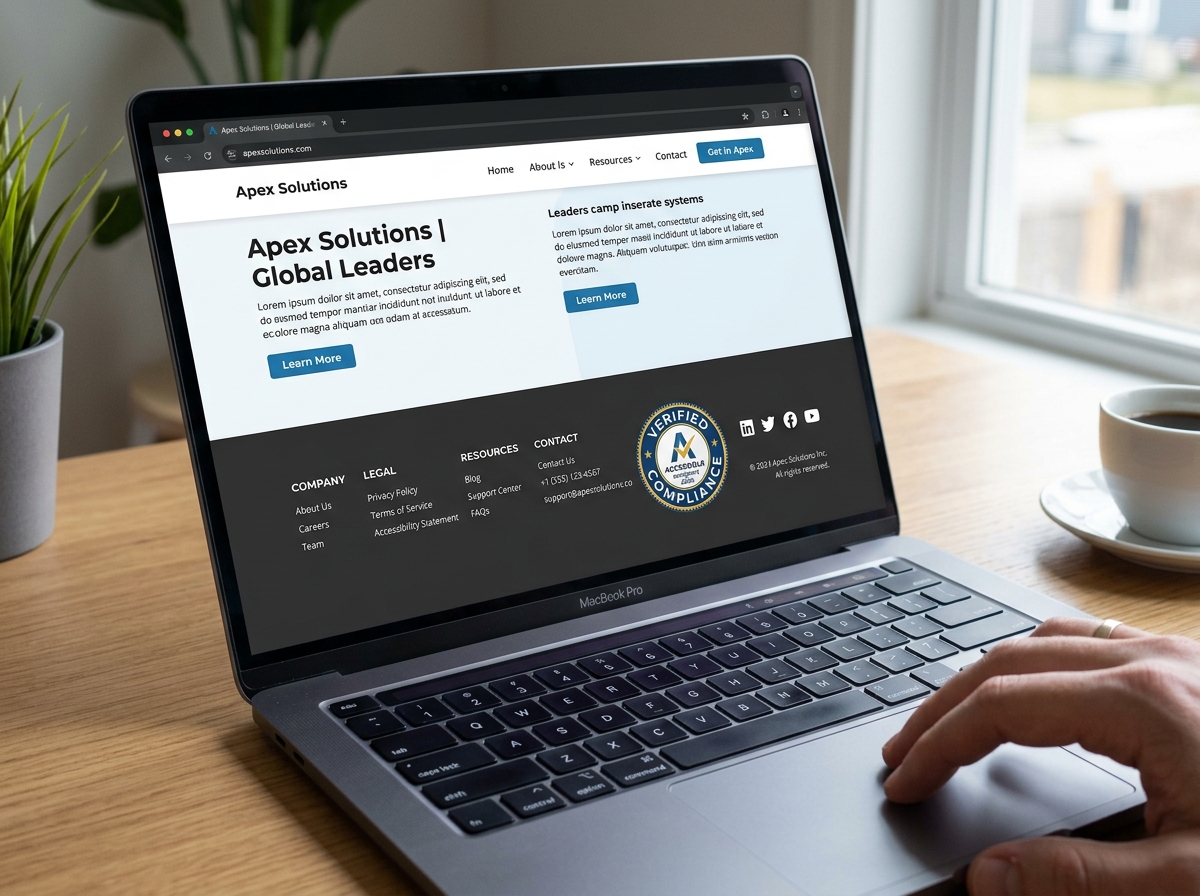
A Website Accessibility Certification is the “seal of approval.” It is issued by a third party after they have verified that your site actually meets the standards you claim to follow. It often includes a compliance seal or badge that you can display on your footer.
The Process of Obtaining a Website Accessibility Certification
Getting certified is not a “one-click” solution. It is a journey that involves technical expertise and testing. We typically break this down into a multi-step process to ensure nothing is missed.
1. The Initial Audit
Everything starts with a baseline. You cannot fix what you do not know is broken. A professional audit involves both automated scanning and manual testing. Automated tools are great for catching things like missing alt-text, but they cannot tell you if a complex menu is actually logical for a screen reader user. For a deep dive into what this looks like, check out our Expert Website WCAG Audit Guide for Businesses.
2. Remediation
Once the audit is complete, you will receive a list of issues. Remediation is the process of going into the code and fixing those problems. This might involve adjusting color contrast, adding keyboard focus indicators, or rewriting HTML to be more semantic. At WCAG Pros, we provide the actual code fixes to make this easier for your team. You can read more about this stage at WCAG Remediation.
3. Verification and User Testing
After the fixes are applied, a verification audit is performed. This ensures that the remediation actually worked and that no new issues were introduced during the process. We believe “true” certification should also involve testing by people with disabilities. Using assistive technology like screen readers (JAWS or NVDA) provides insights that no automated tool can replicate.
Steps to Achieve Website Accessibility Certification
To get from point A to a certified badge, we look at several factors:
- Audit Scope: We determine which pages and templates need to be tested.
- Screen Count: We identify unique layouts (home page, contact page, blog template) to ensure broad coverage.
- User Flows: We test critical paths, like the checkout process or a newsletter signup, to ensure they are fully functional.
- Conformance Statement: Once everything is verified, we issue the formal statement that acts as your certification.
Reputable Providers and Training Resources
When looking for certification, you want a provider with deep roots in the accessibility community. Organizations like the International Association of Accessibility Professionals (IAAP) offer individual certifications for professionals, such as the Certified Professional in Accessibility Core Competencies (CPACC).
For those who want to learn the ropes themselves, there are excellent resources available. The W3C offers a “Digital Accessibility Foundations” course on edX that is free to audit. Other reputable training can be found through:
- DHS Trusted Tester Training for Section 508 compliance.
- General Services Administration (GSA) accessibility tools and events.
- USA.gov training for government agencies.
Common Misconceptions and the Role of AI Overlays
There are a lot of myths floating around website accessibility certification. One of the biggest is that a certificate provides a “legal shield.” While certification is a powerful defense in a lawsuit because it proves you have made a good-faith effort toward “meaningful access” under ADA Title III, it is not a 100% guarantee against a demand letter.
Another misconception is that certification is a one-time event. In reality, websites are living things. You add blog posts, change products, and update plugins. Most certifications are valid for one to two years and require annual re-audits or continuous monitoring to remain valid.
Can AI Overlays Lead to Website Accessibility Certification?
This is a hot topic. Tools like accessiBe and UserWay have massive install bases, but can they get you certified? Most experts, including us, say no.
AI overlays are “band-aids” that sit on top of your site. They can fix some visual issues, but they often fail to address deep-seated code problems. In fact, many screen reader users find overlays intrusive or frustrating. A true website accessibility certification requires fixing the underlying source code. Relying solely on an overlay can give a sense of false security. For more on this, see our Automated Tools Audit page.
Ongoing Maintenance and Validity
Maintaining your certification is just as important as getting it. Here is how we recommend staying on top of it:
- Periodic Audits: Schedule a check-up every six to twelve months.
- Content Governance: Train your content team to add alt-text and use proper heading structures as they post new updates.
- Accessibility Maturity: Move beyond just “fixing bugs” and make accessibility a part of your design and development culture from day one.
- Annual Re-evaluation: Ensure your certification provider performs a full verification of any new features or site changes annually.
For a roadmap on staying compliant, read our guide on ADA Site-Wide Audit: Your Roadmap to Total Compliance.
Frequently Asked Questions about Website Accessibility Certification
Is website accessibility certification legally required?
Technically, no. The ADA does not explicitly say you must have a “certificate.” However, it does require that you provide equal access to your services. Certification is the industry-recognized way to prove you are doing exactly that. In some sectors, like California government agencies, meeting WCAG 2.1 AA is a legal mandate.
How much does website accessibility certification cost?
Pricing varies wildly based on the size and complexity of your site. A small five-page site will cost significantly less than a 500-page e-commerce store with complex user flows. Factors that influence the cost include the number of unique templates, the depth of manual testing required, and whether remediation support is included.
How long is a website accessibility certification valid?
Most reputable certifications are valid for one to two years. For example, WebAIM statements are valid for two years, while WACA certificates last for three years with annual reviews. Because web technology and guidelines change (like the recent update to WCAG 2.2), regular updates are necessary.
Conclusion
At the end of the day, website accessibility certification is about more than just avoiding a lawsuit. It is about opening your digital doors to everyone, regardless of how they navigate the web. It improves your SEO, enhances the user experience for all visitors, and broadens your market reach to include the 1 in 4 Americans living with a disability.
At WCAG Pros, we make this process transparent and achievable. We provide comprehensive page-by-page audits, actual code fixes for your developers, and free re-audits to ensure you earn your compliance badges. If you are ready to make your site accessible and get the certification to prove it, we are here to help.
Visit us at https://wcagpros.com/ to start your journey toward a more inclusive digital world.
Read more website accessibility articles
Get Help With Your Website
We'll follow up with info about:
- The process
- Cost
- Timeline
We promise to respect your privacy, and never abuse the information you provide. We will not sell or rent your information to any third party.
By submitting this form, you consent to receive SMS messages and/or emails from SEM Dynamics LLC, dba WCAG Pros. To unsubscribe, follow the instructions provided in our communications. Msg & data rates may apply for SMS. Your information is secure and will not be sold to third parties.