
Don’t Trip on Regulations with Our 2018 ADA Hotel Checklist
Don’t Trip on Regulations with Our 2018 ADA Hotel Checklist
Your 2026 Guide to ADA Compliance for Hotels 2018 and Beyond
ADA compliance for hotels 2018 marked a critical turning point for the hospitality industry. While lawsuits surged in 2018, the trend has only intensified over the last decade. Today, in 2026, hotels remain among the most frequently targeted businesses for accessibility non-compliance, making these standards more relevant than ever.
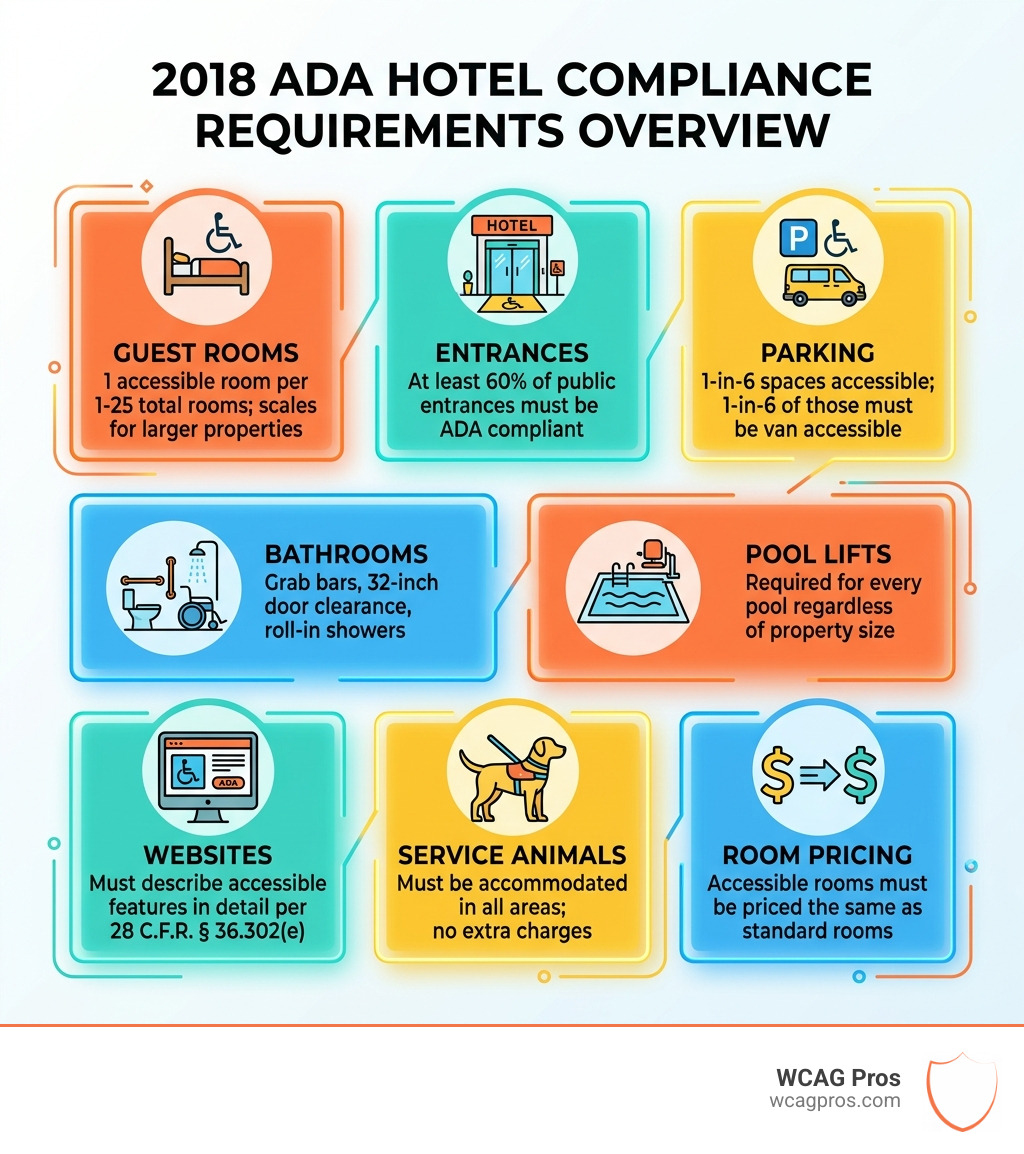
Here is a quick summary of what ADA compliance for hotels requires:
| Area | Key Requirement |
|---|---|
| Guest Rooms | 1 accessible room per 1-25 total rooms; scales to 2% for larger properties |
| Entrances | At least 60% of public entrances must be ADA compliant |
| Parking | 1-in-6 spaces accessible; 1-in-6 of those must be van accessible |
| Bathrooms | Grab bars, 32-inch door clearance, roll-in showers |
| Pool Lifts | Required for every pool regardless of property size |
| Websites | Must describe accessible features in detail per 28 C.F.R. § 36.302(e) |
| Service Animals | Must be accommodated in all areas; no extra charges |
| Room Pricing | Accessible rooms must be priced the same as standard rooms |
The ADA is a civil rights law. It requires hotels to give every guest an equal opportunity to enjoy their stay, whether that guest uses a wheelchair, has low vision, or is deaf. Non-compliance is not just a legal risk. It is a barrier to equal access.
One case from a 180-room Phoenix hotel illustrates the stakes clearly. A wheelchair user arrived to find her “fully accessible” room had a missing shower seat, a bathroom door that had been repainted down to 31 inches of clearance (one inch below the legal minimum), and a parking access aisle that had been painted over during a routine lot repaint. The hotel settled for $112,000.
I’m Matthew Post, co-founder of WCAG Pros and a web developer with over 20 years of experience helping businesses navigate ADA compliance for hotels 2018 and beyond, with a focus on digital accessibility and WCAG remediation. In this guide, I’ll walk you through every major compliance area so you can protect your property and your guests.
Applying ADA Compliance for Hotels 2018 Standards to Modern Properties

When we talk about ada compliance for hotels 2018, we are looking at a landscape governed by two primary sets of rules: the 1991 ADA Standards and the 2010 ADA Standards for Accessible Design. For most hotels operating today in 2026, the 2010 Standards are the law of the land. However, there is a concept known as safe harbor. If your hotel was built or altered before March 15, 2012, and it complied with the 1991 Standards, you might not have to retroactively change elements to meet the 2010 rules until you decide to renovate that area.
But do not let that make you complacent. The Department of Justice (DOJ) still requires the removal of architectural barriers in existing facilities when such removal is readily achievable. This means if a fix is easy to do without much difficulty or expense, you are legally obligated to do it. Think of it as a sliding scale based on your hotel’s resources. A large resort has a higher expectation for barrier removal than a small bed and breakfast.
For deeper insights into how these rules apply to the workforce and guest services, you can explore Reasonable Accommodations in the Lodging Industry | ADA National Network or check out the ADA Guide for Places of Lodging: Serving Guests Who Are Blind or Who Have Low Vision | ADA.gov.
Physical Requirements and Room Ratios
How many accessible rooms do you actually need? This is one of the most common questions we hear at WCAG Pros. The number is strictly defined by your total room count.
| Total Number of Rooms | Minimum Number of Accessible Rooms |
|---|---|
| 1 to 25 | 1 |
| 26 to 50 | 2 |
| 51 to 75 | 4 |
| 76 to 100 | 5 |
| 101 to 150 | 7 |
| 151 to 200 | 8 |
| 201 to 300 | 10 |
| 501 to 1000 | 3% of total |
It is not just about the total number of rooms though. You also have to split these between rooms with mobility features (like roll-in showers) and rooms with communication features (for guests who are deaf or hard of hearing). For example, a 100-room hotel generally needs at least one room with a roll-in shower and several others with visual alarms and notification devices.
Essential Features of ADA Compliance for Hotels 2018 Guest Rooms
An accessible room is more than just a wider door. It is a carefully designed space where every element is reachable and usable. One of the biggest “gotchas” is the 32-inch clear width for doors. We often see doors that are technically 32 inches wide, but the hinges or the door stop reduce the actual clearance.
Key features include:
- Grab Bars: These must be installed between 33 and 36 inches above the floor. They need to be sturdy enough to support a 250-pound load.
- Turning Space: There must be a 60-inch diameter circle or a T-shaped space to allow a wheelchair to turn around.
- Hardware: All handles, locks, and faucets must be operable with one hand without tight grasping or twisting of the wrist.
- Bed Height: While the ADA does not set a strict height, the industry recommendation is 17 to 23 inches to make transfers from a wheelchair easier.
For a full list of construction specs, the ADA Checklist for New Lodging Facilities is an excellent technical resource.
Navigating Common Areas and Exterior Accessibility
Accessibility does not stop at the guest room door. The journey starts in the parking lot. Under ada compliance for hotels 2018 standards, at least one in every six accessible parking spaces must be van accessible, featuring an eight-foot-wide access aisle.
Once guests leave their cars, they need a clear path of travel. At least 60 percent of your public entrances must be accessible. If your main entrance has stairs, you must provide a ramp with a slope no steeper than 1:12. This means for every inch of height, you need a foot of length.
Common areas like gyms and pools are also high-risk zones for lawsuits. Since 2012, the DOJ has clarified that pool lifts must be fixed (not portable) and independently operable. This means a guest should be able to use the lift without calling a staff member for a battery or a key. In restaurants, ensure that at least 5 percent of your seating consists of accessible tables with proper knee clearance. You can find more details on these spaces at ADA Compliance Requirements in Commercial Hospitality | Commercial Hospitality Authority.
Signage and Wayfinding Standards
If a guest cannot find the accessible route, it might as well not exist. ADA signage requirements are very specific. Permanent room signs must include Braille and raised characters. They should be mounted so the baseline of the lowest tactile character is 48 inches above the floor and the highest is 60 inches.
We recommend using high-contrast colors (like white text on a dark blue background) to help guests with low vision. Only about 5 percent of blind individuals read Braille, so clear, high-contrast visual information is just as important as the tactile dots.
Digital Accessibility and Online Reservation Systems
In 2018, the “buzz” in the industry was all about the DOJ finally stepping in to regulate websites. While formal regulations took time to arrive, the courts did not wait. Under 28 C.F.R. § 36.302(e), hotels are required to describe their accessible features on their website in enough detail that a person can determine if the room meets their needs.
Today, in 2026, this requirement is more strictly enforced than ever. You cannot just have a checkbox that says “ADA Room.” You need to specify if it has a roll-in shower, visual alarms, or a specific bed height. If you want to know more about the legalities, we have written extensively on Website ADA Compliance Hotels and the broader question: Does My Website Have To Be ADA Compliant.
Technical WCAG Standards for ADA Compliance for Hotels 2018
Beyond the descriptions, the website itself must be technically accessible. This usually means following the Web Content Accessibility Guidelines (WCAG) 2.1 or 2.2. At WCAG Pros, we focus on making sure your site is perceivable, operable, understandable, and robust.
Common digital barriers include:
- Keyboard Navigation: Can a guest book a room without using a mouse?
- Alt Text: Do your images have descriptions so screen readers can explain them to blind guests?
- Form Labels: Are your “Check-in” and “Check-out” date pickers properly labeled for assistive technology?
Ignoring these points can be expensive. We break down the financial risks in our article on The Real Costs Of Ignoring Website Accessibility. If you are unsure where you stand, a professional WCAG Audit is the best place to start.
Operational Policies and Risk Mitigation
You can have the most accessible building in the world, but if your staff does not know the rules, you are still at risk. One of the biggest operational hurdles is the service animal policy. Under the ADA, you must allow service dogs (and sometimes miniature horses) in all areas where guests are allowed. You cannot charge a “pet fee” for a service animal, and you cannot ask for “papers” or “certification.” You can only ask two questions: Is the dog a service animal required because of a disability? and What work or task has the dog been trained to perform?
Maintenance is another huge litigation trigger. In fact, 73 percent of hotel ADA violations found in lawsuits involve maintenance failures, not construction defects. If a pool lift battery is dead or a hallway is blocked by a housekeeping cart, you are out of compliance. If you have been Sued ADA Noncompliance, you know how stressful this can be. That is why many properties find that Why Your Business Needs An ADA Compliance Consultant Right Now is a question that answers itself through saved legal fees.
Recommended Staff Training Procedures
Training should be an ongoing process, not a one-time meeting. We recommend covering these topics:
- Disability Etiquette: Using person-first language and offering help without being intrusive.
- Equipment Operation: Ensuring every front desk agent knows how to check a pool lift battery or set up a communication kit.
- Emergency Procedures: Having a clear plan for evacuating guests who cannot use the stairs.
- Effective Communication: Training staff to use “sighted guide” techniques for blind guests or to provide written menus for deaf guests.
Frequently Asked Questions about Hotel ADA Compliance
Can hotels charge more for accessible rooms?
Absolutely not. Federal law is very clear on this. You must provide accessible rooms at the same price point as standard rooms of the same class. If your only available accessible room is a suite, but the guest booked a standard room, you generally cannot upcharge them for the accessibility they require.
What constitutes readily achievable barrier removal?
“Readily achievable” means easily accomplishable without much difficulty or expense. This is a subjective term that depends on your hotel’s size and financial health. Adding a ramp to a single step or installing grab bars is almost always considered readily achievable. Installing an elevator in a historic building might not be, though you would still need to provide “program access” by moving services to the first floor.
Are pool lifts required for small hotel properties?
Yes. The 2010 Standards require at least one accessible means of entry for every pool, regardless of the hotel’s size. For very small pools, a portable lift might have been acceptable in the past, but the 2012 clarification pushed the industry toward fixed lifts. The only exception is if it is structurally impracticable, which is a very high bar to clear.
Conclusion
Navigating ada compliance for hotels 2018 and beyond is a continuous journey in 2026. It requires a mix of physical maintenance, digital updates, and constant staff vigilance. At WCAG Pros, we specialize in the digital side of this equation. Our team provides comprehensive page-by-page audits and WCAG Remediation to ensure your booking process is open to everyone.
By prioritizing accessibility, you are not just avoiding a lawsuit. You are opening your doors to a loyal market of travelers who spend billions of dollars annually. If you are ready to secure your property’s future, let us help you turn compliance into a competitive advantage.
Read more website accessibility articles
Get Help With Your Website
We'll follow up with info about:
- The process
- Cost
- Timeline
We promise to respect your privacy, and never abuse the information you provide. We will not sell or rent your information to any third party.
By submitting this form, you consent to receive SMS messages and/or emails from SEM Dynamics LLC, dba WCAG Pros. To unsubscribe, follow the instructions provided in our communications. Msg & data rates may apply for SMS. Your information is secure and will not be sold to third parties.