
The Ultimate Guide to a WCAG Comprehensive Website Audit
The Ultimate Guide to a WCAG Comprehensive Website Audit
What Is a WCAG Comprehensive Website Audit (And Why It Matters Now)
A wcag comprehensive website audit is a structured evaluation of your website against the Web Content Accessibility Guidelines (WCAG) to identify barriers that prevent people with disabilities from using your site.
Here is what it covers at a glance:
| Audit Element | What It Means |
|---|---|
| Standard | WCAG 2.1 or 2.2, typically Level AA |
| Testing methods | Automated scans + manual expert review |
| What is tested | Pages, forms, navigation, media, documents |
| Tools used | Screen readers, keyboard testing, contrast checkers |
| Output | Detailed report with issues, severity, and fixes |
| Goal | Full conformance to reduce legal risk and improve access |
Over 1.3 billion people worldwide live with a disability. When your website is not accessible, you are locking out a massive portion of potential customers. Worse, you are exposing your business to serious legal risk. ADA Title III lawsuits related to website accessibility increased by 320% between 2013 and 2021, with over 2,000 cases filed in 2019 alone.
The problem is that many businesses assume a quick automated scan is enough. It is not. Automated tools catch only 25 to 40% of real accessibility issues. The rest require human judgment, assistive technology testing, and expert review.
A WCAG audit is not just a checkbox exercise. It is the only reliable way to know where your site truly stands.
I’m Matthew Post, co-founder of WCAG Pros and a web developer with over 20 years of experience specializing in WCAG compliance and accessibility remediation. I personally oversee every wcag comprehensive website audit we conduct, bringing deep technical expertise and a practical, business-focused approach to every project. In this guide, I will walk you through exactly how a thorough WCAG audit works, step by step.
Why Your Business Needs a WCAG Comprehensive Website Audit
If you run a business in Norco or anywhere else in the United States, your digital presence is often the first point of contact for customers. Imagine walking up to a store only to find the door is locked for you but open for everyone else. That is what an inaccessible website feels like to a person using a screen reader or someone who cannot use a mouse.
Conducting a wcag comprehensive website audit is the first step toward opening those doors. WCAG stands for Web Content Accessibility Guidelines. These are the international standards developed by the W3C to ensure the web is usable for everyone. While WCAG itself is a set of guidelines, it is the benchmark used by the Department of Justice and the courts to determine if a site complies with the ADA.
Legal Risk and Compliance
The legal landscape is changing fast. Between the ADA and Section 508, which applies to federal agencies and their contractors, there is no room for error. A single demand letter can cost a business thousands of dollars in legal fees and settlement costs. By following an ADA Site-Wide Audit: Your Roadmap to Total Compliance, you can identify these risks before they turn into lawsuits.
Expanding Your Market Reach
Beyond staying out of the courtroom, there is a massive business opportunity here. People with disabilities and their families have a global spending power of over 13 trillion dollars. If your site has barriers, you are handing that business to your competitors. An Expert Website WCAG Audit Guide for Businesses helps you understand that accessibility is not just about charity. It is about reaching 26% of the adult population in the U.S. who live with some form of disability.
Improving User Experience for Everyone
Have you ever tried to read a website on your phone while outside in bright sunlight? That is a color contrast issue. Have you ever tried to watch a video in a quiet library without headphones? That is a captioning issue. When we fix things for users with disabilities, we make the site better for every single visitor.
Core Components of Digital Accessibility Testing
A truly wcag comprehensive website audit is built on four pillars known as the POUR principles. These principles ensure that your content is usable regardless of how someone interacts with it.
- Perceivable: Users must be able to see or hear the information. This includes things like alt text for images and high color contrast.
- Operable: Users must be able to navigate the site. This means the site works with a keyboard and does not have “keyboard traps” where a user gets stuck.
- Understandable: The content and navigation must be clear. Users should not be confused by how the site behaves.
- Robust: The site must work with a wide range of technologies, including older browsers and current assistive devices like screen readers.
Conformance Levels: A, AA, and AAA
When we perform an audit, we measure your site against three levels of conformance. You can find more details in our guide on Everything You Need to Know About WCAG Versions and Audits.
- Level A: The bare minimum. Without this, your site is nearly impossible for people with disabilities to use.
- Level AA: The global standard. This is what most laws, including the ADA, point to as the requirement for businesses.
- Level AAA: The highest level. This is usually reserved for specialized sites, as it can be very difficult to achieve for every single page.
Automated vs Manual Testing
We cannot stress this enough: you cannot rely on robots alone. Automated tools are great for a quick check, but they miss more than they find.
| Feature | Automated Testing | Manual Testing |
|---|---|---|
| Speed | Very fast | Slower, more detailed |
| Accuracy | High for code-based rules | High for user experience |
| Context | Cannot understand context | Understands if alt text is meaningful |
| Keyboard | Limited detection | Full verification of navigation |
| Screen Readers | Does not use them | Tests real-world screen reader usage |
For a deeper dive into how to evaluate these elements, you can check out the Web Accessibility Evaluation Guide which provides excellent technical context on structural testing.
Step-by-Step Methodology for Conformance Evaluation
At WCAG Pros, we follow a rigorous process based on the WCAG-EM (Evaluation Methodology). This ensures that our wcag comprehensive website audit is repeatable, reliable, and legally defensible.
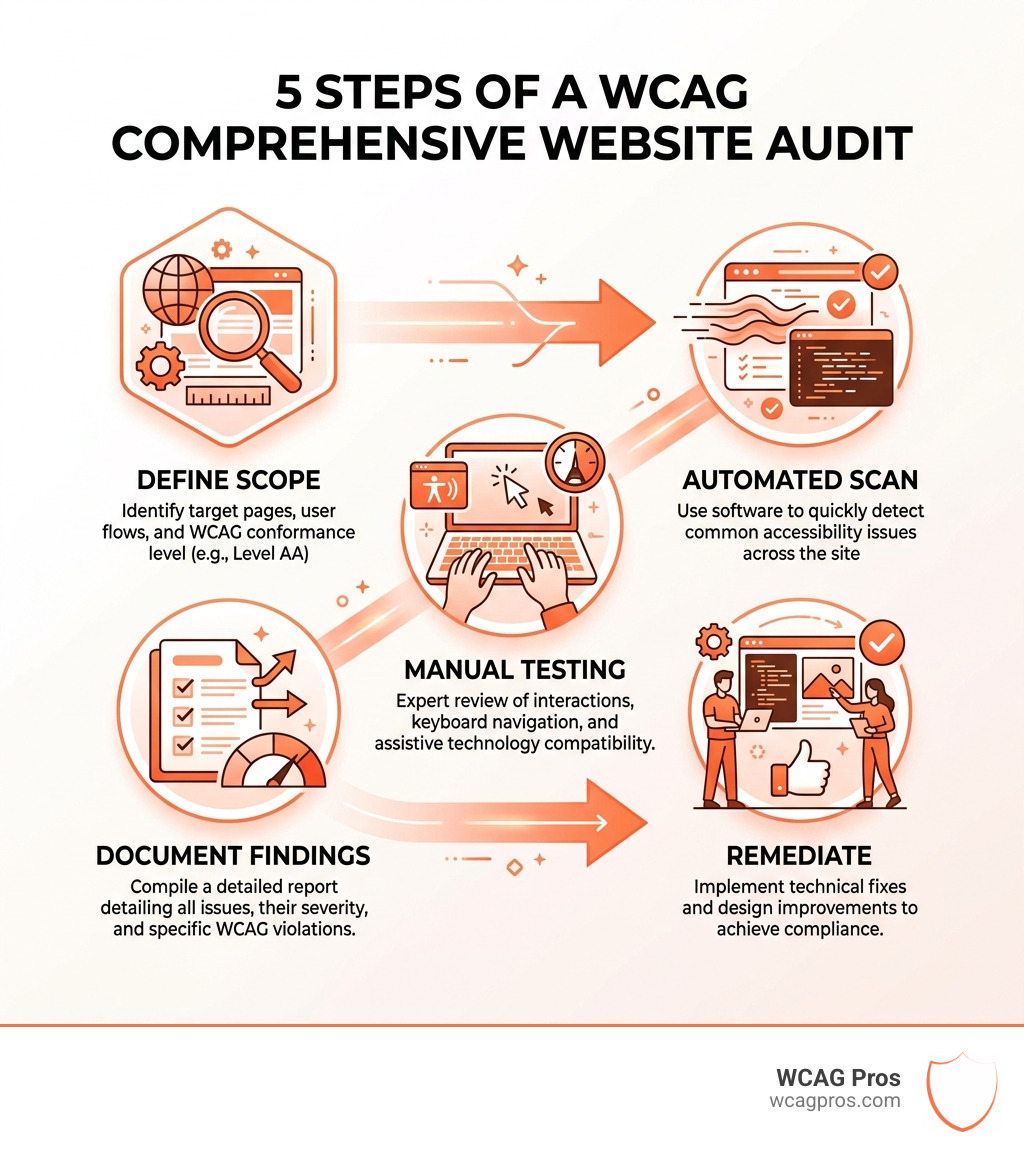
1. Define the Scope
We start by deciding exactly what needs to be tested. Does the audit cover the whole site, or just a specific section? What version of WCAG are we targeting? Usually, we aim for WCAG 2.1 or 2.2 at Level AA. This step is crucial because it sets the expectations for the entire project.
2. Explore the Website
We look for key pages that represent the site as a whole. This includes the homepage, contact forms, checkout flows, and any pages with unique layouts or complex features like maps or video players. We call this a representative sample. According to WCAG-EM Overview, selecting a diverse sample is the only way to ensure the audit reflects the true state of the site without testing every single one of ten thousand pages.
3. Automated Scanning
We run Automated Tools Audit software to catch the “low hanging fruit.” This includes missing alt tags, empty links, and basic color contrast failures. This gives us a baseline of issues that can be fixed quickly.
4. Manual Testing and Assistive Technology
This is where the real work happens. Our experts use the site exactly like a person with a disability would.
- Keyboard Navigation: We put the mouse away and try to use every link, button, and form using only the Tab and Enter keys.
- Screen Readers: We use tools like NVDA for Windows and VoiceOver for Mac and iOS. We listen to how the site is read aloud to ensure the structure makes sense.
- Visual Inspection: We check for things like focus indicators (the little box that shows where you are on a page) and text resizing.
Our WCAG Audit service is designed to be exhaustive. We check all 54 success criteria for Levels A and AA.
5. Essential Testing Tools
To do this right, we use a specific toolkit:
- WAVE and axe DevTools: For automated code analysis.
- Colour Contrast Analyzer: To ensure text is readable against its background.
- NVDA and JAWS: The most popular screen readers for desktop.
- VoiceOver: For testing on iPhone and Mac.
- Browser DevTools: To inspect the underlying code for ARIA labels and roles.
Frequently Asked Questions about WCAG Auditing
When businesses approach us for a wcag comprehensive website audit, they usually have a lot of questions. Accessibility can feel like a maze, but we are here to help you find the exit.
How should issues be prioritized?
Not all bugs are created equal. We categorize findings by severity:
- Critical: These issues block a user from completing a task, like a checkout button that cannot be clicked with a keyboard. These must be fixed first.
- Serious: These make it very difficult to use the site but do not completely block the user.
- Moderate/Minor: These are often cosmetic or minor technical violations that should be addressed but are not urgent.
Once the audit is done, we move into WCAG Remediation. We provide specific code fixes so your developers do not have to guess how to solve the problem.
How do we validate the fixes?
After your team implements the changes, we perform a re-audit. This is where we verify that the fixes actually work and have not introduced new problems. This is a key part of our process at WCAG Pros. We offer free re-audits because we want to make sure you actually reach the finish line. You can learn more about this in our guide on How to Pass Your WCAG 2.1 AA Certification with Flying Colors.
If you want to see what we look for during an audit, download The Ultimate WCAG Checklist (PDF, Excel, and Print-Ready Versions).
How often should you perform a WCAG comprehensive website audit?
Websites are not static. Every time you add a new blog post, a new product, or a new plugin, you risk breaking your accessibility. We recommend a full audit at least once or twice a year. For high traffic sites that change daily, monthly automated scans combined with quarterly manual checks are the gold standard for compliance maintenance.
If you are just starting out, you might need to Pick the Best Web Accessibility Evaluation Tool for Your Team to help with ongoing monitoring.
What are the limitations of automated tools in a WCAG comprehensive website audit?
As we mentioned earlier, automated tools are limited. They are great at finding “hard” errors like a missing tag, but they fail at “soft” errors. For example, a tool can tell you if an image has an alt tag, but it cannot tell you if that tag says “image123.jpg” or “A golden retriever playing in the park.” Only a human can tell if the description is helpful.
You can explore some of these tools yourself using The Ultimate List of Free Online Accessibility Checkers, but remember they are only the starting point.
How does a WCAG comprehensive website audit help with ADA legal compliance?
The ADA is a “strict liability” law. This means that if your site is inaccessible, it does not matter if you intended to be inclusive or not. An audit serves as your primary evidence of a “good faith effort” to comply.
If you ever receive a demand letter, the first thing your lawyer will ask for is your most recent audit report and your remediation plan. Having a wcag comprehensive website audit on file, along with documented progress toward fixing issues, is your strongest shield against predatory lawsuits. It shows that you are taking Title III requirements seriously and are actively managing your risk.
Conclusion
The digital world is for everyone. A wcag comprehensive website audit is more than just a technical report. It is a commitment to inclusion, a smart business move, and a vital legal safeguard. Whether you are a small business in Norco or a large national brand, your website should be a bridge, not a barrier.
At WCAG Pros, we specialize in the heavy lifting. We do the deep, page-by-page manual testing that automated tools miss. We provide the code fixes your developers need. And we stay with you until your site is truly compliant, providing the certification badges that prove your commitment to accessibility.
Do not wait for a legal complaint to find out your site is broken. Take control of your digital presence today.
Start your WCAG remediation journey today and let us help you build a more inclusive future for all your users.
Read more website accessibility articles
Get Help With Your Website
We'll follow up with info about:
- The process
- Cost
- Timeline
We promise to respect your privacy, and never abuse the information you provide. We will not sell or rent your information to any third party.
By submitting this form, you consent to receive SMS messages and/or emails from SEM Dynamics LLC, dba WCAG Pros. To unsubscribe, follow the instructions provided in our communications. Msg & data rates may apply for SMS. Your information is secure and will not be sold to third parties.