
A Comprehensive Guide to ADA Business Requirements
A Comprehensive Guide to ADA Business Requirements
Why ADA Business Requirements Matter for Every Business Owner
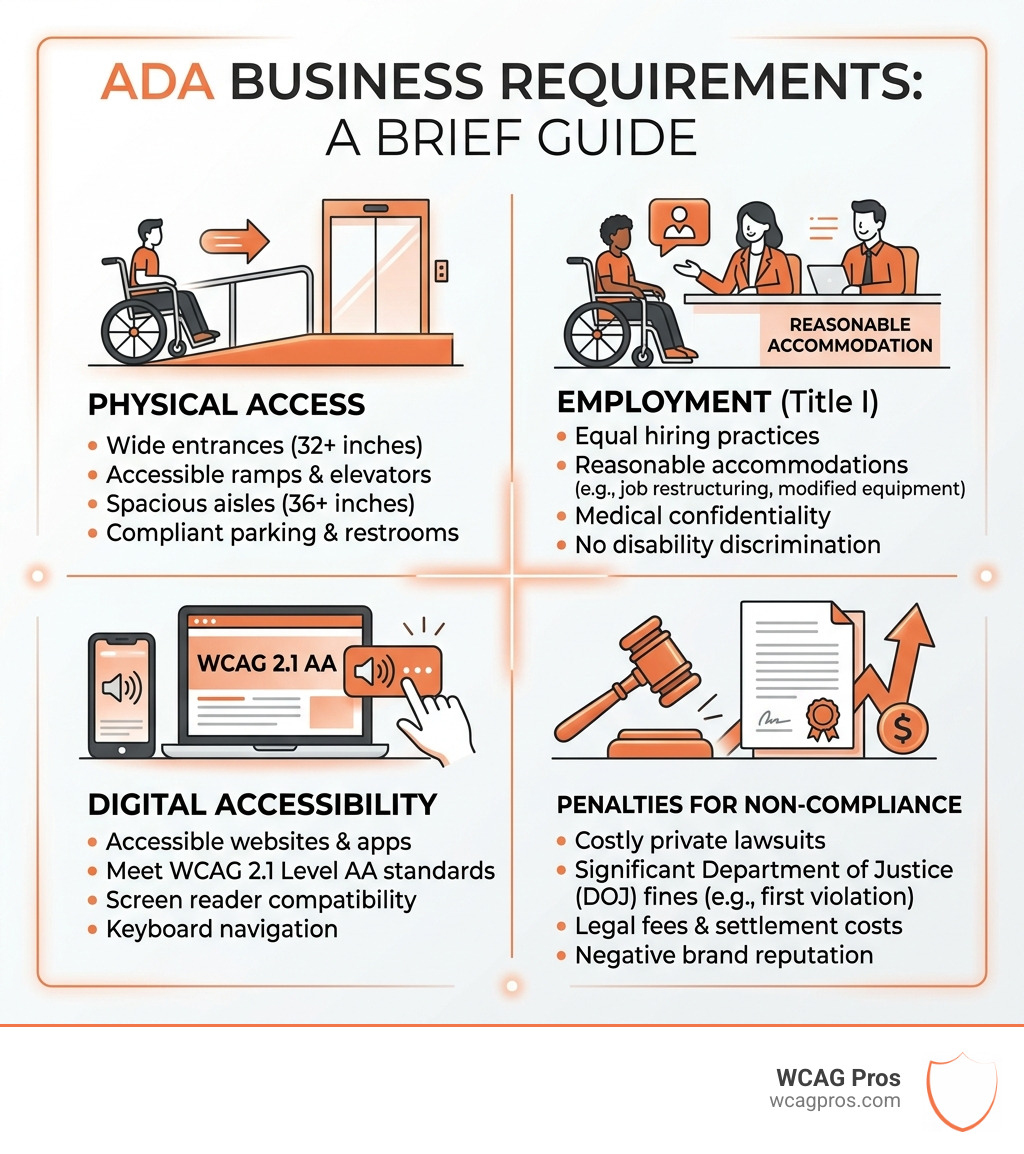
ADA business requirements are the legal rules that businesses must follow to ensure people with disabilities have equal access to their services, facilities, and digital platforms. Here is a quick summary:
| Requirement Area | What It Covers |
|---|---|
| Physical access | Ramps, doors (32+ inches), aisles (36+ inches), parking, restrooms |
| Employment (Title I) | Hiring, reasonable accommodations, medical confidentiality |
| Public accommodations (Title III) | Equal service, policy modifications, service animals |
| Digital accessibility | Websites and apps meeting WCAG 2.1 AA standards |
| Penalties | DOJ fines up to $75,000 (first violation), private lawsuits |
The Americans with Disabilities Act (ADA) was signed into law in 1990 as the world’s first comprehensive civil rights law for people with disabilities. It was built on a simple idea: people with disabilities deserve full and equal access to all aspects of public life.
The scale of who this affects is significant. More than 50 million Americans (about 18% of the population) have a disability. That is a massive portion of the workforce, the customer base, and the general public.
And yet, many businesses are still not compliant. ADA lawsuits have surged in recent years, with thousands filed annually targeting both physical locations and websites.
The law is not going away. Enforcement is growing. And the costs of ignoring it are rising fast.
I’m Matthew Post, co-founder of WCAG Pros and a web developer with over 20 years of experience auditing and remediating websites for ADA business requirements and WCAG compliance. I’ve seen how businesses of all sizes face real legal and financial risk from non-compliance, and I’m here to help you understand exactly what is required and what to do about it.
Understanding ADA Business Requirements for Public Accommodations
When we talk about ADA business requirements, we usually start with Title III. This section of the law focuses on “public accommodations.” In plain English, if your business is open to the public, you fall under this category. It does not matter if you own the building or just lease a small corner of it. If customers come to you for goods or services, the ADA applies to you.
The Department of Justice (DOJ) identifies 12 categories of Businesses That Are Open to the Public at ADA.gov. These include:
- Places of lodging (hotels, inns)
- Establishments serving food or drink (restaurants, bars)
- Places of exhibition or entertainment (theaters, stadiums)
- Places of public gathering (auditoriums, convention centers)
- Sales or rental establishments (grocery stores, hardware stores, clothing boutiques)
- Service establishments (banks, laundromats, offices of lawyers or accountants, pharmacies)
- Public transportation terminals
- Places of public display or collection (museums, libraries)
- Places of recreation (parks, zoos)
- Places of education (private schools)
- Social service center establishments (daycare centers, senior centers)
- Places of exercise or recreation (gyms, bowling alleys)
If you fall into any of these buckets, you have a legal obligation to ensure that individuals with disabilities can enjoy your services just as easily as anyone else. Ignoring these rules is a gamble that often ends poorly. You might be wondering Is Your Business Open to Everyone or Just a Lawsuit? and the answer usually depends on how proactive you are with your compliance plan.
General Nondiscrimination and ADA Business Requirements
The heart of the ADA is nondiscrimination. This means more than just having a ramp at the front door. It means your entire way of doing business must be inclusive. We often see businesses trip up on the “soft” side of compliance, such as policies and communication.
For example, you must make “reasonable modifications” to your usual way of doing things. If you have a “no pets” policy, you must make an exception for service animals. Under the ADA, a service animal is specifically a dog (or in some rare cases, a miniature horse) that is trained to perform a specific task for a person with a disability. Emotional support animals do not count under Title III, but you cannot ask for “papers” or “certification” for a service dog. You can only ask two questions: is the dog a service animal required because of a disability, and what work or task has the dog been trained to perform?
Effective communication is another big one. If a deaf customer comes into your shop, you might need to exchange notes or provide a sign language interpreter for complex transactions. For vision-impaired customers, providing large-print menus or reading a document aloud are simple ways to meet ADA business requirements.
Physical Accessibility and Readily Achievable Barrier Removal

If your business is located in an older building, you might think you are “grandfathered in.” This is a common myth. The ADA requires existing facilities to remove architectural barriers when it is “readily achievable” to do so.
What does “readily achievable” mean? It means the change is easy to accomplish without much difficulty or expense. This is a sliding scale based on your business’s size and financial resources. A massive corporation has a higher bar for what is “readily achievable” than a mom-and-pop coffee shop.
Common physical ADA business requirements include:
- Door Widths: Doors should have at least a 32-inch clear opening.
- Aisle Width: Interior paths should be at least 36 inches wide to allow for wheelchairs.
- Ramps: If you have steps, a ramp with a 1:12 slope is the standard.
- Parking: You must have a specific number of accessible spots depending on the size of your lot.
- Restrooms: Grab bars, specific toilet heights (17 to 19 inches), and knee clearance under sinks are mandatory.
If full compliance isn’t possible due to structural or financial limits, you must still provide alternatives. For instance, if a restaurant cannot install a ramp, they might offer curbside pickup or home delivery to ensure the customer still gets the service. You can find more details on these specific hurdles in the Small Business and ADA Readily Achievable Requirements | ADA National Network factsheet.
Employment Standards and Title I Compliance
While Title III covers your customers, Title I covers your employees. If you have 15 or more employees, you must follow Title I ADA business requirements. This title prohibits discrimination against “qualified individuals” with disabilities in all parts of employment, from the initial job application to firing and benefits.
A “qualified individual” is someone who can perform the “essential functions” of the job, with or without a “reasonable accommodation.” As an employer, you cannot ask an applicant if they have a disability or request medical records before making a job offer. You can only ask if they can perform the job duties.
Once an offer is made, you can require a medical exam, but only if you require it for every new hire in that same job category. Most importantly, all medical information must be kept in a separate, confidential file. It should never be tucked into a general personnel folder where a supervisor might stumble upon it. For a deep dive into these rules, the EEOC provides The ADA: A Primer for Small Business.
Reasonable Accommodation and ADA Business Requirements
When an employee with a disability needs a change in the workplace to do their job, they might request a “reasonable accommodation.” This kicks off what the law calls the “interactive process.” You and the employee should sit down and talk about what they need and how you can help.
Accommodations don’t have to be expensive. In fact, statistics show that:
- 20% of accommodations cost nothing at all.
- Over 50% cost less than $500.
- The median cost is only about $240.
Typical accommodations include:
- Providing a screen reader for a blind employee.
- Adjusting a work schedule for someone who needs regular medical treatments.
- Reassigning “marginal” tasks (like lifting heavy boxes) to another staff member.
- Providing an ergonomic chair or a height-adjustable desk.
You only have to provide these accommodations if they do not cause an “undue hardship,” which means significant difficulty or expense. However, before you claim hardship, consider The ROI of Accessibility for Small Businesses. Often, the cost of the accommodation is far less than the cost of recruiting and training a new employee.
Digital Accessibility for Websites and Mobile Apps
In 2025, your “business location” isn’t just a physical address. It is also your website and your mobile app. The DOJ has made it very clear that ADA business requirements extend to the digital world. If your website is blocked to someone using a screen reader, it is the same as having a “No Entry” sign on your front door for people with disabilities.
The current gold standard for digital compliance is the Web Content Accessibility Guidelines (WCAG) 2.1 Level AA. While the original ADA text from 1990 doesn’t mention the internet, courts and the DOJ use WCAG as the benchmark for whether a business is providing equal access.
If you are wondering Does My Website Have to Be ADA Compliant?, the answer for almost every business is a resounding “yes.” This is especially true for e-commerce sites, banks, and healthcare providers. To see where you stand, you can review our ADA Website Compliance 2025 Accessibility Checklist.
Implementing WCAG Standards for Online Presence
At WCAG Pros, we specialize in helping businesses navigate the 54 points of the WCAG guidelines. Making a website accessible is a technical task, but it usually boils down to four main principles: Perceivable, Operable, Understandable, and Robust (POUR).
Key steps for your digital ADA business requirements include:
- Alt Text: Providing text descriptions for images so screen readers can describe them to blind users.
- Keyboard Navigation: Ensuring a user can navigate your entire site using only the “Tab” and “Enter” keys (no mouse required).
- Color Contrast: Making sure text stands out clearly against the background (a 4.5:1 ratio is standard).
- Captions: Adding closed captions to all videos for users who are deaf or hard of hearing.
Beyond avoiding lawsuits, there is a major business case for this. Accessible websites are easier for everyone to use, and they often rank better in search engines. We have written extensively about How Having an ADA Compliant Website Can Increase Your Revenue because an inclusive site opens your doors to a market with billions of dollars in spending power.
Financial Incentives and Risk Management
Compliance can feel like a burden, but the federal government actually offers “carrots” alongside the “sticks.” Small businesses can take advantage of tax credits and deductions to offset the costs of meeting ADA business requirements.
| Incentive | Who Qualifies | What It Covers |
|---|---|---|
| Disabled Access Credit (Section 44) | Businesses with <$1M revenue OR <30 employees | 50% of expenditures between $250 and $10,250 (Max $5,000/year) |
| Barrier Removal Tax Deduction (Section 190) | All businesses | Up to $15,000 per year for removing physical or transport barriers |
| Work Opportunity Tax Credit (WOTC) | All businesses | Up to $2,400 for hiring individuals from certain target groups |
By using these incentives, a $5,000 accessibility project could effectively cost you much less after taxes. This makes it much easier to stay ahead of the curve. For a full breakdown of how to plan your budget, see our ADA Compliance for Small Businesses in 2025: A Complete Guide.
Consequences of Non-Compliance and Legal Penalties
The “stick” side of the equation is much more painful. If the DOJ investigates your business, they can levy civil penalties of up to $75,000 for a first violation and $150,000 for subsequent ones.
However, the more common threat comes from private lawsuits. “Serial plaintiffs” often file hundreds of lawsuits against businesses with inaccessible websites or physical barriers. Even if you settle, you could be looking at $5,000 to $20,000 in legal fees and settlement costs, plus you still have to fix the original problem.
Beyond the money, the damage to your reputation can be permanent. In an era where social responsibility matters to consumers, being labeled as “discriminatory” is bad for the bottom line. This is exactly Why Your Business Needs an ADA Compliance Consultant Right Now. We help you find the holes in your compliance before a lawyer does.
Frequently Asked Questions about ADA Business Requirements
Which businesses are exempt from ADA requirements?
There are very few exemptions. Religious organizations and controlled entities (like churches and synagogues) are generally exempt from Title III. Private clubs are also exempt, but only if they are truly private and not open to the public. Regarding employment (Title I), the law only applies to businesses with 15 or more employees. However, even if you have only 5 employees, you still have to follow Title III’s public accommodation rules for your customers.
What does readily achievable mean for small businesses?
“Readily achievable” means the barrier removal is easy to do without much difficulty or expense. It is determined on a case-by-case basis. If you are a small shop with very little profit, installing a $50,000 elevator is likely not readily achievable. However, installing a $200 portable ramp or rearranging your shelves to widen an aisle probably is. The DOJ expects you to do what you can with the resources you have.
Are websites legally required to be ADA compliant?
Yes. While the ADA was written in 1990, the DOJ and the courts have consistently ruled that websites are “places of public accommodation” or are at least a service provided by a public accommodation. In 2024 and 2025, we have seen a massive wave of litigation targeting digital barriers. Using WCAG 2.1 AA as your benchmark is the best way to protect your business.
Conclusion
Navigating ADA business requirements can feel like a daunting task, but it is a journey worth taking. At WCAG Pros, we believe that accessibility is not just a legal checkbox. It is a strategic advantage. When you make your business accessible, you aren’t just avoiding a lawsuit. You are welcoming 50 million Americans who are often overlooked by your competitors.
Whether you need a physical audit of your storefront in Norco, CA, or a comprehensive code-level audit of your website, we are here to help. We provide page-by-page WCAG audits, clear code fixes, and compliance badges to show the world you care about inclusion.
Don’t wait for a demand letter to arrive in the mail. Take the first step toward a more inclusive and legally sound business today. Start your WCAG remediation journey with us and let’s make the digital and physical world accessible for everyone.
Read more website accessibility articles
Get Help With Your Website
We'll follow up with info about:
- The process
- Cost
- Timeline
We promise to respect your privacy, and never abuse the information you provide. We will not sell or rent your information to any third party.
By submitting this form, you consent to receive SMS messages and/or emails from SEM Dynamics LLC, dba WCAG Pros. To unsubscribe, follow the instructions provided in our communications. Msg & data rates may apply for SMS. Your information is secure and will not be sold to third parties.