
The Ultimate Guide to Website Accessibility Certification Services
The Ultimate Guide to Website Accessibility Certification Services
Understanding Website Accessibility Certification Services
Website accessibility certification services help businesses ensure their digital content is accessible to everyone. This is not just a matter of good ethics. It’s often a legal requirement.
These services provide official verification that your website meets accessibility standards. This helps you avoid legal issues and welcomes more users.
Here’s what website accessibility certification services typically offer:
- Expert Audits: Thorough checks of your website against global accessibility standards like WCAG.
- Remediation Guidance: Support and solutions to fix identified accessibility barriers.
- Official Documentation: Certificates, reports, and compliance badges proving your commitment.
- Ongoing Support: Strategies for maintaining accessibility as your website evolves.
Globally, over 1.4 billion people live with some form of disability. In the U.S. alone, roughly 1 in 4 adults has a disability. An accessible website makes sure these users can interact with your content. It also protects your business from potential lawsuits and improves your brand’s reputation for inclusivity.
I’m Matthew Post, co-founder of WCAG Pros. My two decades in web development have focused on resolving complex website issues, including the rising demand for expert Website accessibility certification services. This guide will walk you through everything you need to know about these essential services.
When we talk about Website accessibility certification services, we are referring to a professional process that validates whether your digital assets are usable by people with disabilities. This validation is usually measured against the Web Content Accessibility Guidelines (WCAG). Currently, WCAG 2.2 is the latest standard, building upon previous versions to include more criteria for mobile accessibility and users with cognitive disabilities.
To understand these standards, we look at the POUR principles: Perceivable, Operable, Understandable, and Robust. These four pillars ensure that content is presented in ways users can sense, navigation is possible for those who cannot use a mouse, the information and UI are clear, and the code is strong enough to work with various assistive technologies.
Ensuring equal access for all is not just a technical goal but a legal one. In the United States, the Americans with Disabilities Act (ADA) has been interpreted by the Department of Justice to include digital spaces. For federal agencies and their contractors, Section 508 of the Rehabilitation Act sets specific requirements. Globally, standards like EN 301 549 in Europe align closely with WCAG to harmonize these requirements.
A professional WCAG Audit is the first step in this journey. It provides a baseline of where your site stands. For private businesses, certification offers a significant layer of legal protection. While no certificate can 100% prevent a lawsuit, having a third-party validation and a history of remediation efforts is a powerful defense in ADA litigation. It shows the court that you have taken proactive, documented steps toward inclusion.
Certification vs Accessibility Statements and VPATs
It is common to confuse a certification with other documents like an Accessibility Statement or a VPAT. While they are related, they serve different purposes.
An Accessibility Statement is a public-facing document that outlines your organization’s commitment to accessibility. It typically includes a custom Accessibility Statement that lists the standards you aim for and provides a way for users to report barriers. This is a great communication tool but does not necessarily prove compliance on its own.
A VPAT (Voluntary Product Accessibility Template) is a template used to create an ACR (Accessibility Conformance Report). This is a highly technical document often required in the public sector or for B2B contracts. According to section508.gov assessment guidelines, these reports help buyers understand exactly how a product meets accessibility standards.
Certification, on the other hand, is the end result of a successful audit and remediation process. It is the “seal of approval” that confirms you have actually reached the goals set out in your statement or ACR.
The Process of Obtaining a Website Accessibility Certification
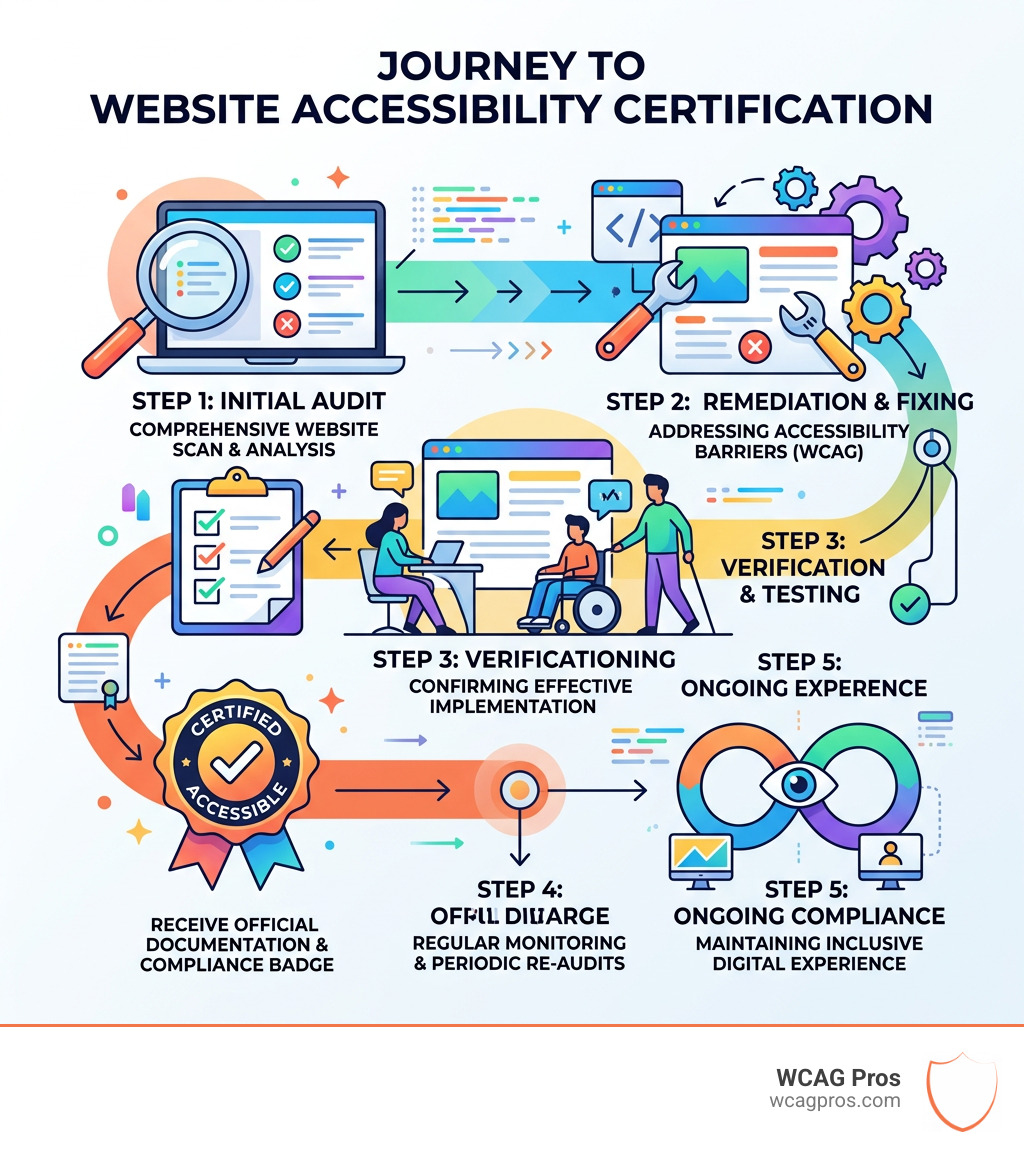
Obtaining a certification is not a “one and done” task. It is a systematic process that ensures no stone is left unturned. At WCAG Pros, we believe in a multi-layered approach to ensure true usability.
The process usually begins with Automated Tools Audit software. These tools are excellent for catching “low hanging fruit” like missing alt text or poor color contrast. However, automation only catches about 30 percent to 40 percent of issues. The real work happens during the manual code review.
Our experts perform a deep dive into your site’s architecture. We use The Ultimate Website Accessibility Testing Checklist for 2026 to verify keyboard navigation, screen reader compatibility, and complex interactive elements that automated tools often miss. We also involve user testing, where individuals with disabilities test the site using their own assistive technologies to ensure the experience is functional, not just “technically” compliant.
Once the audit is complete, we provide remediation support. This involves giving your developers specific code fixes or, in our case, handling the fixes for you. After the fixes are implemented, a verification audit is conducted to confirm that all barriers have been removed and no new issues were introduced during the repair phase.
Key Deliverables of Website Accessibility Certification Services
When you complete the certification process, you shouldn’t just get a “thumbs up.” You need tangible assets to prove your compliance. Key deliverables include:
- Compliance Badges: Visual seals you can display in your footer to show users and auditors your status.
- Formal Audit Reports: Detailed documentation of every test performed and the results.
- PDF Certificates: Official documents that can be shared with legal teams or stakeholders.
- Verification Seals: Time-stamped graphics that link to a hosted certification page.
- Remediation Documentation: A record of the WCAG Remediation steps taken to reach compliance.
These deliverables serve as your ADA Site-Wide Audit: Your Roadmap to Total Compliance, providing a clear paper trail of your efforts.
Choosing the Right Provider for Your Organization
Selecting a provider for Website accessibility certification services is a major decision. Not all providers offer the same level of depth. Some rely entirely on “overlay widgets” or AI that claims to fix everything with one line of code. Research shows these solutions often fail to provide full compliance and can sometimes make the experience worse for screen reader users.
The best approach is a hybrid one that combines powerful scanning technology with human expertise. When you are looking for a partner, consider their reputation, their technical expertise in manual coding, and whether they offer remediation or just a list of problems for you to fix yourself.
| Audit Methodology | Automated Only | Manual Expert | Hybrid (Our Approach) |
|---|---|---|---|
| Speed | Very Fast | Slow | Balanced |
| Accuracy | Low (approx. 30%) | High | Very High |
| Usability Testing | No | Yes | Yes |
| Cost | Low | High | Moderate |
| Legal Strength | Weak | Strong | Strongest |
You should also check How to Choose the Right Web Accessibility Consultant for 2025 to ensure your consultant understands the latest legal shifts, such as the new Section 752 reporting requirements for federal entities.
Why Choose WCAG Pros for Your Certification
At WCAG Pros, we don’t just point out what’s wrong. We roll up our sleeves and fix it. Our USP is our comprehensive page-by-page audit of all 54 WCAG A/AAA points. We don’t just sample a few pages. We look at the whole site to ensure total coverage.
We provide expert code fixes directly to your team or implement them ourselves. Plus, we offer free re-audits to ensure that once the fixes are in place, you get your compliance badges without extra fees. Based in Norco, CA, we understand the specific legal pressures businesses face in the U.S. and provide the dedicated support needed to navigate them. We help you Pick the Best Web Accessibility Evaluation Tool for Your Team so you can maintain what we build together.
Maintaining Compliance and Re-Certification
A website is a living thing. You add blog posts, update products, and change layouts. Every time you make a change, you risk breaking your accessibility. This is why ongoing monitoring is a core part of Website accessibility certification services.
To maintain accessibility compliance principles, we recommend a cadence of regular checks. Most organizations benefit from monthly automated scans paired with annual or bi-annual manual re-audits. This ensures that as software updates happen or content changes, your site remains barrier-free.
For those in the public sector, the new Section 752 reporting mandates more frequent assessments. Even for private businesses, the European Accessibility Act (EAA) is pushing for more rigorous, ongoing oversight. Re-certification frequency usually depends on how often your site changes. A static brochure site might only need a yearly check, while a dynamic e-commerce platform needs much closer supervision.
Frequently Asked Questions about Certification
Can certification protect me from ADA lawsuits? While no service can provide absolute immunity, a certification is the strongest defense available. It proves you have met recognized standards and have a professional process for maintaining them. Courts often look favorably on businesses that show a good-faith effort through third-party audits and remediation.
How much does certification cost? Pricing varies based on the size and complexity of your website. A site with thousands of unique page templates will require more manual hours than a small business site. Most providers offer tiered packages based on the number of pages and the level of support needed.
Is AAA certification necessary? For most businesses, WCAG 2.1 or 2.2 Level AA is the “gold standard” for legal compliance. Level AAA is the highest level and is usually reserved for specialized sites or specific government projects. It is very difficult to achieve for most mainstream websites.
Why can’t I just use an automated widget? Widgets and overlays are often marketed as a quick fix, but they cannot fix underlying code issues like improper heading structures, complex form labels, or logical reading orders. Manual testing is essential to ensure a truly usable experience for everyone.
Conclusion
Investing in Website accessibility certification services is an investment in your company’s future. It opens your doors to a massive market of users who are often overlooked, including the 1 in 4 U.S. adults living with a disability. Beyond the ethics of inclusion, it provides vital legal safety in an era of rising digital litigation.
By choosing a comprehensive partner like WCAG Pros, you ensure that your site isn’t just “technically” okay, but truly welcoming. We help you build brand loyalty and reach every possible customer. Ready to start your journey toward a more inclusive web? Visit us at https://wcagpros.com/ to learn more about our page-by-page audits and certification badges.
Read more website accessibility articles
Get Help With Your Website
We'll follow up with info about:
- The process
- Cost
- Timeline
We promise to respect your privacy, and never abuse the information you provide. We will not sell or rent your information to any third party.
By submitting this form, you consent to receive SMS messages and/or emails from SEM Dynamics LLC, dba WCAG Pros. To unsubscribe, follow the instructions provided in our communications. Msg & data rates may apply for SMS. Your information is secure and will not be sold to third parties.