
5 Cheaper Alternatives to Website Accessibility Services
5 Cheaper Alternatives to Website Accessibility Services
Why Businesses Are Turning to Website Accessibility Services Right Now
Website accessibility services help businesses make their websites usable for people with disabilities, covering everything from audits and remediation to ongoing compliance monitoring.
Here is a quick look at the most common types of services available:
| Service Type | Best For | Example Providers |
|---|---|---|
| Automated AI overlays | Small businesses, quick setup | accessiBe, EqualWeb, AccessWay |
| Hybrid AI + human platforms | Mid to large organizations | Level Access, Deque |
| CMS plugins | WordPress, Shopify, Wix users | AccessWay, EqualWeb |
| Training programs | In-house teams | Deque University, WebAIM |
| Free tools and government resources | Budget-conscious starters | ADA.gov, WebAIM Chrome extension |
The pressure on businesses is real. Over 11,000 ADA-related website lawsuits have been filed, and that number keeps climbing. The Department of Justice has enforced web accessibility since 1996, and today both government websites and public-facing businesses are legally required to provide equal digital access.
Beyond legal risk, an inaccessible website shuts out a massive audience. People with disabilities control over $8 trillion in expendable income globally. That is a market no business can afford to ignore.
The good news is that full compliance does not always require a large budget. There are affordable paths forward, and this article walks you through five of them.
I’m Matthew Post, co-founder of WCAG Pros and a web developer with over 20 years of experience specializing in website accessibility services and WCAG compliance audits. I have personally overseen hundreds of audit and remediation projects, helping businesses reduce legal risk and create genuinely inclusive digital experiences.
Understanding the Need for Website Accessibility Services
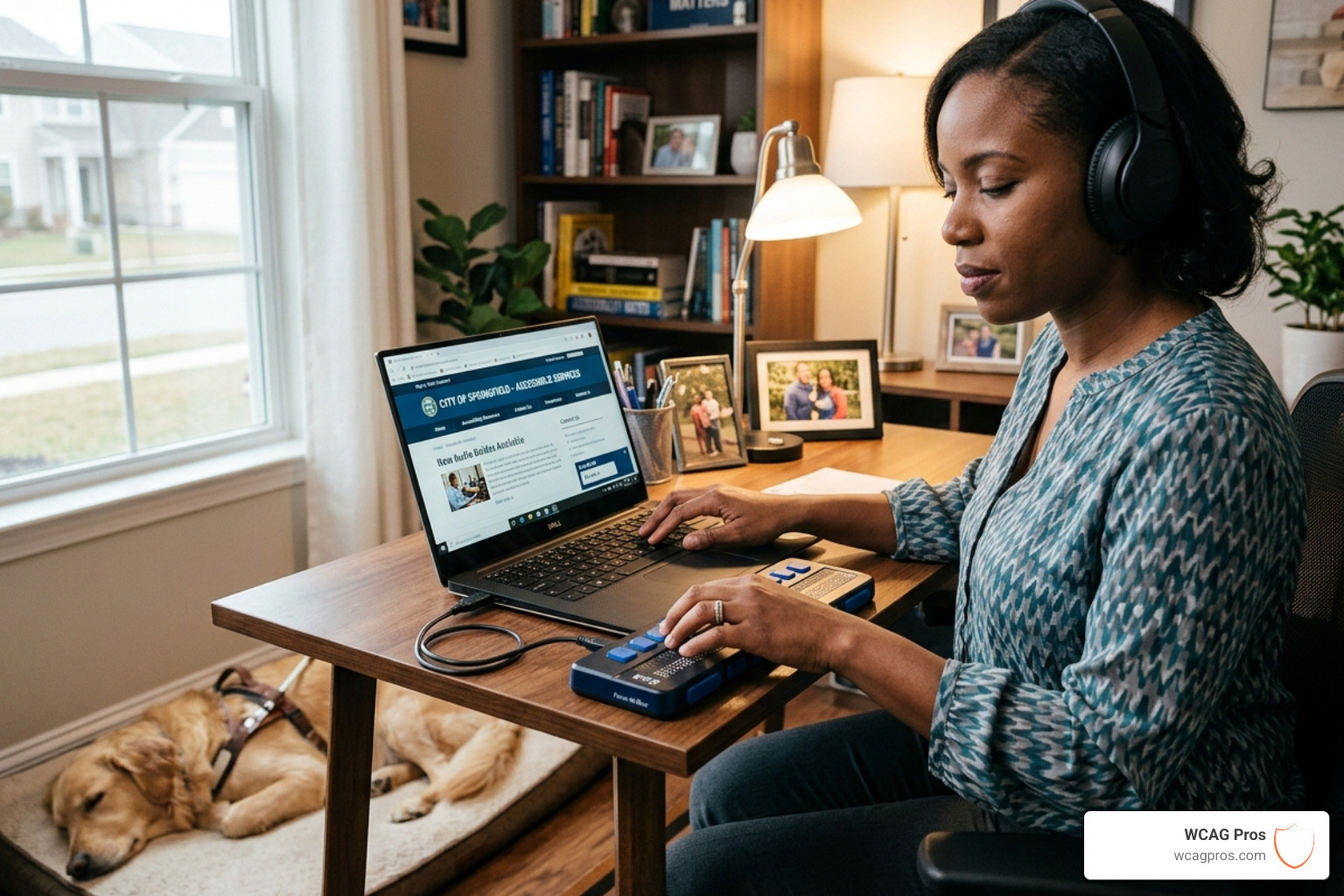
When we talk about digital inclusion, we are talking about making sure that everyone can use the internet regardless of their physical or cognitive abilities. Imagine trying to buy groceries online but being unable to click the “checkout” button because you cannot use a mouse. For millions of users, this is a daily reality.
The landscape of website accessibility services is shaped by several key regulations. The Americans with Disabilities Act (ADA) is the primary driver in the United States. While the ADA was written in 1990 before the modern web existed, the Department of Justice (DOJ) has made it clear that Title II (state and local governments) and Title III (public businesses) apply to digital spaces.
Other critical standards include:
- WCAG 2.2: The Web Content Accessibility Guidelines are the global gold standard for technical compliance.
- Section 508: This applies to federal agencies and any business doing work with the federal government.
- European Accessibility Act (EAA): This requires many private businesses selling products or services in the EU to meet strict accessibility standards.
With over 11,000 lawsuits filed and the trend going parabolic, businesses are realizing that ignoring these standards is a high-stakes gamble. For a deeper dive into the technical side, check out our Expert Website WCAG Audit Guide for Businesses.
Legal Requirements for Website Accessibility Services
The DOJ has prioritized web accessibility to ensure that people with disabilities are not denied equal access to information and services. This is often referred to as “effective communication.” If a blind student cannot register for classes because the portal is inaccessible, that is a violation of Title II. If a veteran cannot use a service organization website to sign up for benefits, that is a barrier as real as a locked door.
Local governments are also taking notice. For example, the Website Accessibility Information – City of Norco – Horsetown USA highlights how municipalities are working to ensure their digital presence serves all citizens. Whether you are a small shop in Norco or a large school district, the law requires you to provide a path for users to report accessibility issues and receive help.
Business Benefits of Professional Website Accessibility Services
While avoiding a lawsuit is a great motivator, the benefits of website accessibility services go much further. When you make your site accessible, you are opening your doors to a market with $8 trillion in expendable income.
Beyond the money, accessibility provides:
- SEO Boost: Search engines love clean code, proper headings, and alt text for images. Accessible sites often rank better.
- Brand Reputation: Showing that your business cares about inclusion builds trust and loyalty.
- Market Expansion: You reach users who were previously blocked by technical barriers.
To understand why acting now is better than waiting for a legal letter, read Why Your Business Needs an ADA Compliance Consultant Right Now.
5 Affordable Alternatives to Traditional Accessibility Consulting
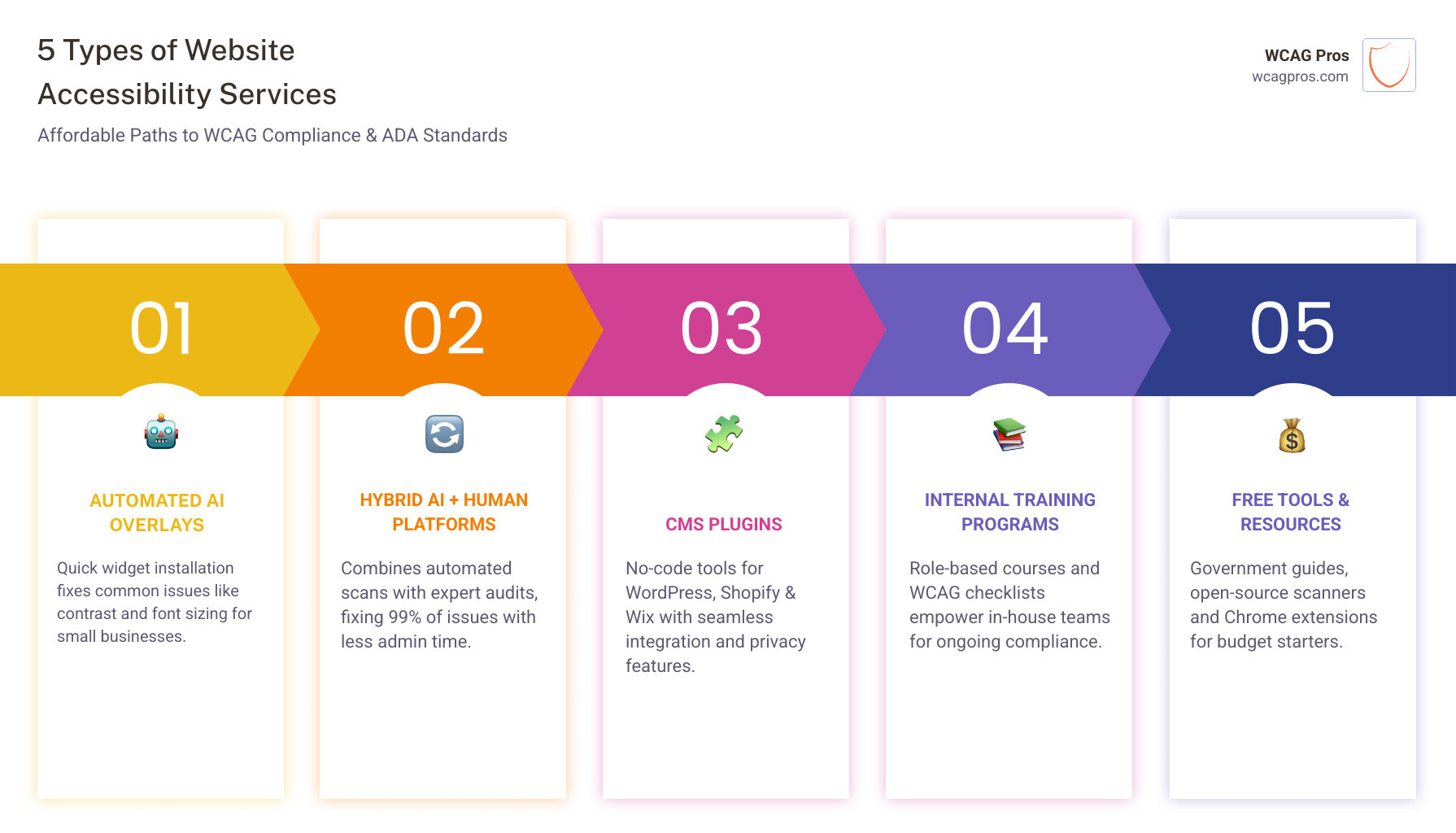
Not every business has the budget for a massive enterprise-level overhaul right away. Fortunately, the market for website accessibility services has evolved to offer several cost-effective solutions. These range from automated tools that install in minutes to hybrid platforms that combine technology with human oversight.
1. Automated AI Overlays and Widgets
Automated AI overlays are often the first stop for small businesses. These tools use a single line of code to add an accessibility menu to your site. Providers like accessiBe and EqualWeb offer these widgets to help bridge the gap quickly.
These tools typically include:
- Quick Installation: You can often get the widget running in about one minute.
- User Controls: Visitors can adjust font sizing, switch to high-contrast mode, or use a virtual keyboard.
- AI Scanning: Some plans include automated scans of up to 100 pages to find common errors.
- Support: Many providers offer 24/7 email technical support to help with the setup.
While these are great for immediate “low-hanging fruit” fixes, they are often seen as a starting point rather than a total solution. They help with things like screen reader adjustments and keyboard navigation but might not catch every complex coding error.
2. Hybrid AI and Human Expertise Platforms
If you need something more robust than a simple widget but cannot afford a full-time consultant, hybrid platforms are a fantastic middle ground. Companies like Level Access have been recognized as leaders in this space. These platforms use automated scans to identify issues and then pair those results with expert evaluation.
The results speak for themselves. Some organizations report fixing 99% of their accessibility issues while reducing the time spent on administration by 80%. This approach moves you toward “accessibility maturity” by integrating compliance into your existing development workflows. For a comprehensive look at this process, see our ADA Site-Wide Audit: Your Roadmap to Total Compliance.
3. CMS Specific Plugins for WordPress and Shopify
For businesses using popular platforms like WordPress, Shopify, Wix, or Squarespace, there are dedicated plugins that make website accessibility services much easier to manage. Tools like the AccessWay widget are currently used by thousands of customers to handle compliance without touching the backend code.
These plugins are designed with “Privacy by Design” in mind, meaning they do not collect personal user data or IP addresses. This helps you stay compliant with GDPR and other privacy laws while you work on your ADA requirements. They are a “no-code” dream for small business owners who want to protect their site without hiring a developer for every small change.
4. Internal Training and Manual Audit Programs
One of the most sustainable ways to handle accessibility is to train your own team. Deque University has trained over 200,000 learners through role-based programs. Instead of paying for external website accessibility services forever, you can teach your designers, developers, and QA testers how to build accessible products from the start.
This approach focuses on:
- WCAG Checklists: Giving your team clear benchmarks for success.
- Design Reviews: Catching barriers during the wireframe stage before they are even coded.
- Strategic Consulting: Using experts to build an internal roadmap.
Investing in your team’s knowledge pays off in the long run by preventing “accessibility debt.” You can learn more about the technical side of fixing these issues on our WCAG Remediation page.
5. Open Source Tools and Government Resources
If your budget is zero, you can still make significant progress using free resources. The DOJ provides extensive guidance on ADA.gov to help businesses understand their obligations. Additionally, organizations like WebAIM offer free Chrome extensions that allow for unlimited scans of your web pages.
Educational institutions also provide great examples of these resources. The Electronic Accessibility – Home – Corona-Norco Unified School District page shows how public entities use these standards to ensure every student and parent has access.
Free tools can help you find:
- Missing Alt Text: Images that screen readers cannot describe.
- Low Color Contrast: Text that is too hard to read against its background.
- Empty Links: Buttons or links that have no descriptive text.
Comparing Automated Overlays and Hybrid Solutions
When choosing between website accessibility services, it is important to understand the trade-offs. Automated overlays are fast and cheap, but they have limitations. They cannot “see” an image and write a perfect description for it, nor can they always understand the context of a complex form.
Hybrid solutions are more thorough because they include human testing. Real people from the disability community test your site to ensure it actually works for them. Some providers even offer litigation support, including a $15k pledge to help with legal fees if your compliance is challenged.
To help you decide which path is right for your organization, we offer The ADA Web Consultation: Your Roadmap to Digital Inclusion.
Frequently Asked Questions about Website Accessibility Services
How much do website accessibility services cost?
The cost of website accessibility services varies wildly depending on the size of your site and the level of support you need. Some basic widgets start at a low monthly fee, while more advanced managed compliance plans can range into several thousand dollars per year. Enterprise-level solutions are usually custom-quoted based on the number of pages and the complexity of the digital assets. For a precise look at your site’s needs, you can request a WCAG Audit.
Can AI overlays guarantee 100% ADA compliance?
No tool can honestly guarantee 100% compliance without human intervention. The DOJ and accessibility experts agree that while automated tools are a great first step, manual testing is essential. AI can miss nuances in keyboard navigation or screen reader flow that only a human tester would notice. If you are looking for long-term security, it is best to learn How to Choose the Right Web Accessibility Consultant for 2025.
What are common barriers to website accessibility?
The most frequent issues we see during audits include:
- Poor Color Contrast: Making it nearly impossible for users with low vision to read content.
- Missing Alt Text: Leaving blind users in the dark about what an image represents.
- Lack of Video Captions: Excluding the deaf community from your video content.
- Inaccessible Forms: Labels that are not clear, making it impossible to fill out a contact or checkout form.
- Mouse-Only Navigation: Sites that cannot be navigated using only a keyboard.
Conclusion
At WCAG Pros, we believe that the web should be a place where everyone can participate. With over 25 years of experience and 8,000 successful audit projects under our belt, we have seen how the right website accessibility services can transform a business.
We offer comprehensive, page-by-page audits that cover all 54 WCAG A and AA points. We don’t just point out the problems; we provide the code fixes and offer free re-audits to ensure you earn your compliance badges. Whether you are just starting out or looking to scale a mature program, we are here to help.
Ready to secure your digital future? Explore The Ultimate Guide to Website Accessibility Certification Services or visit our homepage at https://wcagpros.com/ to get started. You can also Contact Us directly to discuss your project or learn more About Us.
Read more website accessibility articles
Get Help With Your Website
We'll follow up with info about:
- The process
- Cost
- Timeline
We promise to respect your privacy, and never abuse the information you provide. We will not sell or rent your information to any third party.
By submitting this form, you consent to receive SMS messages and/or emails from SEM Dynamics LLC, dba WCAG Pros. To unsubscribe, follow the instructions provided in our communications. Msg & data rates may apply for SMS. Your information is secure and will not be sold to third parties.