
Why Your Small Business Needs an Annual ADA Compliance Audit
Why Your Small Business Needs an Annual ADA Compliance Audit
Why Every Small Business Needs an Annual ADA Compliance Audit
An annual ADA compliance audit is a systematic review of your website to identify barriers that prevent people with disabilities from using it, measured against WCAG 2.1 Level AA standards. Here is what you need to know at a glance:
What an annual ADA compliance audit covers:
- Automated scanning across all key pages to flag common WCAG failures
- Manual expert testing of keyboard navigation, screen readers, color contrast, and forms
- A prioritized remediation report ranking issues by severity and legal risk
- Re-testing after fixes to verify successful remediation
- Documentation to demonstrate active compliance efforts
Why it matters right now:
- 97% of websites currently fail ADA compliance
- 5,100+ ADA website lawsuits were filed in 2025, a 37% increase over 2024
- The average settlement costs $35,000 per violation
- The federal WCAG 2.1 Level AA deadline for Title II entities was April 24, 2026
The stakes have never been higher. Over 1 in 4 U.S. adults lives with some form of disability, and plaintiff attorneys are actively using automated tools to find non-compliant websites. A single demand letter can cost your business tens of thousands of dollars in legal fees and settlements before you even step into a courtroom. And yet, the fix is far less costly than the consequence.
I’m Matthew Post, co-founder of WCAG Pros and a web developer with more than 20 years of experience auditing websites for annual ADA compliance audit requirements and overseeing remediation projects. I’ll walk you through exactly how to execute this process to protect your business and make your site genuinely accessible.
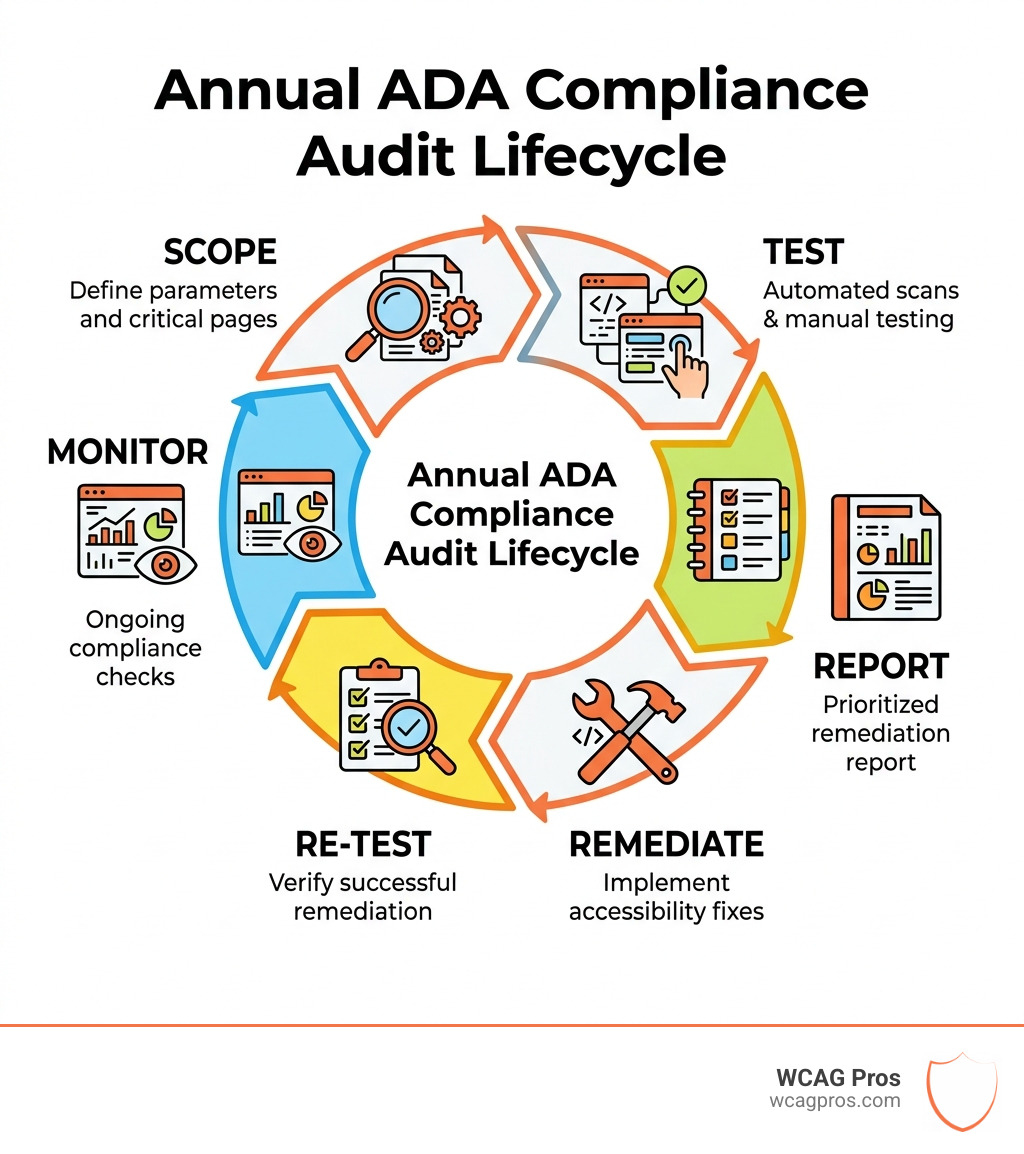
Annual ada compliance audit terms to learn:
Understanding the Annual ADA Compliance Audit
When we talk about an annual ADA compliance audit, we are referring to a deep dive into your website’s health through the lens of accessibility. The Americans with Disabilities Act (ADA) requires businesses to provide equal access to their goods and services, and in 2026, the Department of Justice (DOJ) has made it clearer than ever that this includes your digital storefront.
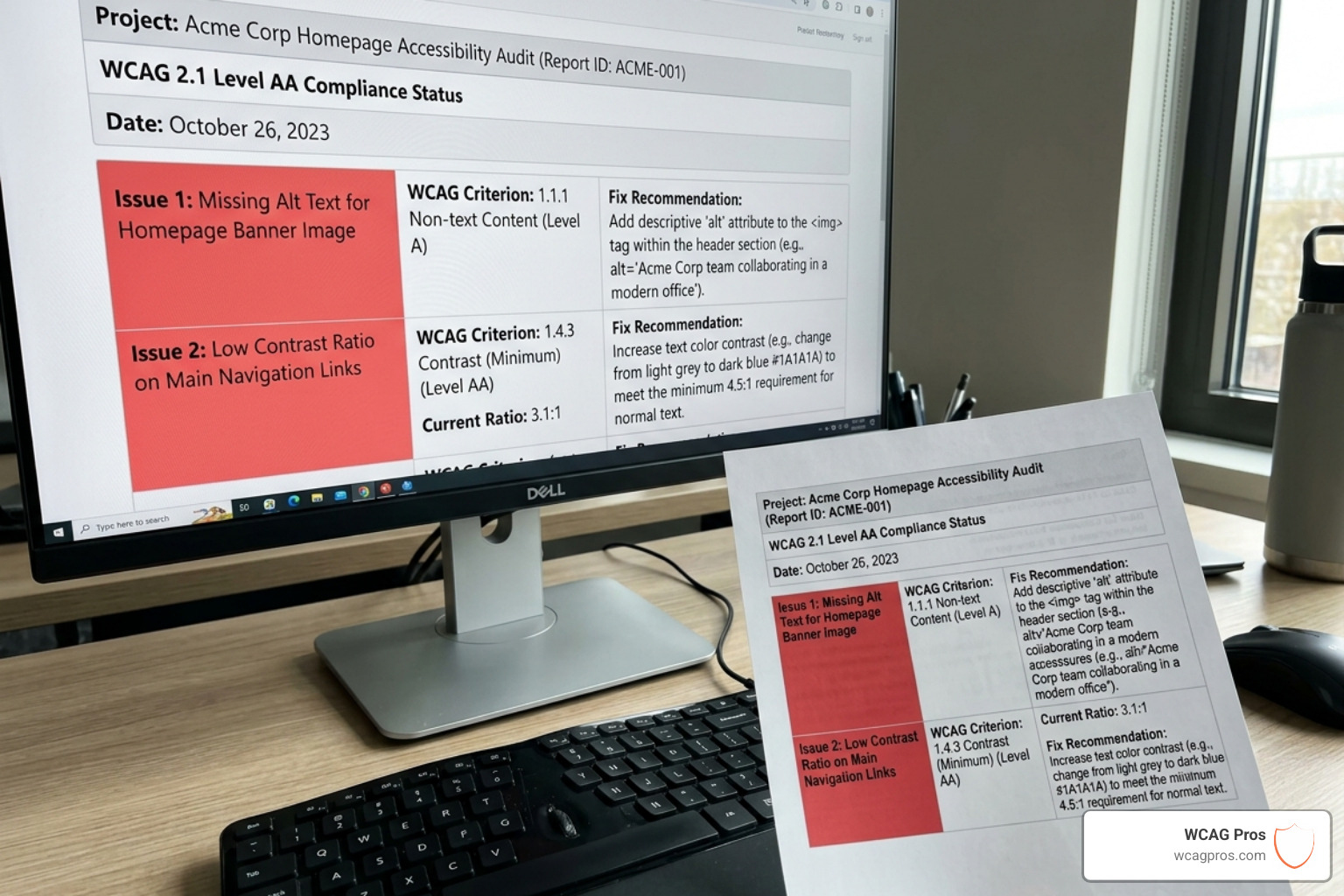
To perform a truly effective audit, we use the POUR principles as our foundation. These four pillars ensure your content is:
- Perceivable: Can users see or hear the content?
- Operable: Can users navigate the site regardless of how they interact with it?
- Understandable: Is the information and the operation of the user interface clear?
- Robust: Does the content work well with current and future assistive technologies?
A comprehensive audit is never just a “one and done” button click. While automated scans are a great starting point for catching low hanging fruit like color contrast errors, they only catch about 30 percent of total issues. To get the full picture, we perform manual testing using assistive technologies like screen readers (JAWS and NVDA) and keyboard only navigation. This ensures that a real person with a disability can actually complete a purchase or fill out a contact form. For a deeper look at this process, check out our Expert Website WCAG Audit Guide for Businesses.
We also recommend looking at resources from the ADA Compliance Team, Inc. [ACT] to understand how physical and digital accessibility often overlap for businesses with brick and mortar locations.
Why Consistency Matters for Digital Accessibility
You might wonder why you need to do this every single year. The reality is that websites are living organisms. We call it “code decay.” Every time your marketing team uploads a new blog post without alt text, or your developer installs a new third party plugin for a “cool” feature, your compliance score can take a hit.
Even browser updates can change how assistive technology interacts with your code. An annual ADA compliance audit acts as a safety net, catching these small slips before they turn into major legal liabilities. If you are just starting out, our Beginner’s Guide to Website Accessibility Audit can help you understand the basics of maintaining a consistent schedule.
The Business Benefits of Regular Auditing
Accessibility is not just about avoiding a lawsuit. It is about reaching a massive, underserved market. There are over 1.3 billion people globally living with a disability. In the U.S. alone, 1 in 4 adults has a disability, and this demographic controls billions in disposable income.
When you invest in an annual ADA compliance audit, you are also investing in better SEO. Search engines love well structured code, clear headings, and descriptive alt text. Furthermore, a more accessible site usually leads to a significant bounce rate reduction. If a user can navigate your site easily, they stay longer and convert better. We often suggest that businesses learn How to Test Your Website’s Accessibility Using Real Users to see these benefits in action.
The Legal Risks of Neglecting Your Annual ADA Compliance Audit
The legal landscape in April 2026 is unforgiving. We have seen a staggering 37 percent increase in litigation compared to just one year ago. In 2025, over 5,100 ADA website lawsuits were filed. These are not just targeting tech giants. Small businesses are increasingly in the crosshairs because they are often the easiest targets for “serial plaintiffs” who use automated tools to find vulnerabilities.
The financial impact is heavy. The average settlement cost is around $35,000 per violation. This does not include your own legal fees or the cost of the emergency remediation you will have to do anyway under a court order. For those operating in our home state, ADA Compliance For California Businesses is particularly strict due to state laws like the Unruh Civil Rights Act, which allows for additional damages.
Neglecting your audit can also lead to devastating brand reputation damage. In an era where social responsibility matters to consumers, being “the business that blocks disabled users” is a PR nightmare you want to avoid. Use our ADA Site-Wide Audit: Your Roadmap to Total Compliance to stay ahead of these risks.
Federal Deadlines and WCAG 2.1 AA Requirements
A major milestone passed on April 24, 2026. This was the federal deadline for many organizations to meet WCAG 2.1 Level AA compliance under Title II of the ADA. While Title II specifically targets state and local governments, the DOJ has historically applied these same technical standards to Title III entities (private businesses that are public accommodations).
If your website provides services to the public, the court’s expectation is that you meet these standards. Failing to do so makes you a “sitting duck” for demand letters. Learning How to Pass Your WCAG 2.1 AA Certification with Flying Colors is now a business necessity rather than a luxury.
Common Issues Uncovered During Audits
During our page by page reviews, we consistently see the same culprits:
- Missing Alt Text: Images that convey information but lack a text description for screen reader users.
- Poor Color Contrast: Text that is too light against its background, making it unreadable for users with low vision.
- Keyboard Traps: Areas where a user can get “stuck” using only a keyboard and cannot navigate away.
- Non-Descriptive Links: Buttons that just say “Click Here” instead of “Download the 2026 Audit Guide.”
To see where your site stands, you can download The Ultimate WCAG Checklist (PDF, Excel, and Print-Ready Versions) to run your own preliminary checks.
How to Execute a Successful Annual ADA Compliance Audit
Executing a successful annual ADA compliance audit requires a hybrid approach. You cannot rely on software alone, but you also need the speed of automation to cover large sites.
| Audit Method | Detection Rate | Best For | Pros | Cons |
|---|---|---|---|---|
| Automated Scan | ~30% | Bulk page checks | Fast, inexpensive | Misses subjective issues |
| Manual Expert Review | ~90-100% | Critical user paths | High accuracy, legal defense | Takes more time |
| User Testing | Contextual | Real world UX | Identifies usability blocks | Requires specific participants |
We start by scoping unique templates. You don’t necessarily need to audit every single one of your 5,000 blog posts if they all use the same layout. Instead, we focus on the homepage, contact pages, checkout flows, and unique landing pages.
Our process includes a heavy focus on Automated Tools Audit for initial data, followed by rigorous keyboard navigation testing. We make sure every link, button, and form field can be reached and activated without a mouse. Then, we bring in the screen readers. Testing with JAWS and NVDA allows us to hear the site exactly as a blind user would. We then compile all this into a remediation roadmap that tells your developers exactly what to fix and in what order. For a step by step guide, refer to The Ultimate Website Accessibility Testing Checklist for 2026.
Assembling Your Accessibility Team
Accessibility is a team sport. It is not just the “IT guy’s problem.” To maintain compliance, you need buy in from:
- Web Developers: To handle the code fixes and ARIA labels.
- Content Creators: To ensure every image has alt text and every video has captions.
- Quality Assurance: To test new features before they go live.
- Third-Party Consultants: Like us at WCAG Pros, to provide objective, expert oversight and certification.
Understanding the roles and the technical standards is key, so we recommend reading Everything You Need to Know About WCAG Versions and Audits.
Budgeting for Compliance Costs
We know that for a small business, every dollar counts. When budgeting for your annual ADA compliance audit, consider it an insurance policy. A proactive audit and remediation plan is significantly cheaper than a $35,000 settlement.
Costs generally vary based on the size and complexity of your site. A simple 5 page brochure site will be much faster to audit than a complex e-commerce platform with thousands of products. When you look at the ROI, you are not just avoiding fines. You are improving your site’s usability for everyone, which directly impacts your bottom line. We have more details on how to plan for these costs in our Expert Website WCAG Audit Guide for Businesses.
Frequently Asked Questions about Annual ADA Compliance Audits
How often should I conduct an annual ADA compliance audit?
As the name suggests, once a year is the standard for a full, comprehensive audit. However, we suggest doing smaller “spot checks” every quarter or whenever you launch a major site redesign. Continuous monitoring is the best way to ensure that “code decay” doesn’t leave you vulnerable.
What is the typical cost of an annual ADA compliance audit?
While we don’t list specific prices here, the cost is influenced by whether you choose a manual, automated, or hybrid approach. Manual audits by experts are more labor intensive but provide the highest level of legal protection. Most small businesses find that a hybrid approach offers the best balance of thoroughness and value.
Can automated tools replace a manual annual ADA compliance audit?
Absolutely not. Automated tools are great for catching things like missing alt tags or color contrast issues, but they have a detection rate of only about 30 percent. They cannot tell you if a screen reader is announcing a menu correctly or if a complex form is actually usable. Human judgment is required to evaluate the subjective criteria of WCAG.
Conclusion
At WCAG Pros, we believe that a more accessible internet is a better internet for everyone. By committing to an annual ADA compliance audit, you are protecting your business from predatory lawsuits while opening your doors to millions of potential customers.
Beyond the audit, we recommend a few best practices for the rest of the year:
- Publish an Accessibility Statement: Tell your users you are committed to inclusion and provide a way for them to report issues.
- Vendor Contracts: Ensure any third party tools you use (like chat widgets or payment processors) are also ADA compliant.
- Team Training: Educate your staff so they don’t accidentally introduce new barriers.
Ready to secure your digital future? Let our team of experts handle the heavy lifting. We provide comprehensive page by page audits of all 54 WCAG points, including code fixes and free re-audits for your compliance badge. Visit our WCAG Audit page to get started today.
Read more website accessibility articles
Get Help With Your Website
We'll follow up with info about:
- The process
- Cost
- Timeline
We promise to respect your privacy, and never abuse the information you provide. We will not sell or rent your information to any third party.
By submitting this form, you consent to receive SMS messages and/or emails from SEM Dynamics LLC, dba WCAG Pros. To unsubscribe, follow the instructions provided in our communications. Msg & data rates may apply for SMS. Your information is secure and will not be sold to third parties.