
ADA Compliant Hotel Rooms: Everything You Need to Know
ADA Compliant Hotel Rooms: Everything You Need to Know
Understanding the ADA Compliant Hotel Room Requirements
When we talk about an ada compliant hotel room, we are referring to a space that follows the 2010 ADA Standards for Accessible Design. These standards became the mandatory benchmark on March 15, 2012. If a hotel was built or renovated after that date, it must strictly follow these rules.
There is a concept often called “safe harbor.” This means that if a hotel was built under the older 1991 standards and has not been altered since, it might not have to immediately tear down walls to meet the 2010 rules. However, the myth of being “grandfathered in” is just that—a myth. Hotels have an ongoing obligation to remove architectural barriers whenever it is “readily achievable” to do so. This means if a fix is easy and doesn’t cost a fortune, the hotel must do it.
Distribution is another key factor. A hotel cannot just put all its accessible rooms in the basement or the smallest corner of the building. These rooms must be distributed among the various classes of guest rooms. If you offer king suites, standard doubles, and poolside villas, you need to provide accessible versions of those different types. For a deeper look at how these laws apply to your operations, check out A Comprehensive Guide To Ada Business Requirements.
Designing an ADA compliant hotel room
The design starts at the door. An ada compliant hotel room must have an entry door with at least 32 inches of clear passage width. This is measured from the face of the door to the opposite stop when the door is open at a 90 degree angle.
Inside the room, space is the most important luxury. There must be a 60 inch diameter turning radius. This allows a person using a wheelchair to make a full 360 degree turn without hitting furniture. Maneuvering space is also required around the beds and toward the bathroom. For example, a King Room Accessible – The Ada Hotel implementation often shows how a large bed can coexist with wide paths of travel.
Minimum ratios for accessible guest rooms
The law is very specific about how many rooms you need. It is a numbers game based on your total inventory. Here is a breakdown of the requirements:
| Total Number of Rooms | Minimum Required Accessible Rooms | Rooms with Roll-in Showers |
|---|---|---|
| 1 to 25 | 1 | 0 |
| 26 to 50 | 2 | 0 |
| 51 to 75 | 3 | 1 |
| 76 to 100 | 4 | 1 |
| 101 to 150 | 5 | 2 |
| 301 to 400 | 12 | 4 |
As you can see, once a hotel hits the 51 room mark, at least one of those accessible rooms must feature a roll-in shower. These mobility features ensure that guests with different levels of physical needs can stay safely and comfortably.
Physical Accessibility Standards for Mobility and Comfort
The bathroom is often where compliance succeeds or fails. A single inch can make the difference between a guest being independent or needing help.
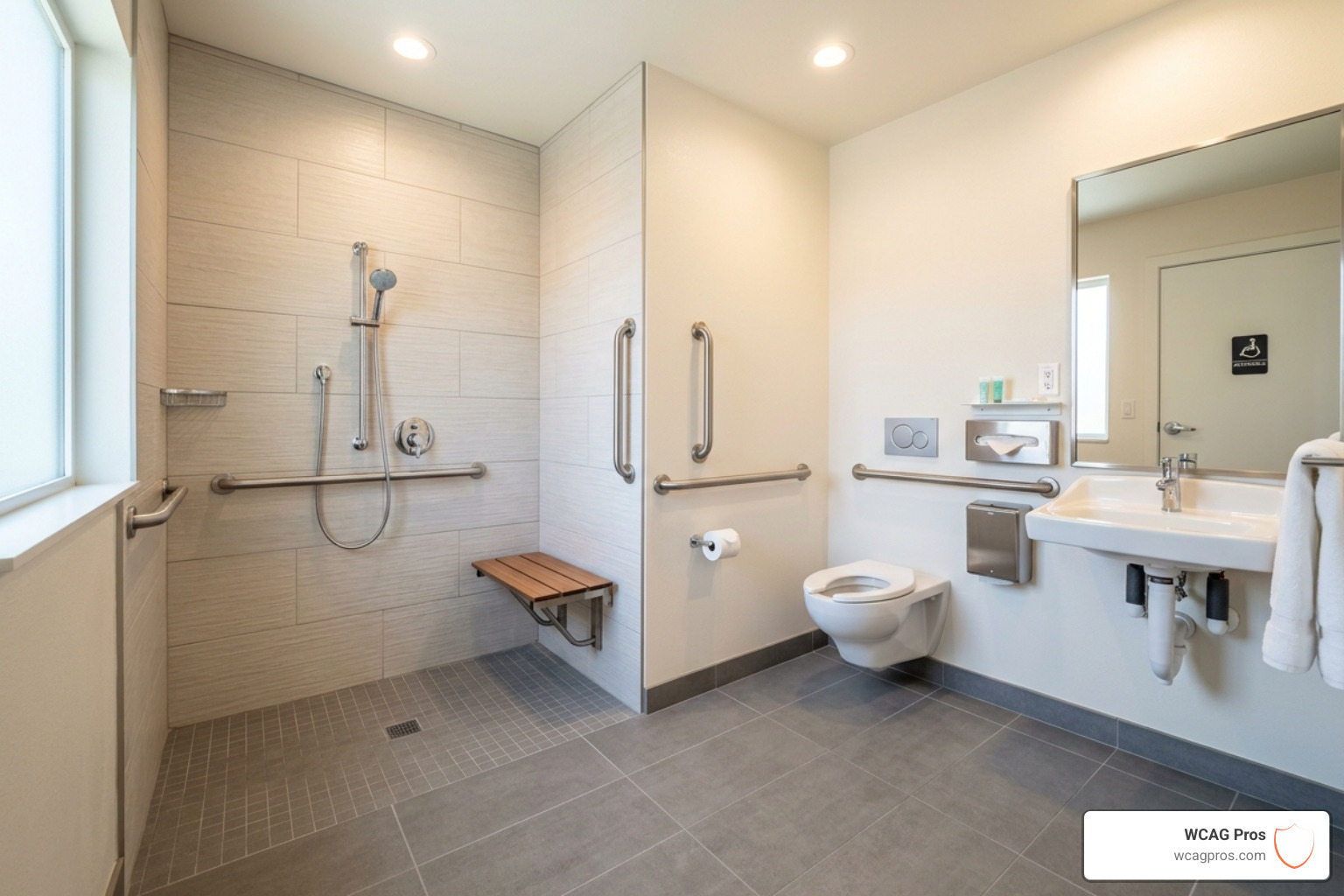
Bathroom specifics: Toilets and Sinks
In an ada compliant hotel room, the toilet seat height must be between 17 and 19 inches above the floor. This height is similar to a standard chair, making transfers from a wheelchair much easier. Grab bars are mandatory: a 36 inch bar must be on the rear wall, and a 42 inch bar must be on the side wall.
The sink (or lavatory) needs a clear floor space of 30 by 48 inches for a forward approach. We also look for 27 inches of knee clearance under the sink so a guest can roll right up to the faucet. Pipes under the sink should be insulated or configured to protect against contact, as some guests may not have sensation in their legs and could be burned by hot pipes. Options like the Two Queen Beds Accessible – The Ada Hotel often highlight these bathroom configurations for families or groups.
Bed access and furniture placement
While the ADA does not set a strict federal height for beds, accessibility experts and many state laws (like those in Maryland) suggest a mattress height of 20 to 23 inches. This aligns with the height of most wheelchair seats, allowing for a level transfer.
We also look for:
- 36 inch wide paths on both sides of the bed (or between beds).
- Reachable controls for HVAC, lights, and drapes.
- Lowered closet rods and shelves (usually no higher than 48 inches).
- Desk knee clearance of at least 27 inches high and 30 inches wide.
Many hotels, such as those offering ADA Compliant Guest Rooms | Rosen Plaza® Hotel, provide these features alongside luxury amenities to ensure the experience feels premium, not clinical.
Common area access for guests
An accessible room is useless if the guest cannot get to it. The journey starts in the parking lot. For a lot with 1 to 25 spaces, you need at least one accessible space, and it must be van-accessible (which requires a wider access aisle of 96 inches).
The lobby registration counter must have a portion that is no higher than 36 inches and at least 36 inches long. This allows a guest in a wheelchair to sign documents and speak with staff comfortably. Other common area requirements include:
- Pool lifts: Must be independently operable by the guest.
- Elevators: Must have Braille and raised characters on jambs, and audible tones (one for up, two for down).
- Clear paths: Sidewalks and hallways must be at least 36 inches wide.
For more details on making sure the entire guest journey is smooth, read Decoding The Ada Room So You Can Rest Easy.
Communication Features for Deaf and Hard of Hearing Guests
Accessibility isn’t just about wheelchairs. A significant portion of the ADA focuses on communication. Hotels must provide rooms equipped for guests who are deaf or hard of hearing.
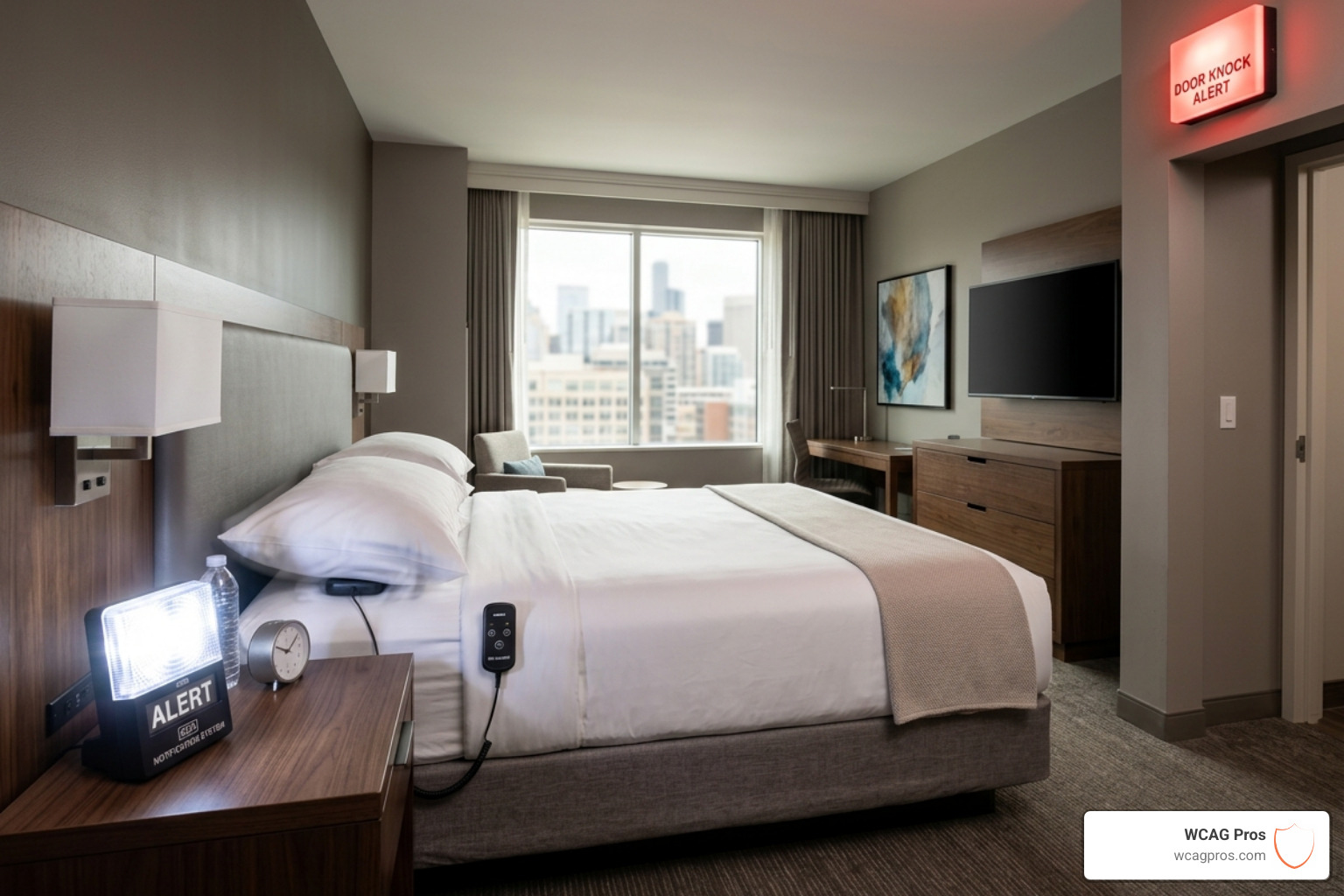
Assistive technology in an ADA compliant hotel room
Hotels are required to provide notification devices that alert guests to incoming phone calls, a knock at the door, or a ringing doorbell. This is often achieved through visual strobes or “hearing-impaired kits.”
These kits or permanent installations include:
- TTY (Text Teletype) devices: For phone communication.
- Visual door knockers: A light that flashes when someone knocks.
- Telephone amplifiers: To increase the volume on the handset.
- Vibrating alarm clocks/Bed shakers: These clip to the pillow or slide under the mattress to wake the guest up.
Rooms like the HALL Deluxe King ADA Hearing Accessible are specifically designed with these multi-modal alerts in mind.
Safety and emergency notification systems
Safety is the highest priority. If a fire alarm goes off, a guest who cannot hear the siren must be alerted visually. ADA standards require visual fire alarms (strobe lights) in all accessible rooms and a specific percentage of standard rooms.
These strobes must be integrated into the building’s fire alarm system. We recommend that hotel staff are trained to explain these systems during check-in, ensuring the guest knows how to use the portable equipment or where the permanent visual alerts are located.
Legal Obligations and Digital Reservation Policies
The law extends to how you sell your rooms. The Department of Justice is very clear: guests with disabilities must be able to reserve accessible rooms with the same efficiency as any other guest.
- Price Parity: You cannot charge more for an ada compliant hotel room than you would for a standard room of the same type.
- Room Holding: Accessible rooms must be held until all other rooms of that type are sold. You cannot “give away” the only accessible room to a non-disabled guest just because they arrived first.
- Information Disclosure: Your reservation system (and your staff) must be able to describe the specific features of the room. A guest needs to know if the shower is a roll-in or a tub with a seat before they book.
- Service Animals: Hotels must allow service dogs in all areas where guests are allowed. You cannot charge a “pet fee” for a service animal, though you can charge for actual damage the animal causes.
Digital compliance is a huge part of this. If your website is not accessible, you are essentially closing your doors to a massive market. Learn more about this at Website Ada Compliance Hotels.
Digital accessibility for booking systems
Under WCAG 2.2 standards, your website must be usable by people who use screen readers or other assistive technologies. This means:
- Text-based descriptions: Don’t just show a photo of the bathroom; describe the grab bars and the shower type in text.
- Accessible date pickers: Avoid complex grid calendars that are hard for screen readers to navigate. Simple drop-down menus for day, month, and year are often much better.
- Alt-text: Every image of an accessible feature should have a description for blind users.
We often see hotels get sued not because their physical rooms are bad, but because their website made it impossible for a disabled guest to book one. For a comprehensive look at these risks, check out A Comprehensive Guide To Ada Business Requirements.
Frequently Asked Questions about Accessible Lodging
Can a hotel charge more for an ADA compliant hotel room?
Absolutely not. Charging a higher rate for an accessible room is a direct violation of Title III of the ADA. The price must be the same as a comparable non-accessible room. If the only accessible room left is a suite, and the guest only requested a standard room, many hotels will honor the lower price to ensure they are providing equivalent access.
Are older hotels exempt from ADA standards?
No hotel is exempt. While older hotels have more flexibility under the “readily achievable” barrier removal standard, they are still required to make progress. If a hotel undergoes a major renovation, it must bring the altered areas up to the 2010 Standards. The idea that a building is “grandfathered” and never has to change is a common misconception that often leads to legal trouble.
What should I do if my room is not compliant?
If you are a guest and find your room is not compliant, you should first bring it to the attention of the hotel management. They may be able to move you or provide a portable solution (like a tub seat or a hearing kit). If the hotel refuses to help, you can file a complaint with the Department of Justice. For hotel owners, the best path is to hire a specialist to perform an audit and create a remediation plan before a complaint is filed.
Conclusion
Creating an ada compliant hotel room is about more than just checking boxes on a government form; it is about hospitality. It is about making sure that every guest, regardless of their physical or sensory abilities, feels welcome, safe, and respected.
At WCAG Pros, we specialize in the digital side of this equation. We help hotels in Norco, CA, and across the country ensure their websites meet WCAG 2.2 standards. From page-by-page audits to providing code fixes, we make sure your booking system is as accessible as your guest rooms.
Don’t let a digital barrier prevent a guest from experiencing your physical hospitality. If you’re ready to ensure your website is fully compliant and inclusive, explore our WCAG audit services today. We are here to help you navigate the complexities of ADA and WCAG so you can focus on what you do best: taking care of your guests.
Read more website accessibility articles
Get Help With Your Website
We'll follow up with info about:
- The process
- Cost
- Timeline
We promise to respect your privacy, and never abuse the information you provide. We will not sell or rent your information to any third party.
By submitting this form, you consent to receive SMS messages and/or emails from SEM Dynamics LLC, dba WCAG Pros. To unsubscribe, follow the instructions provided in our communications. Msg & data rates may apply for SMS. Your information is secure and will not be sold to third parties.