
How to Find Ada Bed Height Requirements in X Easy-to-Follow Steps
How to Find Ada Bed Height Requirements in X Easy-to-Follow Steps
What Are ADA Bed Height Requirements? (Quick Answer)
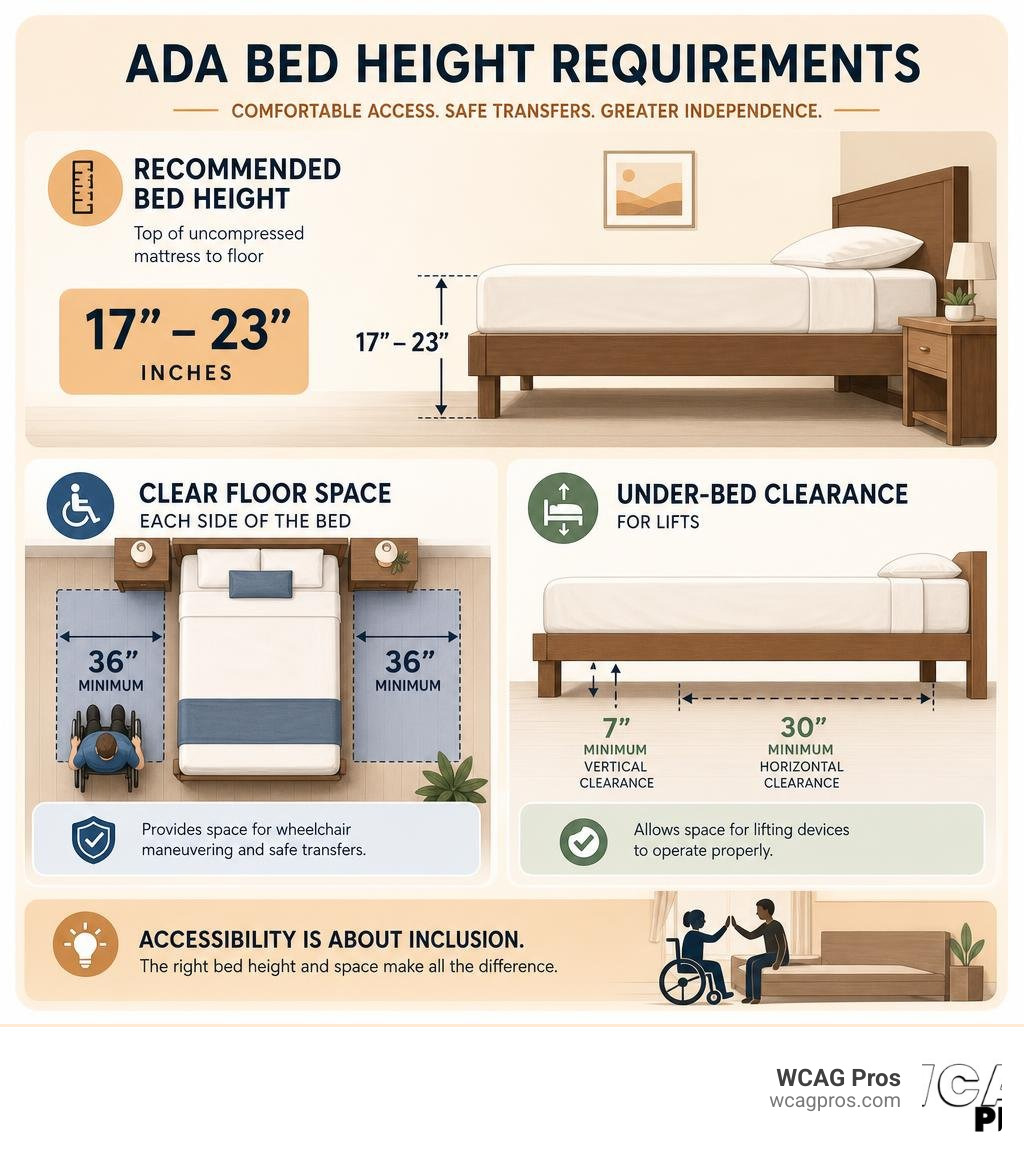
ADA bed height requirements are not explicitly defined in the 2010 ADA Standards for Accessible Design. However, the widely accepted recommendation is:
| Detail | Specification |
|---|---|
| Recommended height range | 17 to 23 inches from floor to top of uncompressed mattress |
| Standard source | ICC A117.1 2017 and accessibility best practices |
| Clear floor space (each side) | 36 inches minimum |
| Under bed clearance (for lifts) | 7 inches vertical, 30 inches horizontal (California Title 24) |
| Memory foam mattresses | Not recommended for accessible rooms |
The ADA requires accessible hotel rooms to have 36 inches of clear floor space on both sides of the bed. But the actual bed height? That falls into a regulatory gray area that catches many facilities off guard.
Here is why that matters. When a guest uses a wheelchair with a seat height of around 19 to 20 inches, a bed sitting at 28 or 30 inches makes a safe transfer extremely difficult or even impossible. As one accessibility fact sheet puts it: a hotel where parking, check in, restrooms, and elevators are all accessible but the bed is not defies the very principle of usability that the ADA is built on.
Many hotels have unknowingly created this problem. Mattresses have gotten thicker over the years, pushing bed heights to 25 to 30 inches. The ADA has not kept pace with that trend.
I’m Matthew Post, co founder of WCAG Pros and a web accessibility specialist with over 20 years of experience helping businesses navigate compliance challenges, including the physical and digital ADA bed height requirements that lodging facilities must address. In this guide, I’ll walk you through exactly how to find, measure, and apply the right standards for your facility.
ADA bed height requirements vocab explained:
Step 1 and 2 Analyze ADA Bed Height Requirements and Measure the Ideal Range

To make a sleeping room truly accessible, we must first look at how the federal government views furniture versus fixed architectural elements. When we conduct physical audits, we realize that many property owners think they are fully compliant because their ramps, doors, and bathrooms meet every line of the law. However, the bed is often completely unusable.
This is because of a regulatory gap that we must analyze before we can accurately measure the ideal range for our guests. Let us break down how this gap affects your compliance strategy and what measurements you should target.
| Bed Type | Typical Height Range | Wheelchair Transfer Usability |
|---|---|---|
| Standard Modern Hotel Bed | 25 to 30 inches | Very poor (requires significant upward lift) |
| Recommended Accessible Bed | 17 to 23 inches | Excellent (aligns with standard wheelchair seat height) |
| Ultra Low Platform Bed | 12 to 15 inches | Poor (requires difficult downward transfer and lacks lift clearance) |
We can understand physical ADA room standards better by reviewing the official ADA Accessibility Standards at Access Board gov. To help you visualize how these components fit together in a real room, you can also read our guide on Decoding the ADA Room So You Can Rest Easy.
Understanding the Federal Regulatory Gap for ADA Bed Height Requirements
When the Department of Justice released the 2010 ADA Standards for Accessible Design, they focused heavily on fixed elements. This includes things like built-in shelving, doors, and plumbing fixtures. Because beds are considered loose furniture, the Access Board did not include a specific federal height requirement for mattresses in transient lodging.
This lack of federal furniture standards has led to a major accessibility hurdle. The Department of Justice has recognized this issue and has previously initiated rulemaking processes to address accessible equipment and furniture. You can read more about the history of these regulatory efforts in the article Coming (Not So) Soon: ADA Proposed Rule For Beds In Accessible ….
Because the federal rules do not explicitly mandate a specific mattress height, we must look to building codes and industry best practices to protect our businesses from complaints and to provide a welcoming experience for all guests.
State Specific Codes and the ICC A117.1 Standard
Since we are based in Norco CA, we must closely follow California Title 24. California has some of the most comprehensive accessibility laws in the country, which often go beyond federal requirements.
While the federal government has been slow to mandate bed heights, model building codes like the ICC A117.1 have stepped in to fill the void. The 2017 version of the ICC A117.1 standard explicitly sets the required bed height between 17 and 23 inches from the floor to the top of the uncompressed mattress.
Various states have initiated code development to solve this problem. For example, you can review the research and scoping efforts in other jurisdictions by reading the Establish Bed Height, Bed Frame and Scoping Recommendations for the Florida Specific Accessibility/Transient Housing Section of Code Statement of the Problem: Selected Current Code Requirements related to transient housing/beds: Florida Accessibility Code for Building Construction:.
For our projects in California, we must combine the national ICC recommendations with our local Title 24 clearances to ensure we are fully covered.
The Recommended 17 to 23 Inch Range for ADA Bed Height Requirements
To achieve a safe transfer surface, we recommend that the top of the mattress sits between 17 and 23 inches above the finished floor. This range is not an arbitrary number. It directly matches the typical seat height of a standard wheelchair, which is usually 19 inches.
When a bed is too high, a guest must lift their entire body weight upward to transfer. When a bed is too low, they must struggle to push themselves back up into their wheelchair.
To achieve this ideal height, we must carefully select our bed components. We cannot simply use standard hotel bedding packages. Instead, we should combine:
- A low profile box spring that measures 2 to 4 inches thick
- An adjustable metal bed frame or a low profile platform
- A supportive mattress that is 10 to 12 inches thick
For more details on how to select these components, you can consult the Bed Height Fact Sheet.
Why Mattress Type and Support Matter for Transfers
Measuring the height of an empty bed is only the first part of the equation. We must also consider how the mattress behaves when a guest actually sits on the edge to transfer.
Memory foam and highly plush mattresses are incredibly popular in the hospitality industry, but they pose a serious safety risk for individuals with mobility limitations. When a person transfers onto a memory foam mattress, the edge sinks deeply. This sinking effect destroys the stable transfer surface and makes it incredibly difficult for a wheelchair user to slide back or turn over.
We recommend choosing a mattress with strong edge support, such as an innerspring mattress with reinforced borders. This ensures the bed maintains its height and stability during a transfer. If a guest has bariatric needs, a soft mattress will compress even further, making a firm and supportive edge even more critical.
Step 3 and 4 Evaluate Bedside Clear Floor Space and Apply Standards Across Facilities
Once we have established the correct bed height, we must look at how the bed fits into the room. A perfect bed height is useless if a wheelchair user cannot get close enough to make a parallel approach. We must evaluate the clear floor space around the bed and understand how these requirements apply to different types of buildings.
Federal Clear Floor Space Requirements
Under federal standards, we must provide an accessible route that is at least 36 inches wide to all accessible elements in the room. This includes the path of travel next to the bed.
If you have a room with a single bed, you must provide a 36 inch wide maneuvering space on both sides of the bed. If you have a room with two double beds, the 36 inch clear space is only required between the two beds. This space allows a wheelchair user to position their chair parallel to the mattress for a safe transfer.
You can find the detailed technical specifications for these layouts in the Requirements for Accessible Units, Sleeping Rooms and Suites [9.2]. To ensure your entire room meets these guidelines, we recommend reviewing our comprehensive guide on ADA Compliant Hotel Rooms: Everything You Need to Know.
California Title 24 and Under Bed Lift Clearance
For our clients in California, we must pay special attention to California Title 24. This code includes a critical requirement that is not found in the federal standards.
Under California building regulations, we must provide clearance under the bed for personal mechanical lifting devices. This means the bed frame cannot be a solid platform. Instead, it must be an open frame that provides a clear space of at least 7 inches vertically and 30 inches horizontally under the bed. This clearance allows the legs of a portable Hoyer lift to slide under the bed, which is essential for guests who cannot transfer independently.
We must ensure that this clearance is maintained and not blocked by storage or low hanging bedskirts. You can read the specific state requirements in the code section 11B 806.2.3 Sleeping areas.
Hotels and Transient Lodging Requirements
Under Title III of the ADA, hotels and other places of lodging must provide accessible guest rooms. The number of required accessible rooms depends on the total inventory of the property.
We must also ensure that we disperse these rooms across different classes and types. You cannot place all of your accessible rooms in the cheapest or most expensive categories. They must be fairly distributed so that guests with disabilities have the same choices as everyone else.
To make sure your property is fully compliant, you can read the official guidelines in 806 Transient Lodging Guest Rooms. You can also use our helpful Don’t Trip on Regulations with Our 2018 ADA Hotel Checklist to audit your rooms.
Hospitals and Long Term Care Facilities
In medical care and long term care facilities, the requirements are different. Under Section 805 of the ADA Standards, we must design patient rooms to allow for easy transfers, but these facilities almost always use specialized medical beds.
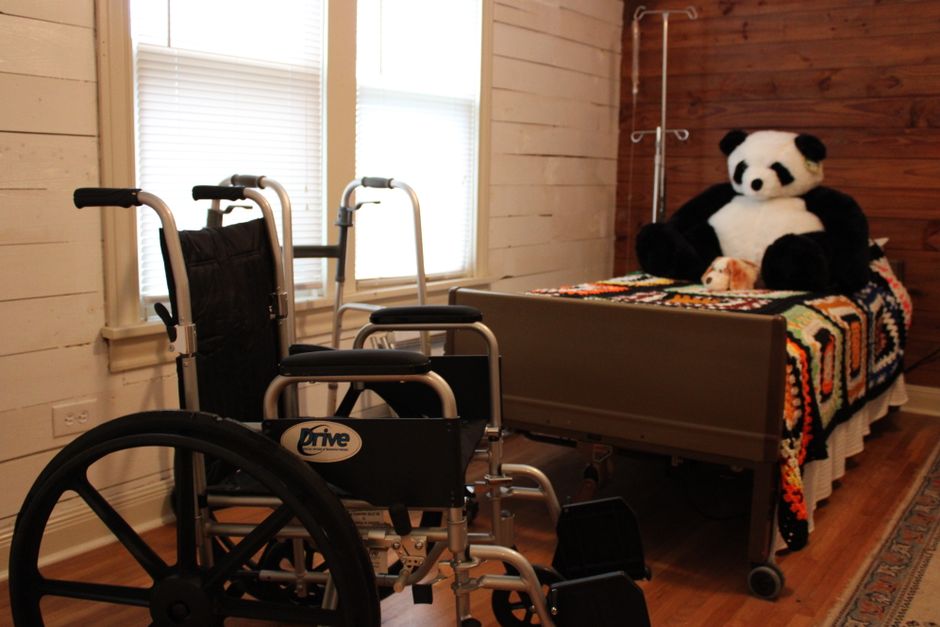
These medical beds are adjustable, meaning the height can be raised or lowered electronically by the patient or a caregiver. Because these beds can be adjusted to match the exact height of a patient’s wheelchair, they do not have the same fixed height issues as standard hotel beds. However, we must still ensure that the clear floor space around these adjustable beds is completely free of obstructions so that medical staff and devices can maneuver safely.
Residential Dwelling Units and Alterations
For residential facilities covered under Section 809, such as public housing or university dormitories, we must ensure that the sleeping areas are adaptable. When we perform alterations on existing buildings, we must bring the spaces into compliance to the maximum extent feasible.
If a building is undergoing renovations, the path of travel alterations must be made unless the cost exceeds 20 percent of the overall alteration cost, which the law deems disproportionate. Under the safe harbor provision, if your facility complied with the 1991 ADA Standards, you may not be required to retroactively alter elements unless you undergo a renovation. However, removing physical barriers that are easily preventable is still a wise business practice to avoid complaints.
Step 5 Verify and Communicate Bed Specifications Online
The physical room is only half of the journey. In June 2026, the way guests book their rooms is almost entirely digital. If a guest cannot find information about your accessible features online, they will simply book somewhere else. We must make sure that our digital reservation systems are as accessible and transparent as our physical spaces.
To understand how to audit your hotel website for compliance, you can read our detailed guide on ADA Website Compliance: Hotels.
Digital Accessibility for Booking Systems
The Department of Justice has made it clear that website accessibility is required under Title III of the ADA. We must design our online booking systems to comply with the WCAG 2.2 Level AA standards.
This means that your website must be fully navigable by keyboard, all images of your accessible rooms must have descriptive alt text, and your date pickers must be usable by screen readers. If your booking system uses complex calendars that cannot be read by assistive technology, you are shutting out a massive portion of your potential customers.
Transparency and Guest Communication
One of the best ways to build trust with the disability community is through complete transparency. We recommend measuring the exact bed heights in all of your accessible rooms and posting those dimensions directly on your website.
When a guest is booking an accessible room, they should be able to see the exact mattress height, the type of bed frame, and whether there is clearance underneath for a personal lift. We should also train our front desk and reservation staff to answer these questions accurately. When a guest calls to ask about the bed height, the staff should not guess. They should have a quick reference sheet at their desk with the exact measurements.
Frequently Asked Questions About Accessible Hotel Beds
We have compiled some of the most common questions we receive about accessible bedding and compliance.
What is the legal ADA bed height for hotels?
There is currently no explicit federal height requirement for beds under the 2010 ADA Standards. However, we highly recommend following the ICC A117.1 standard, which sets the ideal height between 17 and 23 inches from the floor to the top of the uncompressed mattress.
Can a hotel charge more for a room with an accessible bed?
No. Under Title III of the ADA, hotels are strictly prohibited from charging extra for an accessible room. The price of an accessible room must be identical to a comparable standard room of the same class.
How do I measure a hotel bed for ADA compliance?
You should place a tape measure on the finished floor surface and measure vertically to the highest point of the uncompressed mattress. Do not push down on the mattress while measuring. You should also measure the vertical clearance under the bed frame to ensure it meets the 7 inch requirement if you are in California.
Conclusion
Creating a truly accessible room requires us to look beyond the basic checkboxes of the law. By ensuring your beds sit at the recommended 17 to 23 inches and maintaining proper clear floor spaces, you can provide a safe and comfortable experience for all of your guests.
At WCAG Pros, we help businesses bridge the gap between physical and digital accessibility. If you want to make sure your online reservation system is fully compliant with WCAG 2.2 and accessible to everyone, we can help. Get a WCAG Audit from our team today to secure your digital presence.
Read more website accessibility articles
Get Help With Your Website
We'll follow up with info about:
- The process
- Cost
- Timeline
We promise to respect your privacy, and never abuse the information you provide. We will not sell or rent your information to any third party.
By submitting this form, you consent to receive SMS messages and/or emails from SEM Dynamics LLC, dba WCAG Pros. To unsubscribe, follow the instructions provided in our communications. Msg & data rates may apply for SMS. Your information is secure and will not be sold to third parties.