
Buyer’s Guide: Best Accessibility Testing Companies for 2026
Buyer’s Guide: Best Accessibility Testing Companies for 2026
Why Accessibility Testing Companies Matter in 2026
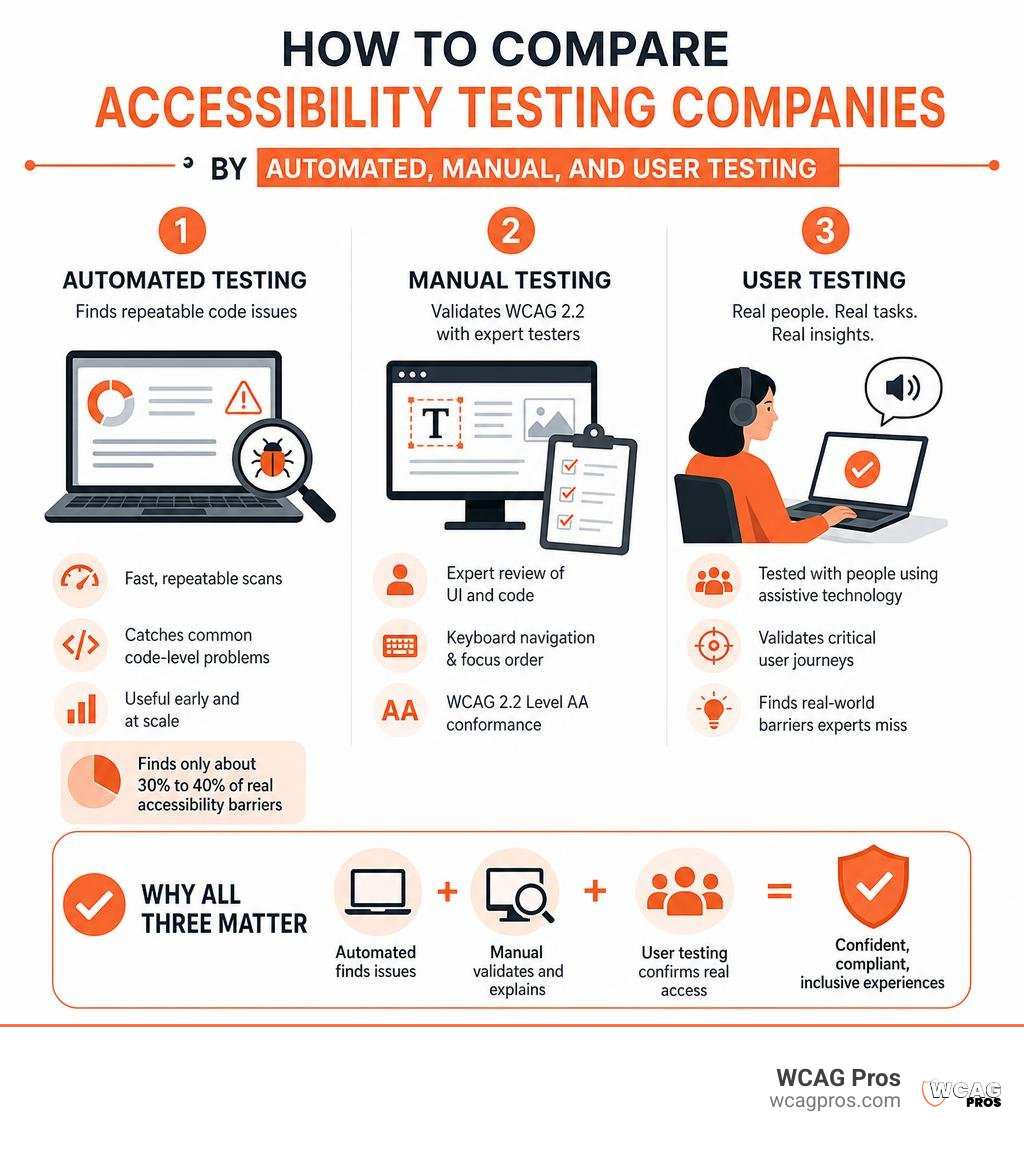
The best accessibility testing companies combine automated scans, manual WCAG 2.2 testing, and real-world testing with people who use assistive technology. For a business website, choose a partner that can validate critical user journeys, provide clear code-level fixes, re-test completed work, and support compliance evidence such as a VPAT or Accessibility Conformance Report.
Automated tools are useful for finding repeatable code problems, but they catch only about 30% to 40% of real accessibility barriers. They cannot reliably judge whether a screen reader user can complete checkout, whether keyboard focus makes sense in a modal, or whether an error message is understandable.
That gap matters. WCAG 2.2 Level AA is the common benchmark for digital accessibility work, while ADA, Section 508, EN 301 549, and the European Accessibility Act can affect organizations based on where they operate and who they serve. With 3,117 web accessibility lawsuits filed in the U.S. in 2025 and roughly 16% of the global population living with a disability, accessibility is both a legal-risk and customer-experience issue.
Matthew Post is the co-founder of WCAG Pros and a web development veteran with more than 20 years of experience. He has audited, remediated, and supervised work from accessibility testing companies and internal teams to help businesses improve WCAG compliance and reduce digital accessibility risk.
Accessibility testing companies terms at a glance:
Core Criteria for Choosing a Digital Accessibility Partner
Selecting a partner requires looking past marketing buzzwords to inspect actual auditing processes. A reliable vendor must show direct proficiency across the complete WCAG 2.2 criteria. This includes verifying newer success criteria like Focus Appearance, Target Size Minimum, and Redundant Entry.
Look for verified staff credentials from the International Association of Accessibility Professionals (IAAP), such as the Certified Professional in Accessibility Core Competencies (CPACC) or Web Accessibility Specialist (WAS) designations. Credentials show that auditors understand both the technical requirements and the practical implications of accessible code.
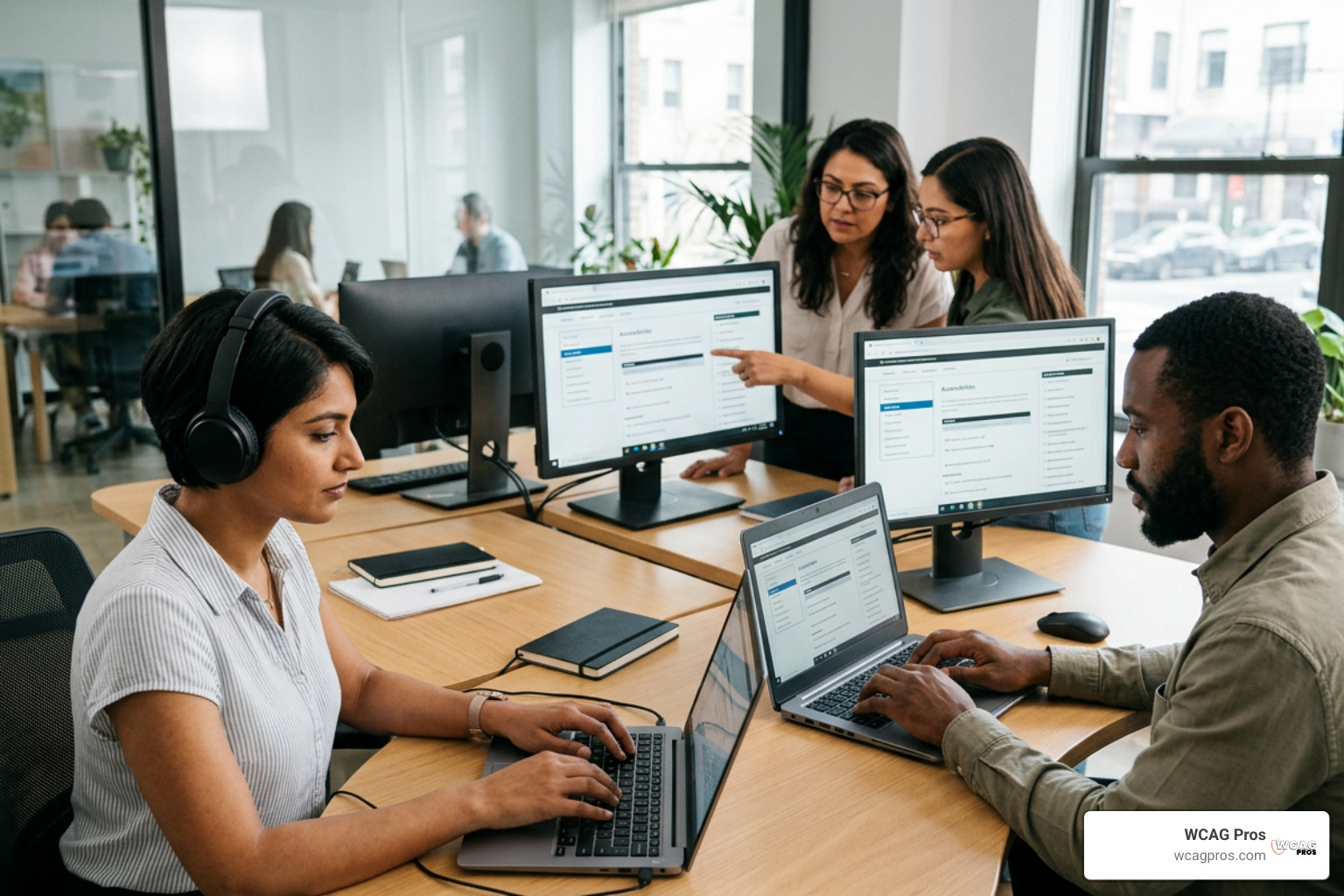
A comprehensive evaluation should not exist in a vacuum. The best partners fit right into your ongoing release cycles through continuous integration and deployment pipelines. For a deeper breakdown of full-service testing models, explore our Website Accessibility Testing Services Definitive Guide.
Criteria for Evaluating Accessibility Testing Companies
When vetting potential providers, review their assistive technology testing matrix. Real audits require physical testing across major screen reader environments:
- JAWS on Windows
- NVDA on Windows
- VoiceOver on macOS and iOS
- TalkBack on Android
Auditors must test keyboard-only navigation manually. They check for keyboard traps where focus gets stuck in dropdowns or dialogs, verify logical tab order, and confirm that all custom interactive controls operate without a mouse. Modern vendors often employ multi-engine scanning platforms alongside manual reviews to generate comprehensive Voluntary Product Accessibility Templates and Accessibility Conformance Reports.
Automated Scanners vs. Manual Expert Audits
Automated scanners are fast and catch syntax-level errors like missing image alt attributes or low-contrast text. We explain these scanner capabilities in our breakdown of Automated Web Accessibility Testing Made Easy.
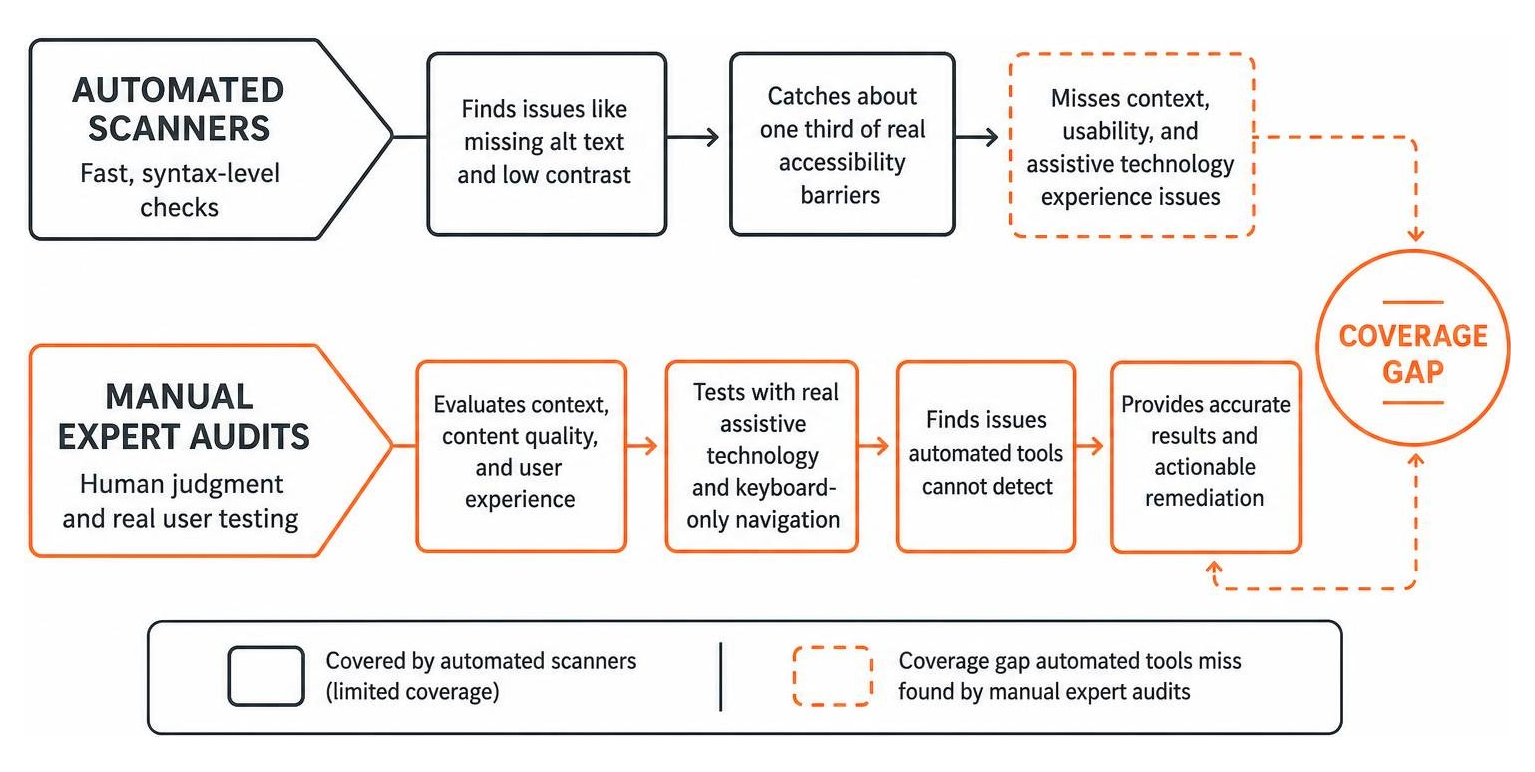
However, automated tools catch barely a third of real accessibility barriers. A scanner cannot tell you whether an image description conveys the right context or if a form error announcement is clear.
Evaluating usability requires human judgment, particularly through testing conducted by native assistive technology users with lived disabilities. To understand how authentic user feedback uncovers hidden roadblocks, read How to Test Your Websites Accessibility Using Real Users.
Top Accessibility Testing Companies for Enterprise and SaaS in 2026
The vendor market features a mix of developer-first tooling companies, enterprise platforms, and manual testing consultancies.
| Company | Core Methodology | Assistive Tech Validation | Remediation Support | Primary Deliverable |
|---|---|---|---|---|
| Deque Systems | axe-core engine, automated IDE tools, manual reviews | Yes (guided and expert) | Code guidance and developer training | Comprehensive audits, VPAT/ACR, developer plugins |
| Level Access | Unified software platform with ongoing governance | Yes (expert manual testing) | AI-assisted fixes and consultative guidance | Enterprise compliance dashboards, VPATs |
| TPGi | ARC automated platform paired with expert auditing | Yes (deep JAWS integration) | Expert advisory and engineering recommendations | Technical audit reports, ACR documentation |
| Fable | On-demand user research with native assistive tech users | Yes (100% lived disability testing) | UX feedback and video user insights | User journey reports, accessibility usability scores |
| QualityLogic | Software QA engineering and Section 508 testing | Yes (manual and automated) | Engineering QA defect reports and API validation | Integrated bug tracking, regression verification |
Deque Systems
Deque Systems is built around the open-source axe-core rules engine, which has surpassed 5 billion downloads. Their enterprise ecosystem includes axe DevTools, which lets developers test components directly inside their code editors and browser developer tools.
Deque provides deep manual audit services, role-based training programs, and enterprise monitoring platforms. Their focus centers on helping software engineering teams catch defects before code ever merges to production.
Level Access
Level Access offers an enterprise compliance platform designed for large-scale digital governance. Their platform pairs automated scanning with expert manual audits to help organizations track progress across complex web ecosystems.
In addition to audit reporting, Level Access provides consultative guidance to help enterprise teams prepare for global regulations like the European Accessibility Act. Their managed services model supports organizations that require ongoing monitoring and governance documentation.
TPGi
TPGi is known for its deep engineering background and connection to the JAWS screen reader through its parent company, Vispero. Their ARC platform delivers automated scanning while their consulting team provides in-depth manual evaluations.
TPGi focuses heavily on Section 508 compliance, enterprise software applications, and complex web tools. Their audit reports offer explicit technical remediation notes tailored to developers building custom user interfaces.
Fable
Fable takes a user-first approach by connecting digital teams directly with people with disabilities who use assistive technology every day. Instead of focusing only on technical WCAG rule checks, Fable emphasizes genuine usability research.
Their platform allows product managers and designers to test interactive prototypes and live user flows with real screen reader, switch device, and screen magnification users. This approach delivers clear insights into whether a digital product is genuinely usable in practice.
QualityLogic
QualityLogic combines traditional software quality assurance with digital accessibility testing. Their engineers validate complex software systems, mobile applications, and APIs against WCAG 2.2 and Section 508 guidelines.
QualityLogic excels at integrating accessibility checks directly into full-scale QA workflows, ensuring that accessibility bugs are tracked and resolved alongside functional software defects.
Integrating Accessibility Testing into the Development Lifecycle
Treating accessibility as a final check right before release creates expensive rework and delayed launches. Shifting accessibility left into the early stages of design and development saves substantial engineering time.
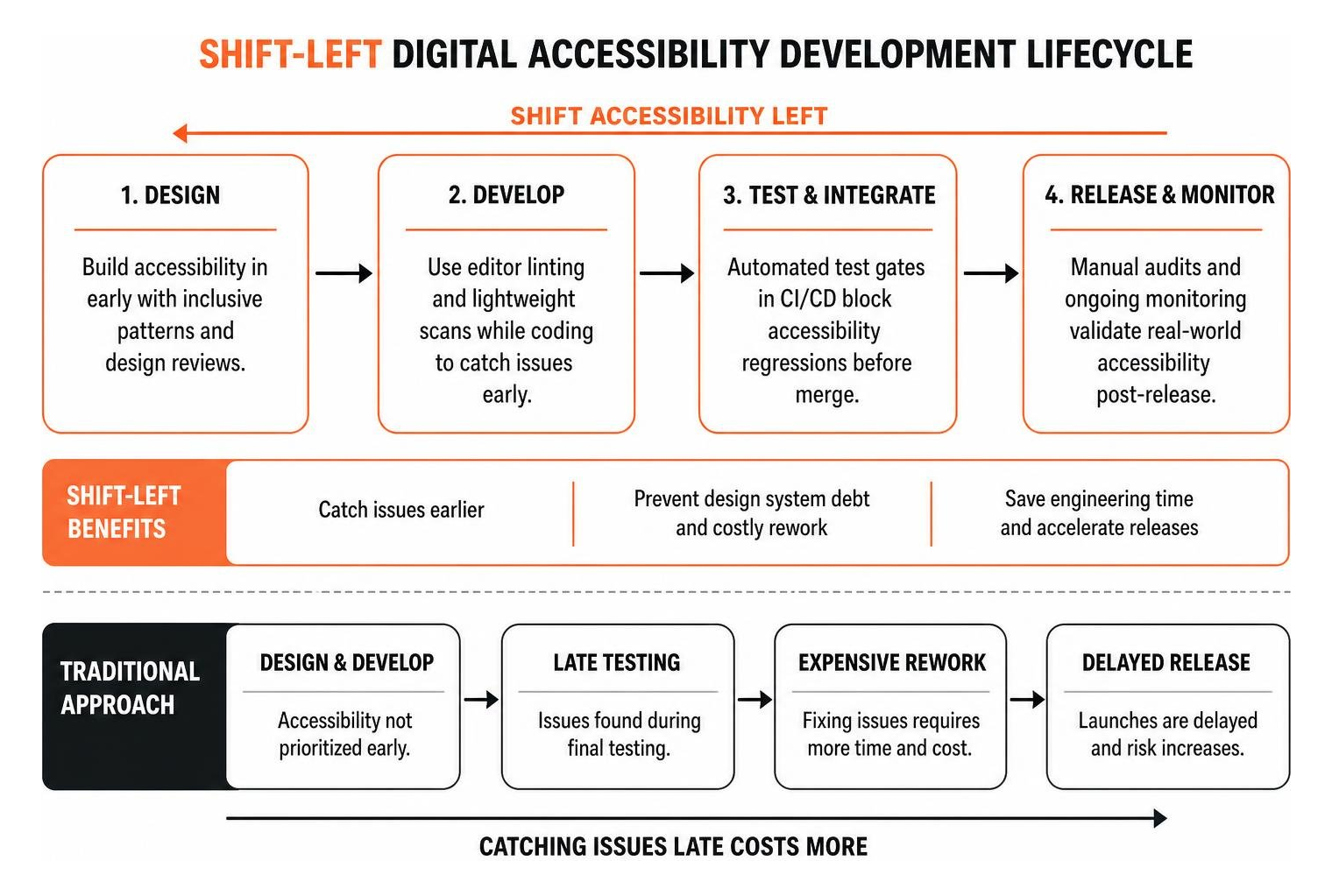
Development teams can implement linting rules and lightweight scanning tools right inside their code editors. By catching color contrast issues and missing button labels during the design and coding stages, teams prevent basic violations from compounding into design system debt. To compare the tools that make this possible, review our resource on Accessibility Audit Tools 101 Compare WCAG 22 Options.
Integrating automated test gates into continuous integration and continuous deployment pipelines ensures that common regressions are blocked automatically before pull requests merge.
How In-House QA Compares to External Accessibility Testing Companies
Building an in-house accessibility testing team provides dedicated attention, but scaling specialized knowledge across every framework and assistive device can be challenging. Independent evaluations help round out internal efforts.
A hybrid model is often the most effective approach:
- Internal teams handle automated pipeline checks, design system tokens, and day-to-day code linting.
- External testing partners conduct comprehensive manual audits, native assistive technology reviews, and third-party compliance validation.
External vendors provide objective reporting that carries legal weight during audits, vendor procurement reviews, and contract negotiations.
Managing VPAT and ACR Documentation for Procurement
A Voluntary Product Accessibility Template is a standardized template that details how a digital product conforms to accessibility standards like WCAG 2.2 and Section 508. Once an expert auditor completes the evaluation, the filled document becomes an Accessibility Conformance Report.
Enterprise buyers and government procurement officers routinely require an accurate ACR before purchasing software. Producing this documentation requires thorough, page-by-page manual verification. Submitting generic or auto-generated templates without testing evidence can derail enterprise deals during security and compliance reviews.
Frequently Asked Questions About Accessibility Testing
What is the difference between an automated scan and a full manual audit?
Automated scans check underlying code against programmatic rules, which detects missing image alternative text, basic form labels, and color contrast ratios. However, automated tools detect only 30% to 40% of real barriers.
A full manual audit uses human specialists and native screen readers to test dynamic user journeys, keyboard navigation, focus management, and contextual clarity.
How much does an enterprise accessibility audit typically cost?
Audit costs depend on the size of the digital property, the number of unique page templates, and the complexity of interactive workflows. Pricing structures generally vary between fixed-scope project rates and hourly consulting arrangements. Complex platforms with dynamic shopping carts, user portals, or custom web applications require more testing time than standard marketing websites.
Why should organizations avoid accessibility overlay widgets?
Overlay widgets are third-party JavaScript plugins that claim to make a website accessible automatically. In practice, overlays cannot fix fundamental backend code, broken form labels, or deep semantic errors.
Overlays frequently conflict with personal screen readers and assistive devices. Federal courts and regulatory agencies have consistently rejected overlays as an acceptable method for achieving ADA compliance. Genuine accessibility requires remediation directly within the website source code.
Conclusion: Selecting the Right Accessibility Testing Partner
Reaching genuine digital accessibility requires an ongoing commitment to clean code, usable design, and objective validation. Relying solely on automated scanners leaves your website exposed to legal liability under the ADA and alienates millions of people who rely on assistive devices.
At WCAG Pros, we specialize in comprehensive, page-by-page manual audits covering all 54 WCAG 2.2 Level A through AAA success criteria. We do not just hand you a list of errors. We provide clear code fixes, developer-level guidance, and free re-audits to verify your remediated pages and award your compliance certification badge.
When you are ready to remove digital barriers and secure verified compliance, schedule your comprehensive WCAG audit with our team.
Read more website accessibility articles
Get Help With Your Website
We'll follow up with info about:
- The process
- Cost
- Timeline
We promise to respect your privacy, and never abuse the information you provide. We will not sell or rent your information to any third party.
By submitting this form, you consent to receive SMS messages and/or emails from SEM Dynamics LLC, dba WCAG Pros. To unsubscribe, follow the instructions provided in our communications. Msg & data rates may apply for SMS. Your information is secure and will not be sold to third parties.