
A Comprehensive Guide to WAI Standards and WCAG 2.2
A Comprehensive Guide to WAI Standards and WCAG 2.2
Why the W3C Web Accessibility Initiative Matters for Your Website
The W3C Web Accessibility Initiative (WAI) is the World Wide Web Consortium program that creates global accessibility standards and practical resources for websites, apps, browsers, and authoring tools. For most commercial websites, the practical starting point is to build and test against WCAG 2.2 Level AA, using semantic HTML, keyboard access, clear labels, sufficient contrast, and accessible media.
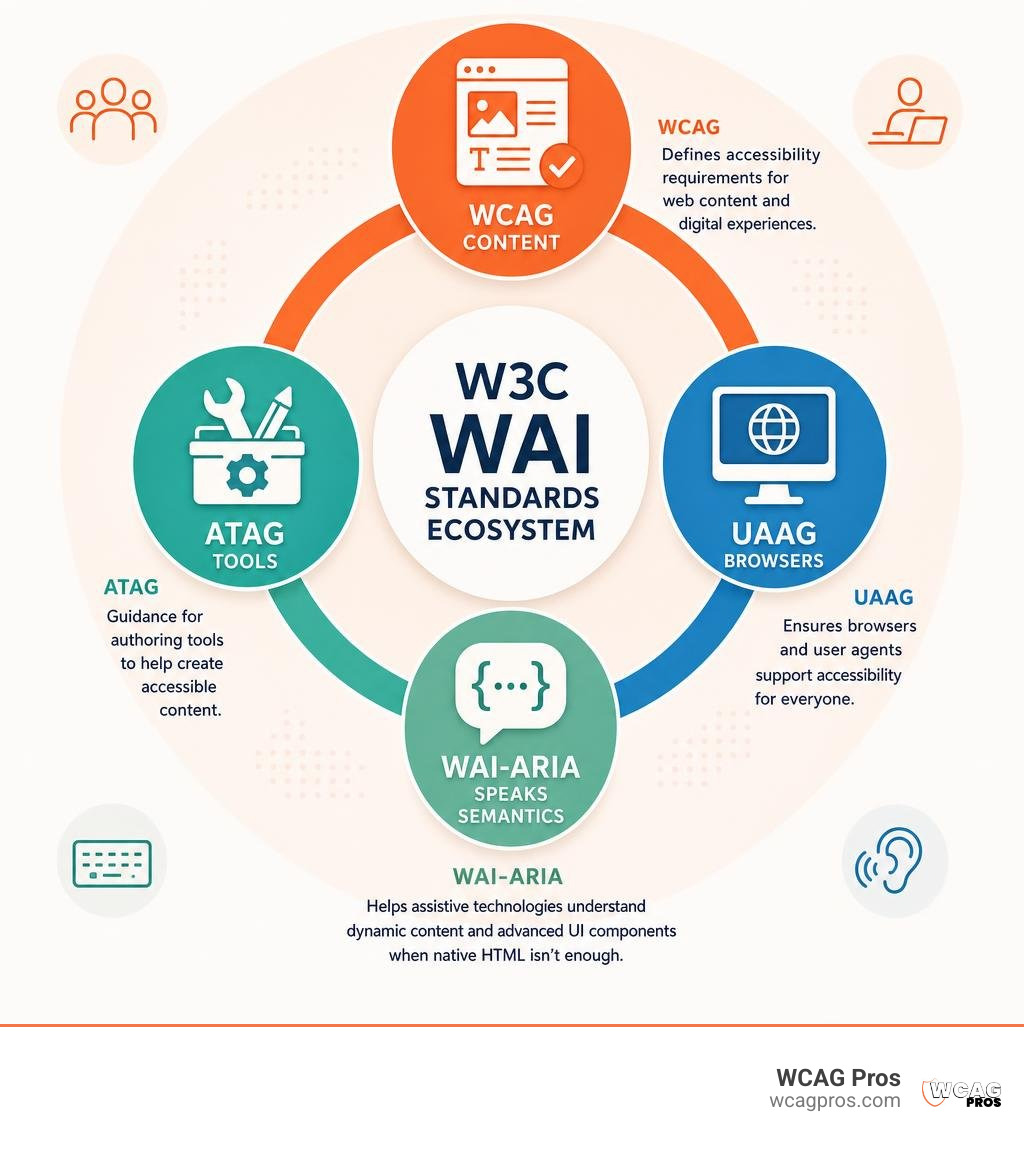
WAI’s standards work together:
- WCAG 2.2 sets accessibility requirements for web content and digital experiences.
- ATAG helps content management systems and other authoring tools create accessible content.
- UAAG addresses accessibility support in browsers, media players, and other user agents.
- WAI-ARIA helps assistive technologies understand dynamic controls and application-like interfaces when native HTML is not enough.
Accessibility is about equal participation, but it is also a business issue. An inaccessible checkout, form, menu, or video can block a customer from using your site. Research cited by U.S. government sources found that 71% of visitors with disabilities leave inaccessible websites. Better accessibility can also improve mobile usability, search-friendly structure, and the experience for people using a phone in bright light, a keyboard instead of a mouse, or captions in a noisy setting.
Matthew Post is the co-founder of WCAG Pros and a web development veteran with more than 20 years of experience auditing and remediating accessibility barriers. His work with the W3C Web Accessibility Initiative standards helps organizations turn WCAG requirements into practical, usable improvements that reduce accessibility and ADA-related risk.
Key w3c web accessibility initiative vocabulary:
Understanding the W3C Web Accessibility Initiative and Its Global Mission

The web was created to connect humanity without friction. As Tim Berners-Lee famously stated, the true power of the web is in its universality, and access by everyone regardless of disability is an essential aspect. When digital products create arbitrary roadblocks for people with visual, auditory, motor, or cognitive impairments, that founding promise breaks down. Under the United Nations Convention on the Rights of Persons with Disabilities, access to information and communications technology is recognized as a fundamental human right.
To turn that vision into enforceable technical realities, the World Wide Web Consortium launched the Home | Web Accessibility Initiative (WAI) | W3C in 1997 with endorsement from the White House and international industry leaders. Instead of leaving accessibility to scattered regional interpretations, WAI created a vendor-neutral space where software engineers, disability advocates, government representatives, and academic researchers could develop shared technical standards.
Through decades of work, WAI has built the technical specifications that guide modern web development. When teams learn how to master W3C web accessibility guidelines without breaking a sweat, they are directly tapping into a consensus-driven framework designed to ensure digital experiences work for everyone across the globe.
Governance Structure of the W3C Web Accessibility Initiative
WAI operates within the W3C as an international public-interest non-profit organization. The governance model balances open public participation with rigorous formal standardization.
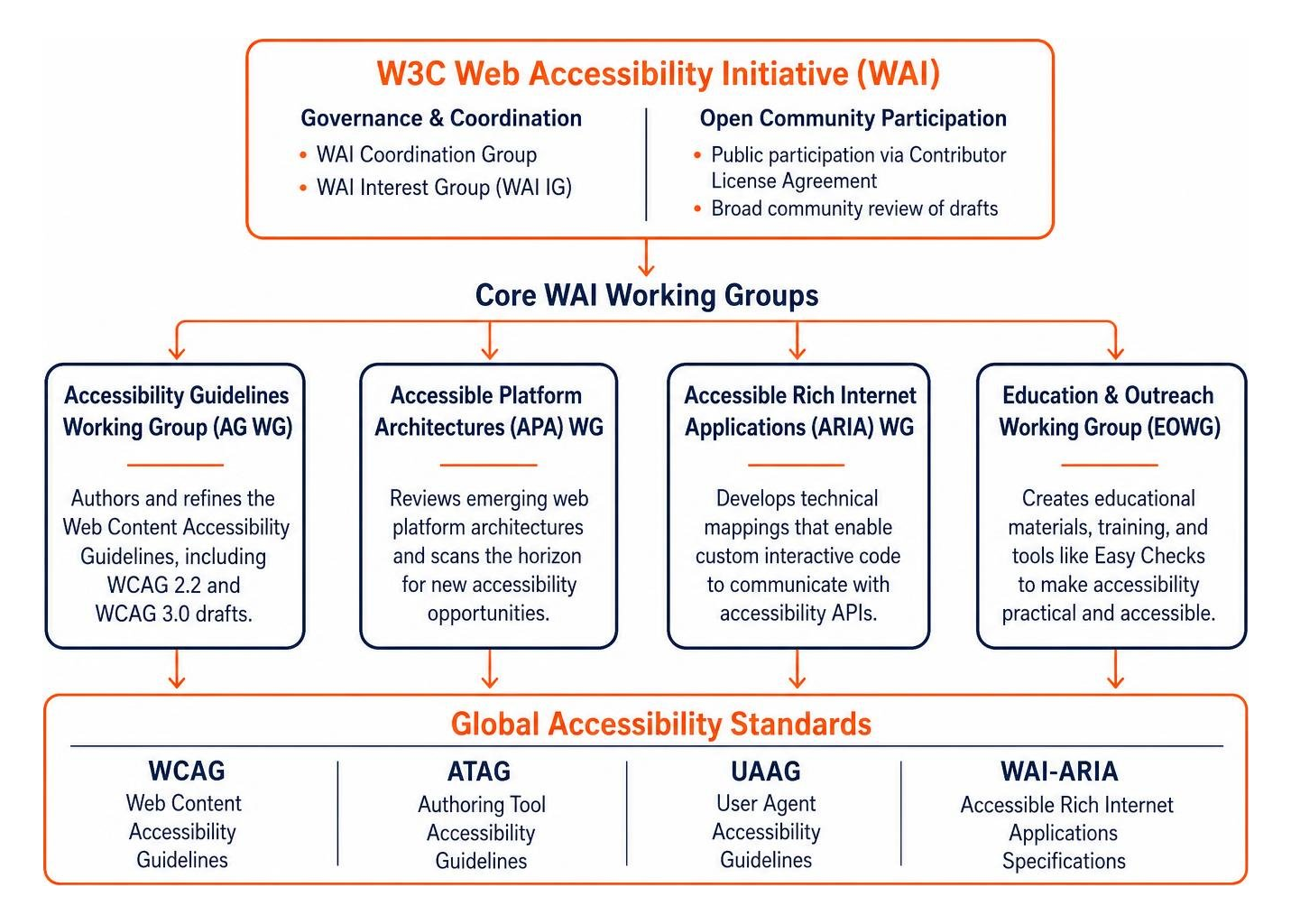
The initiative is steered by internal bodies such as the WAI Coordination Group, which aligns priorities across technical tracks. Meanwhile, broad community participation is facilitated through groups like the WAI Interest Group (WAI IG). Anyone from the public can sign a Contributor License Agreement to participate in W3C community groups, ensuring standard drafts receive scrutiny from real-world developers and end users alike. You can explore their organizational goals on the About W3C WAI | Web Accessibility Initiative (WAI) | W3C page.
Core Working Groups and Collaboration Model
The standard-setting power of WAI comes from its dedicated working groups:
- Accessibility Guidelines Working Group (AG WG): Responsible for authoring and refining the Web Content Accessibility Guidelines, including WCAG 2.2 and the evolving WCAG 3.0 draft specifications.
- Accessible Platform Architectures (APA) Working Group: Reviews emerging web platform architectures, conducting horizon scanning for virtual reality, algorithmic safety, and connected devices.
- Accessible Rich Internet Applications (ARIA) Working Group: Develops the technical mappings that allow custom interactive code to communicate with native platform accessibility APIs.
- Education and Outreach Working Group (EOWG): Creates educational materials, training modules, and testing checklists like the W3C Easy Checks to make accessibility concepts approachable.
Core Accessibility Specifications: WCAG, ATAG, UAAG, and WAI-ARIA
Web accessibility does not depend solely on the author writing front-end markup. It requires an interdependent ecosystem where authoring software produces clean code, browsers interpret that code reliably, assistive technologies process the semantic layer, and the web content itself follows accessible design rules.

When all three pillars align, people using screen readers, braille displays, voice controls, or screen magnifiers experience seamless digital interaction. For teams building custom digital applications, our definitive guide to WCAG guidelines covers how these layered technical requirements intersect in everyday design sprints.
Web Content Accessibility Guidelines (WCAG 2.2) and the POUR Framework
The most widely adopted standard across the globe is the Web Content Accessibility Guidelines. Originally codified in the Web Content Accessibility Guidelines (WCAG) 2.0 recommendation, the standard establishes four foundational principles known as the POUR framework:
- Perceivable: Information and user interface components must be presentable to users in ways they can perceive through sight, sound, or touch. This means supplying alt text for images, transcripts for audio, and sufficient color contrast.
- Operable: User interface components and navigation must be fully functional through multiple inputs, especially physical keyboards, without requiring timed pointer gestures or causing keyboard traps.
- Understandable: Information and interface operations must be predictable, legible, and clear, with meaningful error handling to prevent user mistakes.
- Robust: Markup must be clean and semantically complete so that user agents, including assistive technologies, can interpret the content reliably as software updates over time.
WCAG organizes its requirements into three progressive levels of conformance: Level A (minimum baseline), Level AA (the global legal and commercial standard), and Level AAA (specialized enhancements). Understanding the complete guide to WCAG AA compliance requirements is critical for organizations seeking to eliminate user friction and satisfy legal mandates.
ATAG and UAAG: Authoring Tools and Browsers
While WCAG focuses on web content, two complementary specifications complete the W3C ecosystem: the Authoring Tool Accessibility Guidelines (ATAG 2.0) and the User Agent Accessibility Guidelines (UAAG 2.0).
| Specification | Primary Audience | Core Focus Area | Impact on Digital Inclusion |
|---|---|---|---|
| WCAG 2.2 | Web developers, content creators, UX designers | Web content, markup, media, visual layout, interactive forms | Ensures digital interfaces are perceivable, operable, understandable, and robust for end users. |
| ATAG 2.0 | CMS vendors, code editors, LMS platforms, website builders | Content authoring interfaces and default output code generation | Enables authors with disabilities to use tools while prompting platforms to generate accessible markup by default. |
| UAAG 2.0 | Web browser developers, media players, assistive software | User agent rendering engines and operating system API bridges | Guarantees browsers expose keyboard focus, zoom controls, speech synthesis, and captions reliably. |
ATAG ensures that platforms like WordPress, Drupal, or proprietary content management systems generate clean, accessible HTML automatically. UAAG ensures that browsers like Chrome, Firefox, Safari, and Edge expose underlying web elements to operating system accessibility hooks.
Accessible Rich Internet Applications (WAI-ARIA)
Modern web applications are dynamic ecosystems driven by asynchronous JavaScript and custom user interface widgets. When standard HTML elements cannot fully express the state or behavior of a custom component, developers turn to the WAI-ARIA Overview | Web Accessibility Initiative (WAI) | W3C .
WAI-ARIA defines specialized roles, states, and properties that broadcast dynamic behavior to assistive technologies. For example, live regions announce real-time shopping cart totals or stock ticker updates without reloading the entire page.
However, ARIA is a double-edged sword. Industry research from WebAIM analyzing one million homepages revealed that pages using ARIA often average 41% more accessibility errors than pages relying on native HTML. This happens when developers misuse custom attributes instead of native elements. The foundational “First Rule of ARIA” states that if a native HTML5 element (such as a The journey from WCAG 1.0 in 1999 to today represents a shift from static HTML instructions to technology-neutral standards that adapt to modern interfaces. WCAG 2.0 established technology-agnostic testable success criteria. As touchscreens and smartphones became ubiquitous, WCAG added criteria focused on responsive screens and mobile inputs. Today, teams review everything you need to know about WCAG versions and audits to keep pace with modern digital devices. Importantly, WCAG releases are designed to be backwards-compatible supersets. Conforming to WCAG 2.2 automatically satisfies earlier benchmarks. For a forward-looking roadmap on regulatory requirements, consult our WCAG compliance guide 2026. WCAG 2.2 introduced vital success criteria specifically designed for mobile devices, low-vision reading, and cognitive usability: WAI is actively developing the next generation of guidelines under the working title WCAG 3.0 (historically codenamed “Silver”). WCAG 3.0 will introduce a more flexible scoring model that better reflects user experience across emerging technologies like augmented reality, virtual reality, and conversational interfaces. Concurrently, WCAG 2.2 has achieved formal international standardization as ISO/IEC 40500:2025. This ISO designation accelerates legal adoption globally. It anchors national regulations such as the European Accessibility Act (via EN 301 549), ADA Title II web accessibility rules in the United States, and Section 508 federal procurement policies. Building an accessible digital ecosystem requires combining automated testing tools with deep manual validation. Automated scanning tools are great for catching obvious missing attributes, but they miss nuanced barriers like confusing reading orders, broken focus traps, or poorly scripted dynamic menus. Beyond user inclusion, accessibility directly fuels organic search performance. When teams align semantic markup, descriptive media transcripts, clean information architecture, and responsive page speeds, they benefit from the natural synergy explored in our guide on WCAG compliance vs SEO. To launch an effective remediation effort, engineering teams should leverage the resources cataloged in the Web Accessibility Evaluation Tools List | Web Accessibility Initiative (WAI) | W3C . Building with a “born accessible” mindset means integrating automated linting tools directly into your continuous integration (CI/CD) pipelines, training designers on 4.5:1 text contrast ratios, and verifying that form fields programmatically declare their autocomplete attributes. For formal compliance documentation, the WAI published the updated WCAG Evaluation Methodology (WCAG-EM) 2.0. This framework expands structured accessibility evaluations beyond standard websites to include mobile apps and enterprise software. WCAG-EM 2.0 pairs with the Accessibility Conformance Testing (ACT) Rules Format 1.1 standard, ensuring that audits produce repeatable, verifiable evidence. Organizations use these structured workflows to author formal Accessibility Conformance Reports (ACRs) and Voluntary Product Accessibility Templates (VPATs) required for enterprise vendor procurement. These three specifications address distinct components of the digital landscape. WCAG governs the content and interface markup created by web developers. ATAG governs the software used to build that content, such as website builders and CMS platforms. UAAG governs how browsers, media players, and assistive software render and communicate that code to users. WCAG 2.2 is not a direct statute itself, but it serves as the technical benchmark adopted by laws worldwide. With its official recognition as ISO/IEC 40500:2025, governments directly incorporate WCAG 2.2 Level AA into enforceable legislation, including ADA Title II regulations in the United States, the European Accessibility Act, and Section 508 requirements. Organizations should begin with an automated gap analysis to clear low-hanging baseline issues across their digital footprint. Next, perform comprehensive manual audits focusing on new WCAG 2.2 criteria like focus appearance, accessible authentication, and touch target sizing. Finally, validate the entire user journey with manual screen reader testing across multiple desktop and mobile environments. Digital equity transforms the web into a welcoming space for every visitor. Embracing accessibility is not just about avoiding legal exposure, it is about respecting human rights, maximizing your audience, and delivering polished digital experiences. When 71% of visitors with disabilities leave inaccessible websites, building an inclusive product is a clear commercial win. At WCAG Pros, located in Norco, CA, we help businesses navigate these standards with confidence. Our team provides comprehensive page-by-page audits evaluating all 54 WCAG Level A and AA criteria, delivering exact code fixes and complimentary re-audits for verifiable compliance certification. Explore our W3C accessibility guidelines resources to ensure your digital properties are built for everyone., , or ) already has the necessary semantic behavior built-in, you should never replace it with a custom ARIA-laden Evolution of Web Guidelines: WCAG 2.0, WCAG 2.2, and WCAG 3.0

Key Success Criteria for Mobile, Low Vision, and Cognitive Accessibility in WCAG 2.2
WCAG 3.0 Development and ISO/IEC 40500 Standardization
Implementing and Testing Digital Accessibility Across Organizations
Implementing Technical Standards from the W3C Web Accessibility Initiative
WCAG-EM 2.0 and Conformance Auditing Workflows
Frequently Asked Questions About WAI and WCAG Conformance
What is the primary difference between WCAG, ATAG, and UAAG?
How does WCAG 2.2 relate to international laws and ISO standards?
What is the recommended roadmap to transition from WCAG 2.0 to WCAG 2.2?
Conclusion
Read more website accessibility articles
Get Help With Your Website
We'll follow up with info about:
- The process
- Cost
- Timeline
We promise to respect your privacy, and never abuse the information you provide. We will not sell or rent your information to any third party.
By submitting this form, you consent to receive SMS messages and/or emails from SEM Dynamics LLC, dba WCAG Pros. To unsubscribe, follow the instructions provided in our communications. Msg & data rates may apply for SMS. Your information is secure and will not be sold to third parties.