
ADA Compliant Hotel Room Requirements Guide
ADA Compliant Hotel Room Requirements Guide
What Is an ADA Compliant Hotel Room? The Quick Answer
What is an ADA compliant hotel room is one of the most searched questions by both hotel operators and travelers with disabilities. Here is the short answer:
An ADA compliant hotel room is a guest room that meets the accessibility standards set by the Americans with Disabilities Act (ADA), ensuring people with physical, hearing, or visual disabilities can use the room safely and independently.
Key features of an ADA compliant hotel room include:
- Wide doorways of at least 32 inches for wheelchair access
- Accessible bathrooms with grab bars, roll-in or transfer showers, and compliant toilet heights
- Clear floor space of at least 36 inches around beds and pathways
- Communication features such as visual alarms and notification devices for guests who are deaf or hard of hearing
- Dispersed room types so guests with disabilities have choices comparable to other guests
Hotels covered under Title III of the ADA must meet these standards or risk legal action. And that obligation extends beyond the physical room to your website and online booking system too.
The hospitality industry has faced growing pressure on both fronts. A staggering 96% of travelers with mobility-related disabilities have reported encountering accessibility issues at hotels. That is not just a guest experience problem. It is a legal and business risk.
I’m Matthew Post, co-founder of WCAG Pros and a veteran programmer with over 20 years of experience in web development and digital accessibility. Through my work auditing and remediating hotel and hospitality websites for WCAG compliance, I have seen how understanding what is an ADA compliant hotel room from both a physical and digital perspective is critical to avoiding costly ADA lawsuits. In the sections below, we will walk through every requirement you need to know.
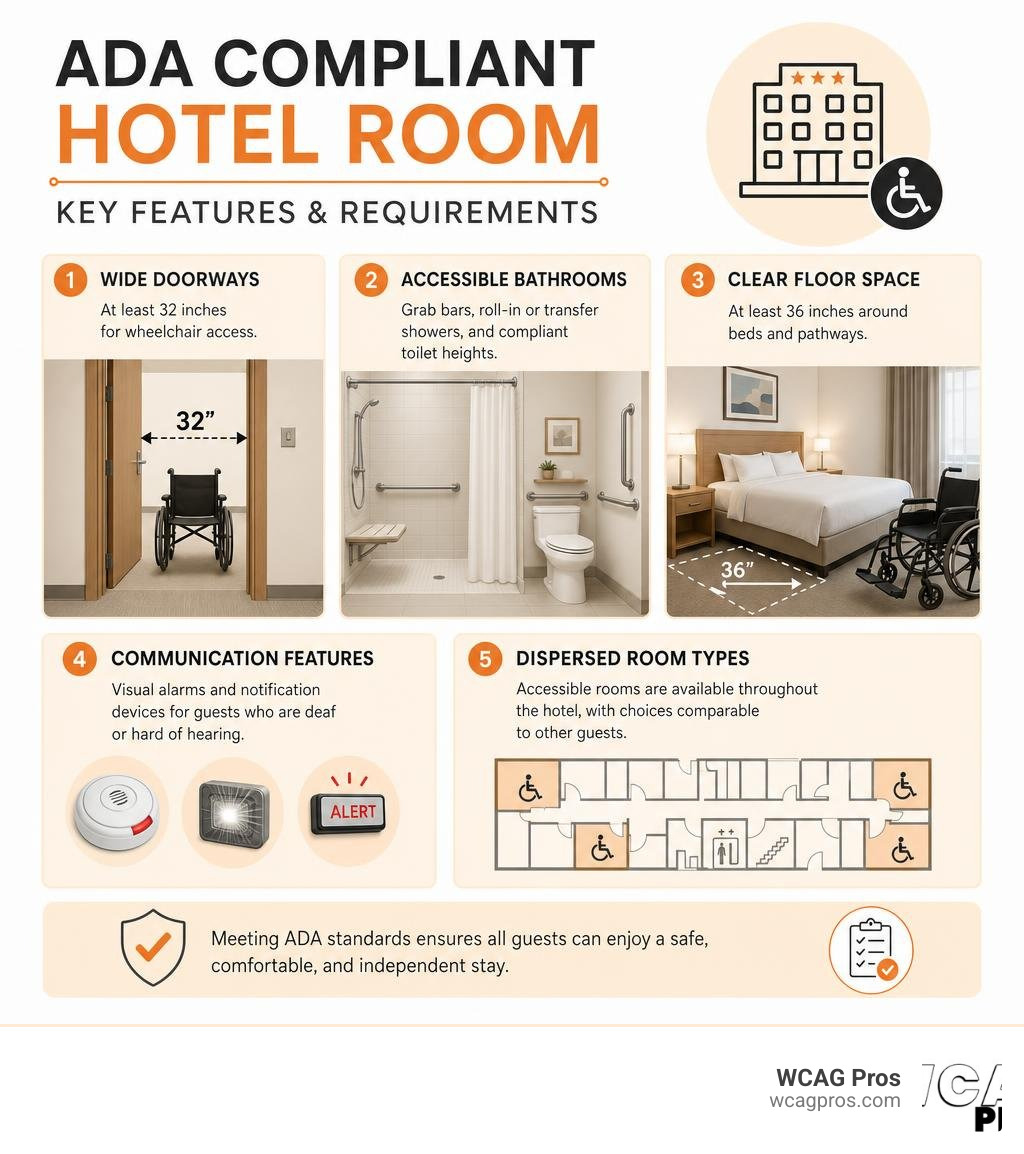
What is an ADA compliant hotel room terms to remember:
What is an ADA Compliant Hotel Room and Its Legal Standards
To fully understand what is an ADA compliant hotel room, we must look at the legal framework established by the Americans with Disabilities Act. Passed in 1990, the ADA is a federal civil rights law that prohibits discrimination against individuals with disabilities. Under Title III of this act, hotels, motels, inns, and other places of transient lodging are classified as places of public accommodation. This means they are legally required to provide equal access to their facilities, services, and amenities.
The specific physical requirements for hotel rooms have evolved over time. For many years, facilities followed the 1991 ADA Standards. However, on March 15, 2012, the Department of Justice implemented the 2010 ADA Standards for Accessible Design.
The application of these standards depends on when your hotel was built or altered:
- Pre-1993 Facilities: Hotels constructed before January 26, 1993, must remove physical barriers where doing so is readily achievable. Readily achievable means easily accomplishable and able to be carried out without much difficulty or expense.
- 1993 to 2012 Facilities: Hotels built or altered between January 26, 1993, and March 15, 2012, must comply with the 1991 ADA Standards.
- Post-2012 Facilities: Any hotel built or altered on or after March 15, 2012, must strictly adhere to the 2010 ADA Standards.
To learn more about how these rules apply to different properties, you can read our deep dive on ADA Compliant Hotel Rooms: Everything You Need to Know. For a comprehensive breakdown of architectural requirements, check out the resources on Understanding ADA Design Requirements for Hotels.
Room Inventory and Dispersion Requirements
Hotels cannot simply designate their least desirable room as the accessible room and call it a day. The ADA requires a specific number of accessible rooms based on the total inventory of the hotel. Additionally, these rooms must be dispersed across different room types, bed configurations, and price points.
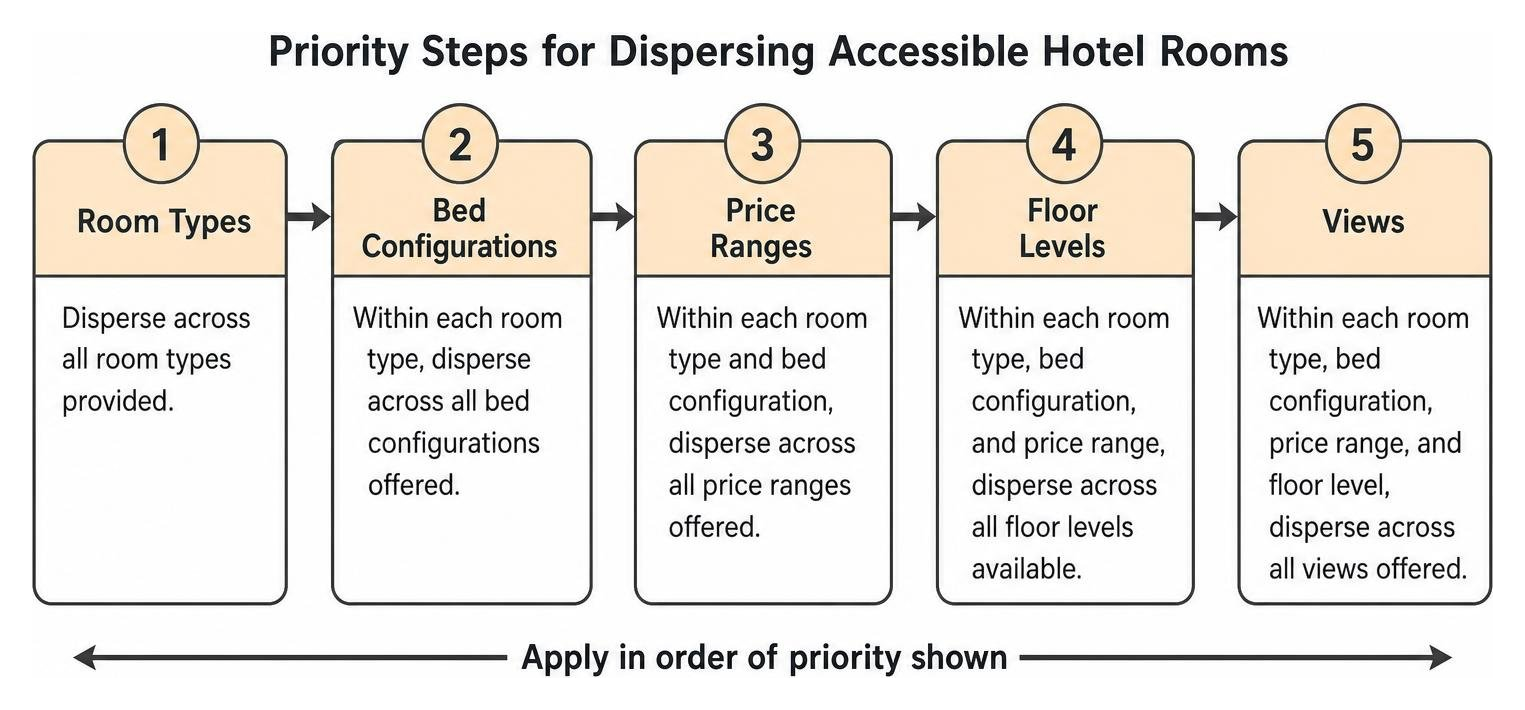
The dispersion rule ensures that a guest with a disability has the same choices as any other guest. If you offer standard rooms, deluxe suites, ocean-view rooms, and king-size beds, your accessible rooms must reflect those same options. You cannot cluster all your accessible rooms on the first floor or in the standard category.
The priority for dispersing accessible rooms follows a specific sequence when you do not have enough rooms to cover every single combination:
According to Transient Lodging Guest Rooms: ADA Standard Section 224, the minimum number of required accessible rooms scales with the size of your lodging facility. Here is a breakdown of the requirements:
| Total Number of Guest Rooms | Mobility Rooms (No Roll-in Shower) | Mobility Rooms (With Roll-in Shower) | Total Required Mobility Rooms |
|---|---|---|---|
| 1 to 25 | 1 | 0 | 1 |
| 26 to 50 | 2 | 0 | 2 |
| 51 to 75 | 3 | 1 | 4 |
| 76 to 100 | 4 | 1 | 5 |
| 101 to 150 | 5 | 2 | 7 |
| 151 to 200 | 6 | 2 | 8 |
| 201 to 300 | 7 | 3 | 10 |
| 301 to 400 | 8 | 4 | 12 |
| 401 to 500 | 9 | 4 | 13 |
| 501 to 1000 | 2% of total | 1% of total | 3% of total |
| 1001 and over | 20 plus 1 per 100 over 1000 | 10 plus 1 per 100 over 1000 | 30 plus 2 per 100 over 1000 |
Key Physical Accessibility Features in Guest Rooms
A truly accessible guest room allows a wheelchair user to enter, move around, and use all amenities without assistance. This requires careful planning of entryways, pathways, and closet spaces.
First, the entry door and all interior doors, including the bathroom door, must provide a minimum clear passage width of 32 inches. This width is measured with the door open at a 90-degree angle from the face of the door to the stop on the frame. Additionally, the door hardware must be easy to operate. Lever handles or U-shaped handles are required because they do not require tight grasping, pinching, or twisting of the wrist. The force required to push or pull open interior doors must not exceed 5 pounds.
Inside the room, hallways and pathways must maintain a minimum clear width of 36 inches. To allow a wheelchair user to turn around completely, the room must feature a turning space. This can be a circular space with a minimum diameter of 60 inches or a T-shaped space that complies with the ADA design criteria.
Closets must also be accessible. If a closet is provided, it must have a clear floor space of 30 by 48 inches at the opening. The clothes rod must be positioned within the accessible reach range, which means providing a low bar in addition to the standard high bar.
To make sure your property meets all physical standards, you can use our detailed guide on how to Don’t Trip on Regulations with Our 2018 ADA Hotel Checklist.

Understanding What is an ADA Compliant Hotel Room Layout
The layout of the furniture is just as important as the size of the room itself. Many hotels make the mistake of placing heavy armchairs or desks in a way that blocks the accessible route.
To prevent this, ensure there is a clear floor space of 30 by 48 inches at all key locations, including the desk, the thermostat, the telephone, and the window controls. The desk itself must be highly functional. It should have a maximum top height of 34 inches, with clear knee space underneath that is at least 27 inches high, 30 inches wide, and 19 inches deep.
All electrical outlets, light switches, and environmental controls must be placed within an accessible reach range. This means they should be mounted between 15 and 48 inches above the finished floor.
For more tips on arranging furniture to create a compliant layout, read our guide on Decoding the ADA Room So You Can Rest Easy.
Bed Height and Transfer Space
One of the most common complaints from wheelchair travelers is bed height. If a bed is too high or too low, transferring from a wheelchair to the bed becomes difficult or even dangerous.
Interestingly, the federal ADA standards do not specify a mandatory bed height. However, the industry best practice is to keep the top of the mattress between 17 and 23 inches from the floor, which aligns with standard wheelchair seat heights.
At WCAG Pros, we work closely with hotels to address these practical issues. Since our primary office is in Norco, California, we also emphasize compliance with California-specific building codes, which strictly regulate accessibility in commercial properties.
To ensure your beds are accessible, you should provide an open-framed bed design. This allows the use of portable patient lifts, which require space under the bed frame to slide the lift base. Additionally, there must be a 36-inch-wide clear path on both sides of the bed, or at least on one side, to allow for a safe transfer.
For a step-by-step walkthrough on measuring and adjusting your beds, read our resource on How to Find ADA Bed Height Requirements in 5 Easy-to-Follow Steps.
ADA Bathroom Requirements for Lodging Facilities
The bathroom is the most critical area of an accessible hotel room. It is also where the majority of compliance violations occur.
To pass inspection, particularly under strict California standards, you must pay close attention to the following fixtures:
- Toilets: The toilet seat must be between 17 and 19 inches above the finished floor. It must be positioned 16 to 18 inches from the side wall to the centerline of the toilet.
- Grab Bars: Grab bars must be installed on the rear wall and the side wall closest to the toilet. They must be securely anchored to support at least 250 pounds of force.
- Sinks: Sinks must have a rim height of no more than 34 inches. The water supply and drain pipes underneath the sink must be insulated or configured to protect against contact, preventing burns from hot water.
For California properties, you can find a comprehensive breakdown of these rules in the California ADA Hotel Bathroom Requirements to Pass Inspection.
Bathroom Elements of What is an ADA Compliant Hotel Room
In addition to the fixtures, the overall space of the bathroom must accommodate a wheelchair. The door swing must not encroach into the clear floor space required for any fixture unless the bathroom is large enough to provide a 30 by 48 inch clear floor space entirely outside the path of the door swing.
The vanity mirror must be mounted with the bottom edge of the reflecting surface no higher than 40 inches above the floor if it is located over a sink. If the mirror is mounted on a wall without a sink underneath, the bottom edge must be no higher than 35 inches.
Furthermore, the bathroom must provide comparable vanity counter space. If your standard rooms feature large double-vanity counters with storage, your accessible bathrooms must offer equivalent space and usability.
You can review all the exact dimensions and mandatory guidelines in Lodging: ADA Mandatory Standards.
Roll-in Showers versus Transfer Showers
When designing or renovating an accessible bathroom, you must choose between a roll-in shower and a transfer shower. The size of your hotel and the total room count will dictate how many of each you need.
A transfer shower is a small compartment, exactly 36 by 36 inches, designed for a guest to transfer from a wheelchair onto a folding shower seat. It must have grab bars on the back and side walls, a handheld showerhead, and controls placed within easy reach of the seat.
A roll-in shower is larger, at least 30 by 60 inches, allowing a guest to roll directly into the shower compartment using a shower wheelchair. It must feature a folding seat, secure grab bars, and a level threshold to prevent water from spilling while allowing smooth wheelchair entry.
For more information on selecting and installing the right shower type, you can consult the Hotels guide provided by Paralyzed Veterans of America.
Communication Features for Deaf and Hard of Hearing Guests
Accessibility is not just about physical mobility. Guests who are deaf, hard of hearing, blind, or have low vision also require specific accommodations.
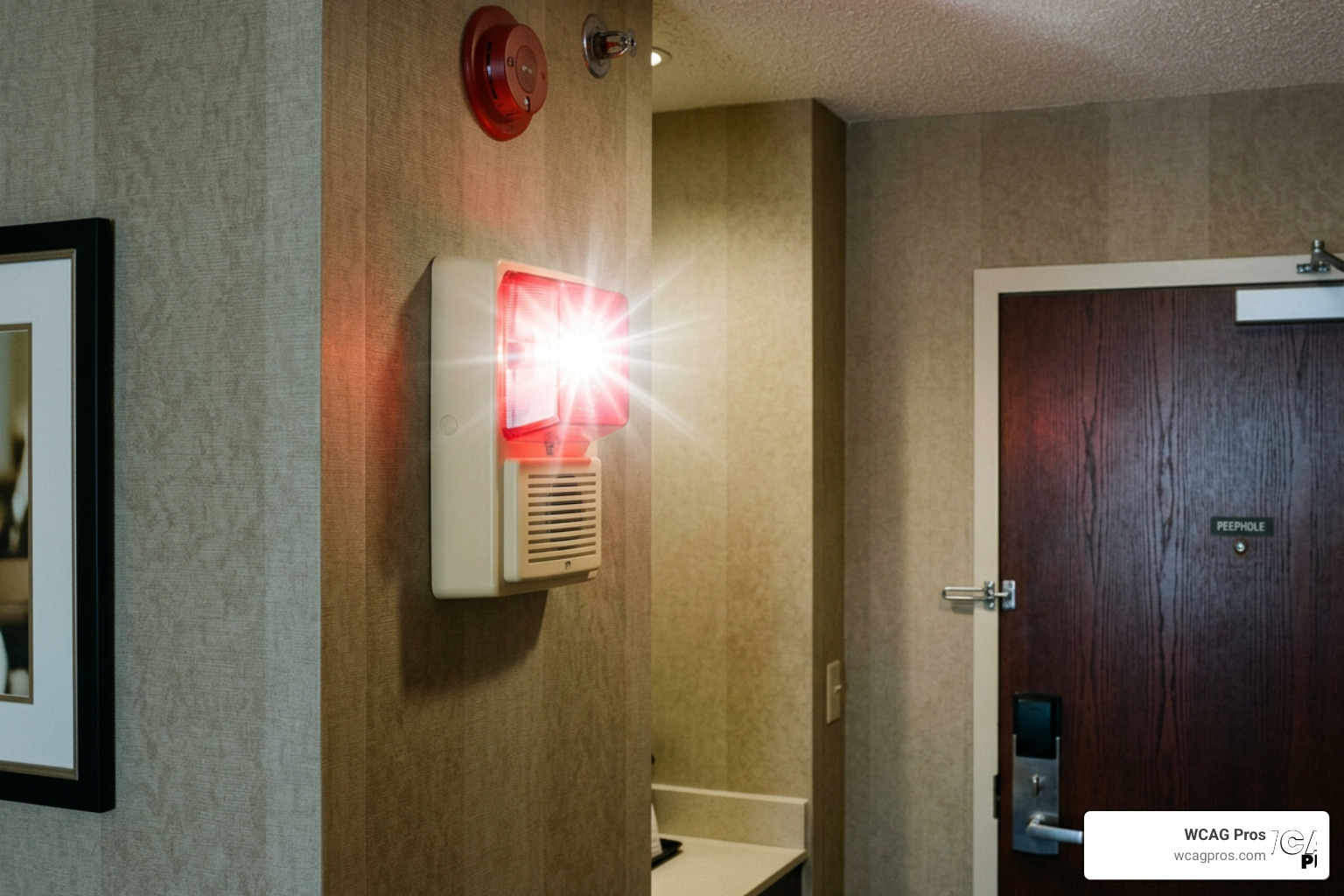
For guests with hearing impairments, hotels must provide communication features. These features include visual notification devices that alert guests to an incoming telephone call, a knock on the door, or a ringing doorbell.
Visual alarms, such as flashing strobe lights, must be installed and connected directly to the hotel’s emergency fire alarm system. Telephones must feature volume controls and TTY outlets to allow for text-based communication.
For guests with visual impairments, tactile signage with raised characters and Braille must be installed next to all permanent room doors and in common areas.
You can find excellent operational tips for serving these guests in the ADA Guide for Places of Lodging: Serving Guests Who Are Blind or Who Have Low Vision | ADA.gov.
Dual-Purpose Rooms and Inventory Rules
It is a common misconception that a single accessible room can cover all accessibility needs. In reality, the ADA separates mobility features and communication features into two distinct categories.
You must provide a certain number of rooms with mobility features, and a separate number of rooms with communication features. While you are permitted to combine these features into a single dual-purpose room, there is a strict limit. No more than 10% of your required mobility rooms can be used to satisfy your communication room requirements.
To understand how to distribute these rooms correctly across your property, refer to the 11B-224.5 Dispersion guidelines.
Digital Accessibility and Online Reservation Rules
Now, let us talk about digital accessibility. As the co-founder of WCAG Pros, this is where my team and I spend most of our time. You can have the most beautiful, perfectly designed physical ADA compliant hotel room in Norco, California, but if a guest cannot find it and book it on your website, you are in violation of the ADA.
Title III of the ADA applies to your digital services just as much as your physical property. Your website and online reservation system must be accessible to people with disabilities. This means conforming to the Web Content Accessibility Guidelines, specifically WCAG 2.2.
An accessible website allows guests who use screen readers, keyboard navigation, or voice recognition software to browse your rooms, view amenities, and complete a booking without barriers.
To learn more about your digital obligations, you can read our article on Website ADA Compliance: Hotels and explore examples of excellent design in 5 of the Best WCAG Compliant Hotel Websites.
DOJ Regulations for Hotel Websites
The Department of Justice implemented a specific regulation, 28 C.F.R. Section 36.302(e), which directly impacts hotel booking systems. Under this rule, hotels must:
- Describe their accessible rooms and public areas in enough detail to allow individuals with disabilities to independently assess whether the room meets their needs.
- Allow guests with disabilities to reserve accessible rooms during the same hours and in the same manner as other guests.
- Hold accessible rooms in the reservation system and prevent them from being booked by non-disabled guests until all other rooms of that type are sold out.
If your website says “To book an accessible room, please call our front desk,” but allows standard rooms to be booked online, you are inviting a lawsuit.
Plaintiff law firms file thousands of digital accessibility lawsuits every year, targeting hotels of all sizes. At WCAG Pros, we help hotels mitigate this risk by performing comprehensive page-by-page audits of all 54 WCAG points, providing code fixes, and offering free re-audits to secure your compliance badge.
Frequently Asked Questions about ADA Hotel Rooms
Are older hotels grandfathered and exempt from ADA requirements?
No. There is no grandfather clause under the ADA. While older hotels built before 1993 are not expected to meet the exact architectural standards of new construction immediately, they have an ongoing obligation to remove physical barriers whenever it is readily achievable. If a renovation is planned, the altered areas must comply fully with the 2010 ADA Standards.
Can hotels charge extra fees for an ADA compliant room?
Absolutely not. Charging a higher rate or adding an extra fee for an accessible room is a direct violation of the ADA. Accessible rooms must be priced at the same rate as non-accessible rooms of the same type.
Are service animals allowed in all areas of the hotel?
Yes. Under the ADA, hotels must allow service dogs in all public areas where guests are normally permitted to go. This includes the lobby, restaurants, pool areas, and fitness centers. Hotels cannot charge pet fees or security deposits for service animals, though they may charge for any physical damage the animal causes.
Conclusion
Providing an inclusive hospitality experience is not just about avoiding lawsuits, it is about welcoming every guest with dignity and respect. From wide doorways and roll-in showers to accessible websites and intuitive booking systems, every detail matters.
By training your staff, auditing your physical property, and ensuring your digital presence meets the latest WCAG 2.2 standards, you can protect your business and tap into a massive, loyal market of travelers with disabilities.
If you want to ensure your hotel website is fully compliant and secure against digital accessibility lawsuits, we can help. Get a professional WCAG audit today from our team of experts at WCAG Pros.
Read more website accessibility articles
Get Help With Your Website
We'll follow up with info about:
- The process
- Cost
- Timeline
We promise to respect your privacy, and never abuse the information you provide. We will not sell or rent your information to any third party.
By submitting this form, you consent to receive SMS messages and/or emails from SEM Dynamics LLC, dba WCAG Pros. To unsubscribe, follow the instructions provided in our communications. Msg & data rates may apply for SMS. Your information is secure and will not be sold to third parties.