
X of the Best WCAG Compliant Hotel Websites
X of the Best WCAG Compliant Hotel Websites
What Is a WCAG Compliant Hotel Website?
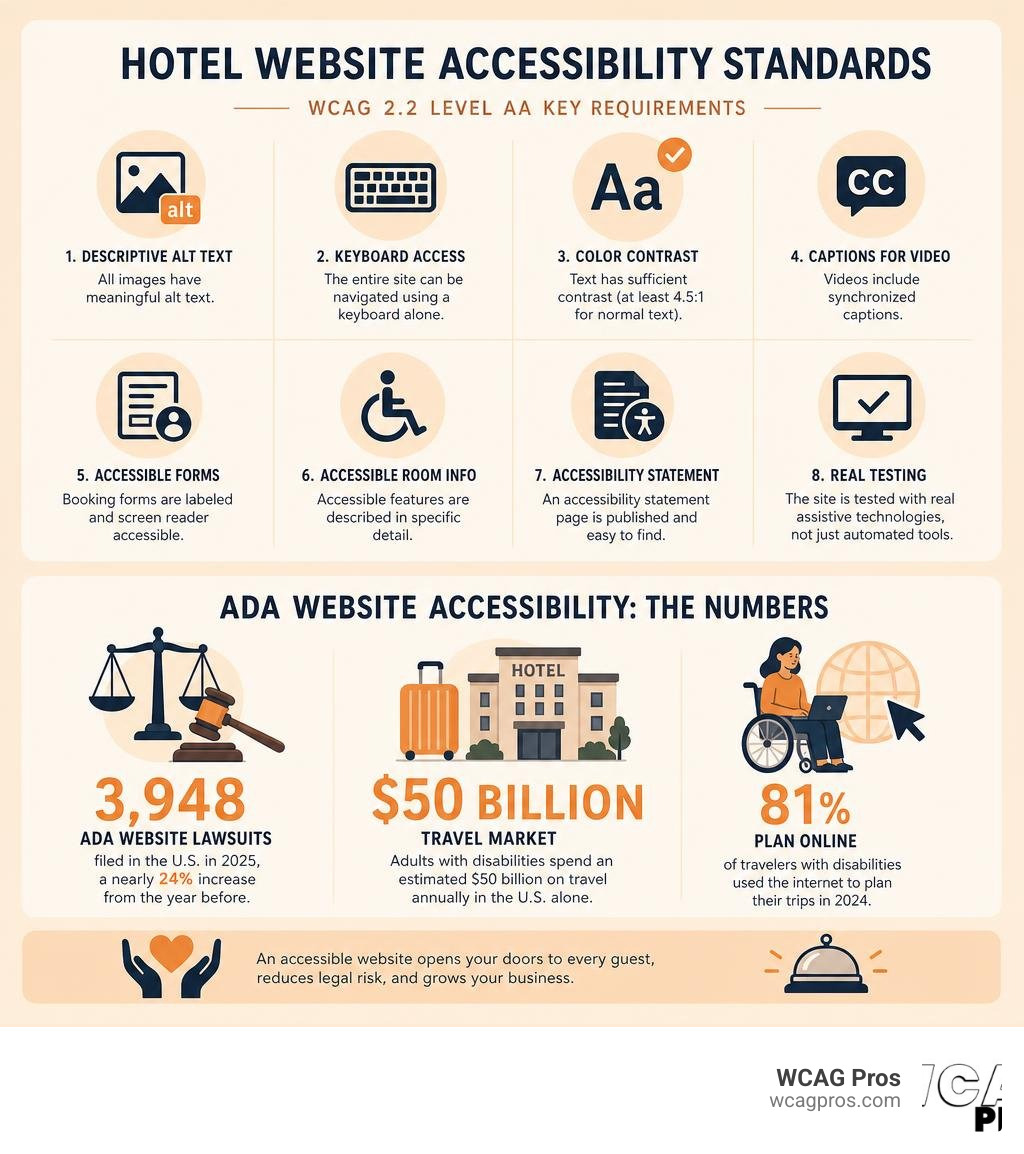
A WCAG compliant hotel website meets the Web Content Accessibility Guidelines (WCAG) 2.2 Level AA standards set by the World Wide Web Consortium. This means every guest, including those with visual, motor, hearing, or cognitive disabilities, can fully use your site to browse rooms, check amenities, and complete a booking.
Quick answer: What makes a hotel website WCAG compliant?
- All images have descriptive alt text
- The site can be navigated using a keyboard alone
- Text has sufficient color contrast (at least 4.5:1 for normal text)
- Videos include synchronized captions
- Online booking forms are labeled and screen reader accessible
- Accessible room features are described in specific detail (door widths, grab bar locations, bed heights)
- An accessibility statement page is published and easy to find
- The site is tested with real assistive technologies, not just automated tools
The stakes for hotels are real and growing. In 2025, 3,948 ADA website lawsuits were filed across the U.S., a nearly 24% jump from the year before. Hospitality is consistently one of the most targeted industries. And the travelers you risk turning away are not a small group. Adults with disabilities spend an estimated $50 billion on travel annually in the U.S. alone, and 81% of travelers with disabilities used the internet to plan their trips in 2024.
For most guests, your website is the first door they walk through. If that door is locked to someone using a screen reader or navigating by keyboard, they will book somewhere else, and you may hear from their attorney.
I’m Matthew Post, co founder of WCAG Pros and a web developer with over 20 years of experience auditing and remediating WCAG compliant hotel websites for hospitality businesses facing real legal and revenue risk. Below, I’ll walk you through the real world examples, common barriers, and practical fixes that matter most for your property.
Quick look at WCAG compliant hotel website:
Understanding the Legal Landscape of a WCAG Compliant Hotel Website
To understand why a WCAG compliant hotel website is so critical in 2026, we have to look at how the law has evolved. The Americans with Disabilities Act (ADA) was passed in 1990, long before the internet became a central part of daily life. Title III of the ADA requires places of public accommodation to provide equal access to their goods and services.
Even though the original text of the ADA does not explicitly mention websites, the U.S. Department of Justice (DOJ) has long maintained that Title III applies to web content. In fact, recent federal regulations have made it clear that if you offer online booking, room descriptions, or digital check in, those features must be fully accessible.
The rise in litigation shows that plaintiffs are not waiting for hotels to catch up. In 2015, there were 4,798 ADA Title III lawsuits filed. By 2020, that number grew to 10,982, with 2,523 of those cases focused specifically on website accessibility. Fast forward to 2025, and website specific lawsuits have climbed to 3,948.
For a deeper dive into how these regulations apply specifically to properties, you can read our guide on Website ADA Compliance Hotels.
Physical and Digital ADA Requirements
- Physical ADA Requirements: Wheelchair accessible ramps, automatic entry doors, roll in showers, grab bars in guest bathrooms, lowered check in desks, clear pathways, pool lifts, and designated parking spaces.
- Digital ADA Requirements: Full keyboard navigation with visible focus indicators, descriptive alternative text for all hotel images, accessible online booking forms with screen reader support, and detailed online descriptions of accessible room amenities.
The DOJ expects hotels to provide enough specific detail about their physical accessibility features so that guests with disabilities can independently assess whether a room meets their personal needs. If your website simply says “ADA accessible room” without listing bed heights, door widths, or bathroom configurations, you are not meeting your legal obligations.
Key Requirements for a WCAG Compliant Hotel Website
The gold standard for web accessibility is the Web Content Accessibility Guidelines (WCAG) published by the World Wide Web Consortium. While some older agreements referenced WCAG 2.0, courts, regulators, and industry experts now look to WCAG 2.2 Level AA as the baseline standard.
WCAG 2.2 is structured around four main principles, often referred to as POUR:
- Perceivable: Information and user interface components must be presentable to users in ways they can perceive. This means providing text alternatives for non text content, synchronized captions for promotional videos, and high color contrast.
- Operable: User interface components and navigation must be operable. Your entire guest journey, from choosing dates to entering a credit card, must be navigable using only a keyboard. There should be no keyboard traps where a user gets stuck in a calendar pop up.
- Understandable: Information and the operation of the user interface must be understandable. Text must be readable, pages must operate in predictable ways, and input forms must help users avoid and correct mistakes.
- Robust: Content must be robust enough that it can be interpreted reliably by a wide variety of user agents, including assistive technologies like screen readers.
To verify if your current site meets these criteria, check out our comprehensive ADA Website Compliance 2025 Accessibility Checklist.
How to Handle an ADA Website Lawsuit or Complaint
Receiving a demand letter or a formal ADA lawsuit can be incredibly stressful for a hotel owner. These lawsuits are often filed by serial plaintiffs who use automated scanning software to find common web barriers, such as missing alt text or unlabeled booking buttons.
If your property receives an accessibility complaint, do not panic, but do not ignore it either. Settlements for website accessibility lawsuits typically range from $5,000 to $75,000. This is in addition to your own legal fees, the plaintiff’s attorney fees, and the cost of actually fixing the website.
Here are the immediate steps you should take:
- Consult a legal professional: Work with an attorney who specializes in digital accessibility and ADA Title III defense.
- Preserve evidence: Do not delete your website or make hasty, uncoordinated changes that might complicate your defense.
- Get a professional audit: Partner with an accessibility consultant to identify the exact violations on your site.
- Create a remediation plan: Establish a clear timeline to bring your website into WCAG 2.2 Level AA compliance.
- Publish an accessibility statement: Show your commitment to inclusion by posting an accessibility page with a clear feedback channel.
To help protect your property from these costly legal issues, you can review our Don’t Trip on Regulations with Our 2018 ADA Hotel Checklist. Additionally, organizations like the California Hotel and Lodging Association offer resources such as the ADA Website Compliance Program to help members navigate these complex requirements.
Real World Examples of WCAG Compliant Hotel Websites
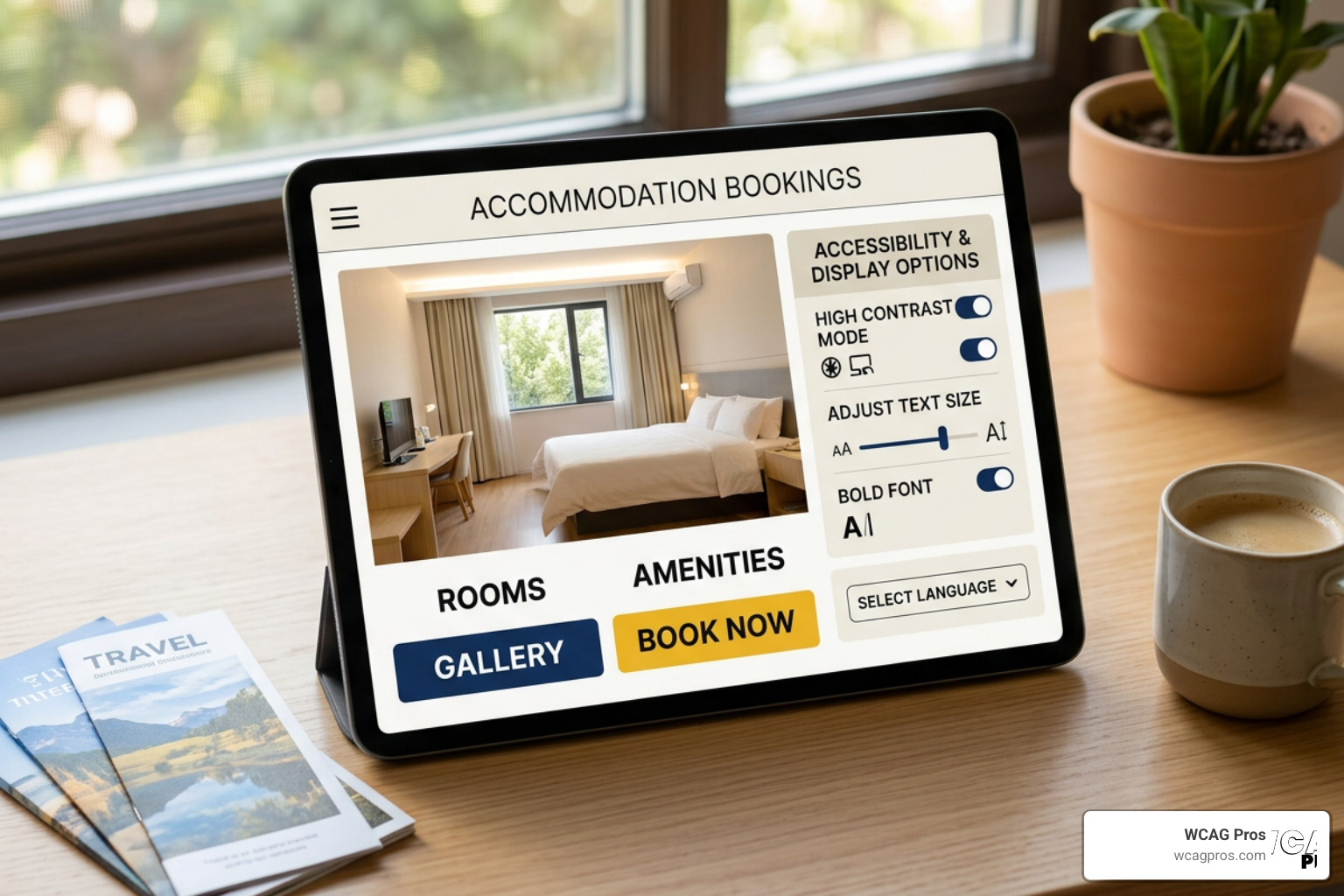
Looking at successful implementations is one of the best ways to understand what a truly accessible guest experience looks like online. A WCAG compliant hotel website does not have to look boring or clinical. It can be visually stunning, fast, and highly brand aligned while remaining fully usable for guests with disabilities.
Hotel ICON Houston
Hotel ICON in Houston, Texas, provides an excellent example of how a luxury property can approach digital accessibility. Their website includes a dedicated accessibility statement that details their commitment to WCAG 2.2 Level AA conformance.
They use formal quality assurance methods, including recurring automated testing via API, to ensure that new content does not introduce new barriers. They also provide a clear physical address and phone number on their accessibility page, inviting guests to share feedback if they encounter any difficulties.
You can view their approach directly on the Houston Accessible Hotel | Hotel ICON, Houston, Texas page.
Hotel Ivy Minneapolis
Hotel Ivy in Minneapolis, Minnesota, takes a highly transparent approach to digital accessibility. Their ADA website conformance page explicitly lists the technical specifications they rely on, such as HTML, CSS, and JavaScript.
They also outline the specific web browsers and assistive technologies that their site is compatible with, while openly noting any unsupported configurations. This level of detail helps screen reader users navigate the site with confidence, knowing exactly what to expect.
To see how they document their conformance, visit the ADA Website Conformance | Hotel Ivy Minneapolis statement.
Vagabond Inn Hotels
For larger hospitality brands, maintaining consistency across multiple locations is key. Vagabond Inn Hotels implements a brand wide digital accessibility program that ensures their online reservation system and property descriptions are accessible to all guests.
By standardizing their templates and booking flows, they make it easy for travelers to find and book accessible guest rooms across all of their properties.
You can explore their brand wide policy on the ADA Website Conformance & Compliance: Vagabond Inn Hotels page.
Common Accessibility Barriers on Hotel Websites and How to Fix Them
Many hotel websites suffer from the same recurring accessibility issues. These barriers not only frustrate potential guests but also make your business a prime target for litigation.
Let us look at the most common problems and how to fix them:
- Missing alternative text: Screen readers cannot interpret images of your beautiful pool or cozy lobby unless you provide descriptive alt text. Ensure every image has a concise description, such as
alt="Deluxe king guest room with roll in shower and grab bars". If an image is purely decorative, use an empty alt attribute (alt="") so the screen reader skips it. - Inaccessible color contrast: Placing white text over a light photo of your beach resort makes it unreadable for users with low vision. Ensure all text meets the minimum WCAG contrast ratio of 4.5:1 against its background.
- Inaccessible PDFs: Many hotels upload their room service menus, spa brochures, or event space layouts as scanned PDFs. These are completely unreadable to screen readers. Always provide an accessible HTML alternative for any document on your site.
- No video captions: If you have an autoplaying promotional video of your property, it must have synchronized captions for deaf or hard of hearing guests, and it must include an easy way to pause the motion.
Designing an Accessible Booking Engine and Room Descriptions
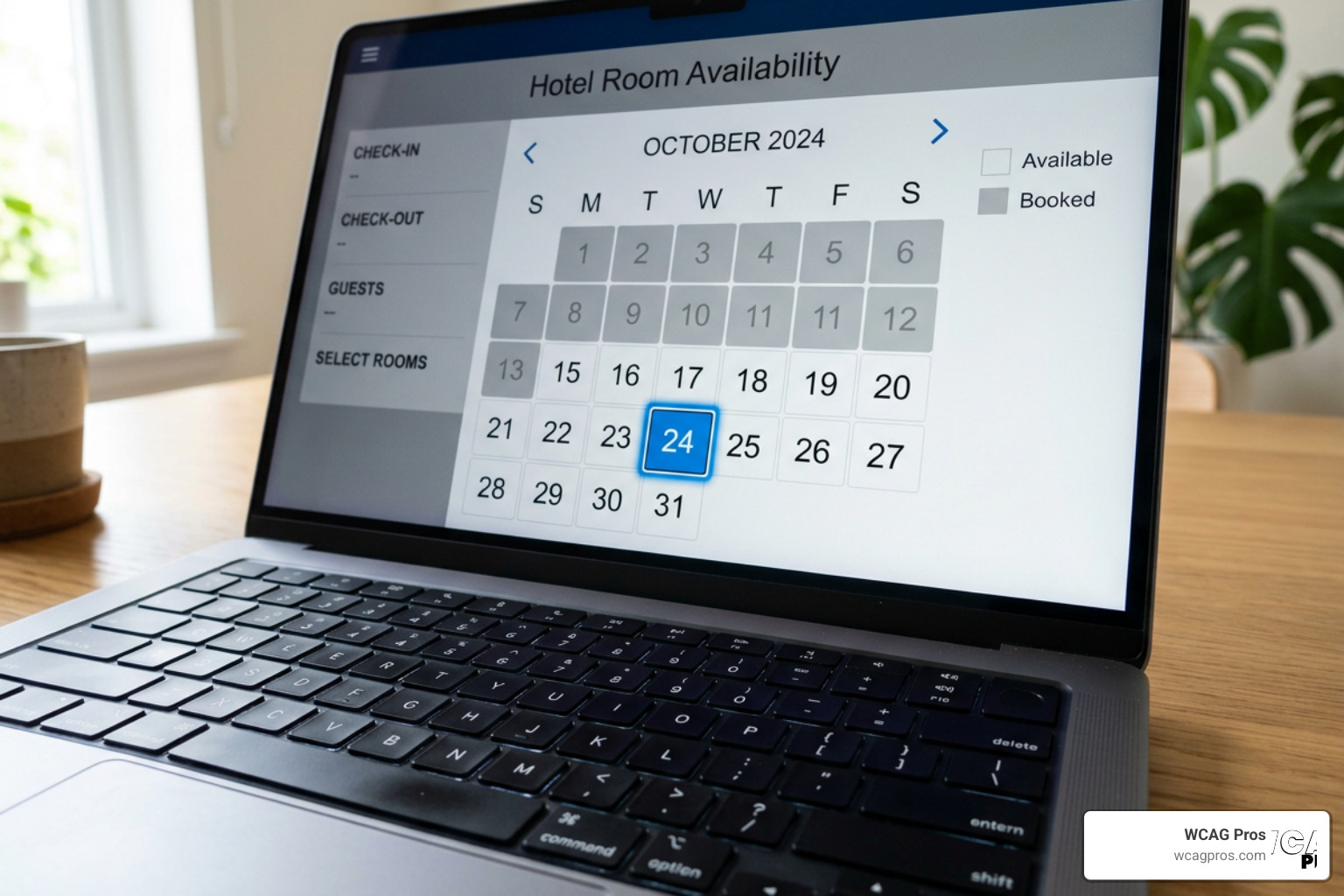
The booking engine is the most critical part of your hotel website, yet it is often the most inaccessible. Many third party booking platforms rely on complex date pickers and drop down menus that are impossible to navigate without a mouse.
On mobile devices, scroll wheels for date selection can be incredibly difficult for screen readers to interpret, often jumping by random increments instead of single days. You must test your booking flow using only a keyboard and a mobile screen reader to ensure guests can select dates, choose a room, and enter payment information smoothly.
Furthermore, your room descriptions must be highly detailed. Under the ADA, you must describe the accessible features of your rooms in enough detail so that guests can determine if the room will work for them.
For a complete breakdown of what you need to include, read our guides on Decoding the ADA Room So You Can Rest Easy and ADA Compliant Hotel Rooms Everything You Need to Know.
Technical Implementation of WCAG Compliant Hotel Website Elements
When building or updating your website, your development team must pay close attention to the underlying code. Proper semantic HTML is the foundation of digital accessibility.
Use correct heading structures (H1, H2, H3) so screen reader users can quickly scan the page. Ensure that interactive elements like buttons and form inputs have clear ARIA labels. For example, a button that simply shows a magnifying glass icon should have an ARIA label of “Search rooms”.
Focus management is also vital. When a user opens a promotional pop up or a booking calendar, the keyboard focus must immediately move inside that element and remain trapped there until the user closes it. Otherwise, a keyboard user will continue tabbing through the background page without being able to interact with the pop up.
For an industry leading example of how to build accessible media components, you can study the technical documentation on Accessibility | Media | Welcome by Accor.
To ensure your team does not miss any critical technical details, you can download The Ultimate WCAG Checklist PDF Excel and Print Ready Versions.
The Business Benefits of Digital Accessibility in Hospitality
While avoiding lawsuits is a powerful motivator, the business benefits of having a WCAG compliant hotel website go far beyond legal defense. Accessibility is a major revenue driver and a significant competitive advantage.
Global travelers with disabilities represent a massive, loyal, and high spending market. When you include the family and friends who travel with them, the economic impact is immense:
- $19 billion spent annually on travel by North Americans with disabilities.
- $50 billion spent annually on travel by U.S. adults with disabilities, which grows to over $100 billion when including companions.
- 92% of consumers believe it is important for travel providers to meet the accessibility needs of all travelers.
- 7 in 10 travelers would choose a more inclusive travel option even if it cost more than a standard competitor.
When you make your website accessible, you also improve your search engine optimization (SEO). Search engine crawlers navigate websites in a very similar way to screen readers. Clean heading structures, descriptive alt text, and fast loading, keyboard friendly pages help search engines index your site more effectively, driving more organic traffic to your direct booking engine.
To learn more about how digital inclusion can help grow your business, read our articles on The Business Benefits of an Accessible Website, How Having an ADA Compliant Website Can Increase Your Revenue, and The Link Between Accessibility and Brand Trust.
Frequently Asked Questions About Hotel Website Accessibility
How often should hotels audit their websites for WCAG 2.2 compliance?
We recommend that hotels perform a comprehensive accessibility audit at least once a year, combined with quarterly automated monitoring. Hotel websites are dynamic, with seasonal packages, restaurant menus, and blog posts being added constantly. Every time you update a room description or upload a new photo gallery, you risk introducing new accessibility barriers.
To understand the full scope of these standards, see our guide Everything You Need to Know About WCAG 2.2 AA Compliance.
Can automated accessibility widgets or overlays guarantee complete ADA compliance?
No. While automated widgets and overlays are marketed as a quick, one click solution for ADA compliance, they cannot guarantee complete compliance or protect your hotel from lawsuits. In fact, many recent ADA lawsuits have specifically targeted websites that use overlays.
These widgets often interfere with the actual screen readers that blind users rely on, creating a frustrating experience. True compliance requires fixing the underlying source code of your website through manual remediation.
What specific details must be included in accessible room descriptions?
Your accessible room descriptions should be as detailed as possible. You should include:
- The width of the entry door and bathroom door entryways.
- The height of the bed from the floor.
- The type of shower (roll in shower or transfer tub) and the location of grab bars.
- The availability of visual and audible alarms for guests with hearing or visual impairments.
- Clear descriptions of any accessible pathways from the lobby to the guest room.
Conclusion
Building and maintaining a WCAG compliant hotel website is not just about checking a legal box or avoiding a predatory lawsuit. It is about opening your virtual doors to every traveler, establishing brand trust, and capturing a massive, loyal segment of the global travel market.
At WCAG Pros, we specialize in helping hospitality brands navigate the complexities of digital accessibility. We provide comprehensive, page by page manual audits covering all 54 WCAG A/AAA success points. We do not just hand you a list of errors, we provide actual code fixes and offer free re audits to help you earn your compliance badges with confidence.
Ready to secure your website and welcome more guests? Schedule a professional WCAG audit with our team in Norco, California, today.
Read more website accessibility articles
Get Help With Your Website
We'll follow up with info about:
- The process
- Cost
- Timeline
We promise to respect your privacy, and never abuse the information you provide. We will not sell or rent your information to any third party.
By submitting this form, you consent to receive SMS messages and/or emails from SEM Dynamics LLC, dba WCAG Pros. To unsubscribe, follow the instructions provided in our communications. Msg & data rates may apply for SMS. Your information is secure and will not be sold to third parties.