
Top Professional Certifications for ADA and WCAG Conformance
Top Professional Certifications for ADA and WCAG Conformance
Choose the Right Web Accessibility Certification Program
A web accessibility certification program can help you evaluate a professional’s knowledge of ADA requirements, WCAG 2.2, testing methods, and remediation work. For business owners, the most useful credentials are those tied to real skills: finding barriers, testing with keyboards and screen readers, fixing issues, and documenting conformance.
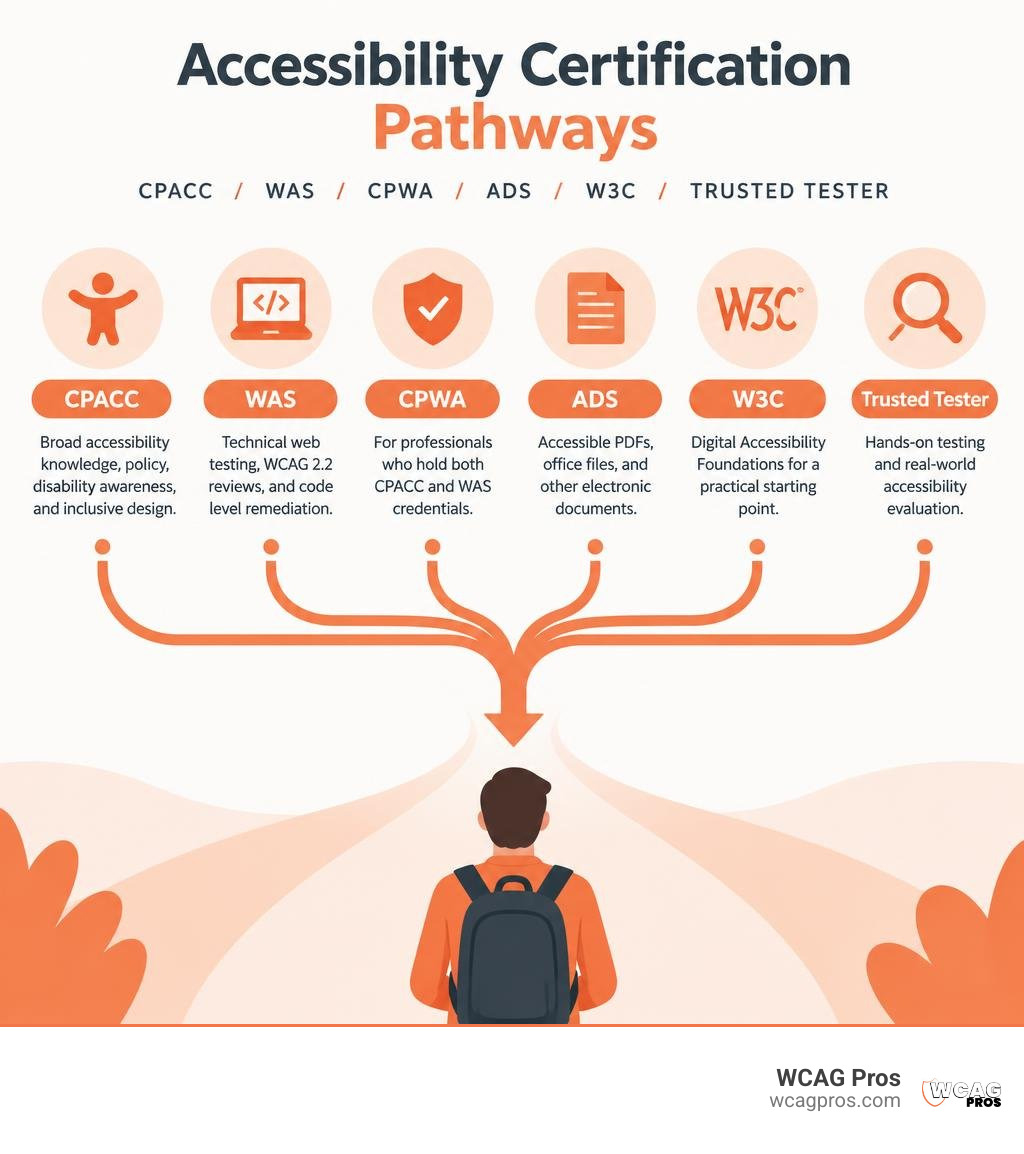
Start by matching the credential to the work you need:
- CPACC for broad accessibility knowledge, policy, disability awareness, and inclusive design.
- WAS for technical web testing, WCAG 2.2 reviews, and code level remediation.
- CPWA for professionals who hold both CPACC and WAS credentials.
- ADS for accessible PDFs, office files, and other electronic documents.
- W3C Digital Accessibility Foundations for a practical starting point before an advanced credential.
A professional credential shows an individual’s capability. It does not define what is an ADA compliant website. A defensible website accessibility effort still requires following an ADA audit checklist, partnering with an experienced website accessibility remediation company, manual testing, and ongoing checks after updates.
I am Matthew Post, co-founder of WCAG Pros and a web development professional with more than 20 years of experience auditing and resolving complex WCAG issues. My work with web accessibility certification program standards and website remediation helps organizations connect qualified expertise with practical ADA risk reduction.
Why Invest in a Web Accessibility Certification Program?
Building an inclusive online experience is no longer optional. According to UNESCO, people with disabilities make up roughly 15% of the global population. Furthermore, the United Nations Convention on the Rights of Persons with Disabilities has been ratified by 180 countries worldwide. These numbers highlight the enormous need for universal design principles across modern digital ecosystems.
Organizations must balance moral imperatives with legal defensibility. Digital accessibility lawsuits continue to rise, and regulatory scrutiny under Title III of the ADA remains strong. When internal teams or third-party partners understand the core guidelines outlined in The Definitive Guide to WCAG Guidelines, digital products become more robust and accessible to everyone.
Investing in a formal credential program ensures that specialists follow recognized frameworks. Independent bodies, such as the International Association of Accessibility Professionals (IAAP), govern these standards rigorously. Reviewing documentation like the IAAP Candidate and Certificant Handbook reveals that these credentials demand structured study, strict ethical commitments, and verified experience.
Top Professional Certifications for Digital Accessibility
Choosing the right credential requires understanding the specific skills each program evaluates. The leading credentials follow global credentialing standards such as ISO/IEC 17024 to ensure independent and objective testing of professional competencies.
| Certification | Focus Area | Experience Required | Target Audience |
|---|---|---|---|
| CPACC | Broad foundational concepts, disability models, universal design, and law | 1+ year | Managers, designers, educators, advocates |
| WAS | Technical WCAG 2.2 testing, ARIA markup, and code remediation | 3 to 5 years | Web developers, QA engineers, technical auditors |
| CPWA | Comprehensive credential combining CPACC and WAS | Meets both CPACC and WAS requirements | Senior consultants, accessibility leads, architects |
| ADS | Non-web digital content, accessible PDFs, and office documents | 1 to 2 years | Document remediation specialists, content creators |
| W3C Foundations | Core introductory principles, inclusive design, and basic checks | None (Introductory) | Anyone beginning their accessibility journey |
| DHS Trusted Tester | Section 508 federal testing standards and repeatable manual processes | None specified | Government contractors, federal test analysts |
IAAP Certified Professional in Accessibility Core Competencies (CPACC)
The Certified Professional in Accessibility Core Competencies (CPACC) credential serves as the cornerstone for digital accessibility knowledge. It focuses on three main areas: disabilities, challenges, and assistive technologies, accessibility and universal design, and accessibility-related standards, laws, and management strategies.
The CPACC does not test technical code writing. Instead, it measures how well a professional understands the human element of disability, systemic organizational changes, and international legal mandates. Candidates typically need at least one year of accessibility experience before taking the exam. Once earned, certificants maintain their credential over a three-year cycle by earning Continuing Accessibility Education Credits (CAECs).
IAAP Web Accessibility Specialist (WAS): Technical Web Accessibility Certification Program

For technical professionals, the Web Accessibility Specialist (WAS) credential evaluates deep, code-level competence. This exam focuses directly on WCAG 2.2 success criteria, semantic HTML, WAI-ARIA implementation, dynamic content management, and manual keyboard navigation.
Candidates need three to five years of first-person, hands-on technical web accessibility experience. A developer holding the WAS designation knows how to test complex components against assistive technologies like JAWS, NVDA, and VoiceOver. For organizations that want to learn how code-level reviews translate into practical website compliance, reading A Practical Guide to Website Accessibility Certification explains the entire auditing and verification pipeline.
IAAP Certified Professional in Web Accessibility (CPWA)
The Certified Professional in Web Accessibility (CPWA) is not a standalone exam. It is an advanced designation awarded automatically to professionals who successfully pass both the CPACC and the WAS exams.
Earning the CPWA demonstrates full-stack accessibility expertise. A CPWA holder understands high-level legal risk and executive policy while also possessing the technical skills to fix broken JavaScript widgets or author automated test suites. This dual-credential designation is highly valued for enterprise leadership roles and specialized consulting positions.
IAAP Accessible Document Specialist (ADS)
Web pages are not the only digital assets requiring accessibility. Organizations generate millions of electronic documents, including PDFs, word-processing files, spreadsheets, and presentation decks. The Accessible Document Specialist (ADS) credential evaluates the creation, remediation, and auditing of these non-web electronic documents.
The ADS exam requires one to two years of hands-on experience working directly with document accessibility tools and techniques. Professionals with this credential ensure that complex tables, reading orders, alternative text, and structural tags inside PDF documents function seamlessly with screen readers.
W3C Digital Accessibility Foundations: Free Web Accessibility Certification Program Pathway
The World Wide Web Consortium (W3C) Web Accessibility Initiative (WAI), in partnership with UNESCO, offers the Digital Accessibility Foundations: Free Online Course | Web Accessibility Initiative (WAI) | W3C . This course takes about 16 to 20 hours to complete and provides a thorough introduction to digital inclusion.
Learners explore real-world user stories, understand how assistive technology works, and review basic WCAG 2.2 principles. Post-course surveys demonstrate remarkable results: 96% of respondents reported increased knowledge, 96% stated they were likely to apply their skills in daily work, and 90% expressed satisfaction with their learning outcomes. Students can audit the course for free or pay a modest fee for a verified edX certificate.
DHS Trusted Tester Certification
The Department of Homeland Security (DHS) Trusted Tester program provides a rigorous, process-driven testing methodology specifically designed for federal compliance. It focuses heavily on Revised Section 508 standards and manual testing workflows.
The program trains testers to follow a standardized, repeatable test process to identify accessibility barriers consistently. Federal agencies and government contractors frequently require this certification to ensure electronic content and web portals meet strict procurement guidelines before public deployment.
How to Prepare and Pass Your Accessibility Exams

Preparing for professional accessibility credentials requires structured study and hands-on practice. Theoretical reading alone is rarely enough to pass advanced technical exams like the WAS or DHS Trusted Tester.
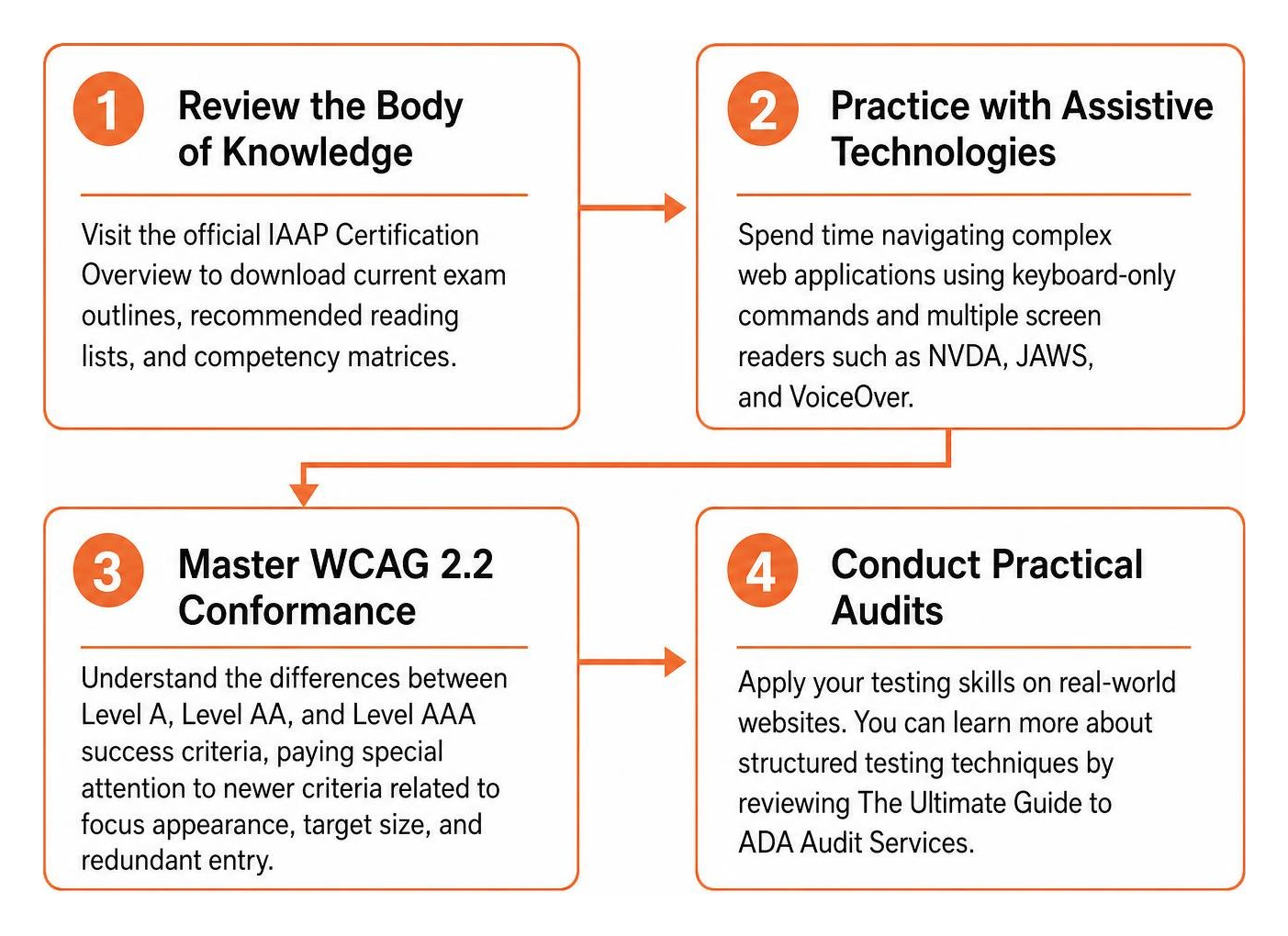
- Review the Body of Knowledge: Visit the official IAAP Certification Overview to download current exam outlines, recommended reading lists, and competency matrices.
- Practice with Assistive Technologies: Spend time navigating complex web applications using keyboard-only commands and multiple screen readers such as NVDA, JAWS, and VoiceOver.
- Master WCAG 2.2 Conformance: Understand the differences between Level A, Level AA, and Level AAA success criteria, paying special attention to newer criteria related to focus appearance, target size, and redundant entry.
- Conduct Practical Audits: Apply your testing skills on real-world websites. You can learn more about structured testing techniques by reviewing The Ultimate Guide to ADA Audit Services.
Frequently Asked Questions About Accessibility Credentials
How long are professional accessibility certifications valid?
IAAP certifications remain valid for three years. To maintain active certified status without retaking the examination, certificants must earn a specified number of Continuing Accessibility Education Credits (CAECs) throughout the three-year cycle and pay the required renewal fees. This continuous professional development ensures that specialists remain updated on evolving web standards and emerging assistive technologies.
Can you get certified in web accessibility for free?
You can access world-class foundational training at no cost. The W3C Digital Accessibility Foundations course is completely free to audit, allowing learners to master core concepts without paying tuition. Additionally, federal employees and contractors can often access the DHS Trusted Tester training pathway through government portals without registration fees. However, formal proctored certifications through independent bodies like the IAAP require examination fees to cover administrative, testing, and credentialing costs.
What is the difference between website certification and individual professional credentials?
An individual professional credential proves that a specific person has the knowledge and skill to audit, remediate, or design accessible content. A website certification or conformance statement indicates that a particular website has undergone rigorous automated and manual testing against WCAG 2.2 AA standards on a specific date. Individual credentials validate human talent, while website audits evaluate digital assets.
Conclusion: Elevating Accessibility Standards Across the Web
Building accessible digital environments requires dedication, practical skill, and continuous learning. Professional credentials help organizations identify qualified talent capable of turning complex WCAG 2.2 standards into functional code. Whether you choose to pursue foundational training through the W3C or advanced technical credentials like the WAS, each step helps create an inclusive digital world.
At WCAG Pros, our team conducts comprehensive page-by-page audits covering all 54 WCAG A and AAA points, providing exact code fixes and free re-audits for verified compliance badges. When you are ready to evaluate your digital assets and eliminate legal risk, schedule a comprehensive WCAG 2.2 audit with our experienced team today.
Read more website accessibility articles
Get Help With Your Website
We'll follow up with info about:
- The process
- Cost
- Timeline
We promise to respect your privacy, and never abuse the information you provide. We will not sell or rent your information to any third party.
By submitting this form, you consent to receive SMS messages and/or emails from SEM Dynamics LLC, dba WCAG Pros. To unsubscribe, follow the instructions provided in our communications. Msg & data rates may apply for SMS. Your information is secure and will not be sold to third parties.