
The Plain English Guide to ADA WCAG Compliance and Risk Reduction
Understanding the Legal and Technical Basis of ADA WCAG Compliance
ADA and WCAG compliance requires organizations to make their digital content accessible to people with disabilities by meeting WCAG technical standards under ADA Title II and Title III. The Americans with Disabilities Act prohibits discrimination across public and private life. Because the original statute was drafted before the internet became fundamental to daily operations, federal agencies and courts rely on technical benchmarks to interpret equal access.
For organizations seeking a clear roadmap, our practical guide to website ADA compliance explores these operational foundations. According to official guidance on web accessibility and the ADA, digital spaces must offer effective communication so that individuals with vision, hearing, motor, or cognitive impairments enjoy equal access to services.
| ADA Title | Entity Type Covered | Enforcement Mechanism | Standard Applied |
|---|---|---|---|
| Title II | State and local public governments, school districts, public universities | Department of Justice administrative enforcement and federal lawsuits | WCAG 2.2 Level AA |
| Title III | Commercial private businesses, public accommodations, retailers | Private plaintiff lawsuits and Department of Justice civil actions | WCAG 2.2 Level AA |
ADA WCAG Compliance for Title II and Title III Entities
Title II applies to state and local government entities. This includes municipal service sites, county tax portals, public university learning systems, and local law enforcement channels. These entities must ensure their digital offerings provide equal access to civic participation.
Title III applies to places of public accommodation. This spans retail storefronts, restaurants, banks, healthcare portals, travel booking platforms, and digital subscription services. Many business leaders ask, does my website have to be ADA compliant? The answer is yes. Federal courts consistently hold that commercial websites are places of public accommodation under Title III.
Technical Standards: How WCAG Translates Law into Digital Rules
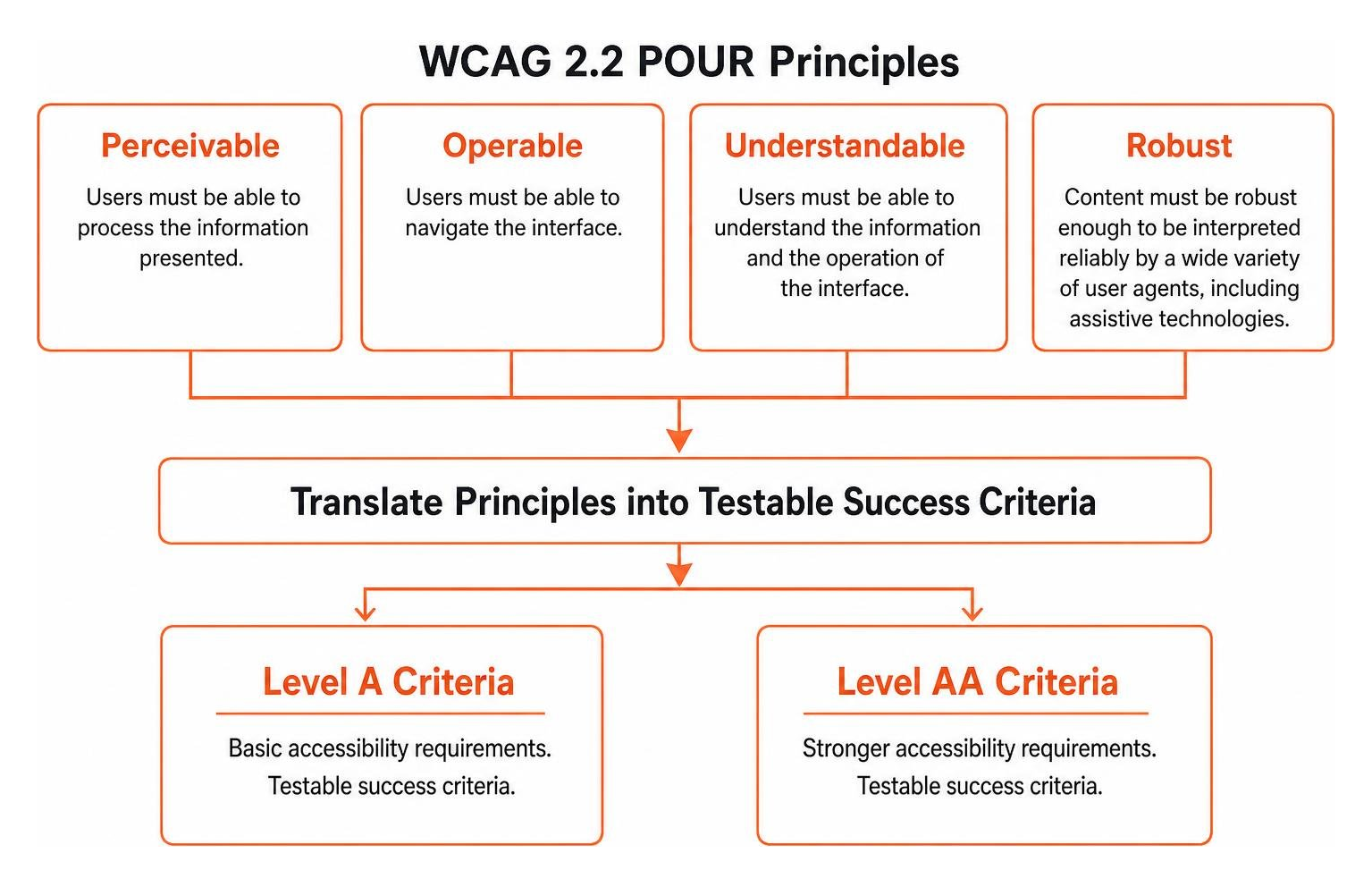
The World Wide Web Consortium develops the Web Content Accessibility Guidelines to create international standards for digital accessibility. The framework is built on four core principles known as POUR:
- Perceivable: Users must be able to process the information presented. Content cannot be invisible to all of a user’s senses.
- Operable: Users must be able to navigate the interface. The site cannot require an interaction that a user cannot perform.
- Understandable: Users must be able to understand the information and the operation of the interface.
- Robust: Content must be robust enough to be interpreted reliably by a wide variety of user agents, including assistive technologies.
To learn more about implementing these technical success criteria, review our comprehensive guide to WCAG 2.2 Level AA standards and consult the official Web Content Accessibility Guidelines (WCAG) 2.2 specification from the W3C.
ADA Title II Web Accessibility Rules and Deadlines
In 2024, the Department of Justice published a final rule establishing technical standards for public entities under Title II. This rule removes ambiguity by mandating WCAG 2.2 Level AA as the technical standard for state and local government web content and mobile applications.
The rule requires public sector bodies to conduct audits, update procurement policies, and remediate inaccessible code. Public sector teams can review the official document on state and local governments first steps toward complying with the Title II rule to align internal processes with federal standards.
Statutory Deadlines by Population Size
Compliance dates for Title II entities are organized into two distinct statutory tiers based on population data:
- April 26, 2027: State and local governments serving a total population of 50,000 or more must achieve full compliance across all web content and mobile applications.
- April 26, 2028: Public entities serving populations under 50,000, along with independent special district governments, must achieve full compliance.
Population figures must be verified using official decennial Census data or Small Area Income and Poverty Estimates for independent school districts. For an exhaustive breakdown of the technical items required before these dates arrive, see our complete guide to WCAG AA compliance requirements.
Key Technical Exceptions Under the Title II Rule
The Department of Justice rule identifies five narrow exceptions where digital materials do not have to strictly conform to WCAG 2.2 Level AA:
- Archived Web Content: Historical records that are maintained solely for research or reference, kept in a dedicated archive section, and have not been altered after the compliance date.
- Preexisting Conventional Electronic Documents: Legacy PDFs, spreadsheets, and word processing files posted before the entity’s compliance date, provided they are not currently used to access active services.
- Third-Party Content: Public commentary or independent user submissions posted to an entity’s forum where the third party is not acting under a contract or licensing arrangement with the entity.
- Password-Protected Individualized Documents: Secure, individualized files such as water utility statements or property tax bills tied to an individual person or account.
- Preexisting Social Media Posts: Social media messages and media published before the applicable statutory compliance date.
These exceptions do not remove an organization’s fundamental ADA duty to provide effective communication. When a constituent with a disability requests an accessible format of an excepted document, the public entity must supply it in a timely manner.
Risk Reduction and Technical Requirements for Organizations
Failing to address digital barriers creates immediate operational and legal exposure. Organizations can significantly reduce risk by implementing systematic code audits and remediation workflows.

Businesses aiming to protect themselves can learn how to stop accessibility lawsuits by meeting WCAG 2.2 Level AA requirements. Conforming to modern standards ensures that navigation menus, transaction flows, and authentication checks work seamlessly for users relying on screen readers or keyboard controls.
ADA WCAG Compliance Auditing and Remediation Steps
Achieving sustainable accessibility requires combining automated scanning with expert human testing. Automated tools catch programmatic issues quickly, but expert manual testers evaluate complex user flows, keyboard traps, and assistive technology behavior.
Our ADA website audit complete guide outlines the full verification process. At WCAG Pros, we provide comprehensive page-by-page audits of all 54 WCAG A and AAA points with code fixes and free re-audits for compliance badges from our Norco CA location.
Essential testing protocols include:
- Keyboard-Only Navigation: Verify that all links, form controls, and dialog boxes can be accessed and operated using only the Tab, Enter, Space, and arrow keys.
- Visible Focus Indicators: Ensure the keyboard focus outline is visible and distinct as users tab through interactive elements.
- Color Contrast Verification: Confirm that standard text has a contrast ratio of at least 4.5:1 against its background, and large text has at least 3:1.
- Screen Reader Validation: Test user flows with assistive screen readers such as NVDA, JAWS, or VoiceOver to verify accurate programmatic labels and alt text.
- Accessible Authentication: Ensure login and identity verification steps do not rely solely on cognitive function tests or unassisted memory recall.
Legal Consequences and Civil Penalties of Noncompliance
Over 3,000 federal web accessibility lawsuits are filed annually against commercial organizations, in addition to tens of thousands of private demand letters. For state and local governments, failing to comply with Title II mandates can trigger federal administrative complaints and the potential loss of federal grant funding.
To evaluate potential liability, read our analysis on the real costs of ignoring website accessibility. Civil penalties for initial ADA violations can reach tens of thousands of dollars, with subsequent violations carrying increased statutory maximums. When factored alongside private settlement costs, plaintiff attorney fees, and emergency remediation, proactive digital accessibility is far more cost-effective than litigation defense.
Frequently Asked Questions About ADA and WCAG Standards
What is the core difference between the ADA and WCAG?
The ADA is an enforceable United States civil rights law that prohibits discrimination against individuals with disabilities across public life. WCAG is an international set of technical guidelines developed by the World Wide Web Consortium that defines specific success criteria for digital accessibility. The ADA provides the legal requirement for equal access, while WCAG provides the technical blueprint used to achieve it.
What are the main exceptions to government web accessibility rules?
The Department of Justice Title II rule provides narrow exceptions for archived historical content, preexisting electronic documents not used for active services, third-party content not posted under contract, password-protected individualized documents, and preexisting social media posts. Entities must still provide accessible alternatives to these materials upon individual request.
What penalties apply to organizations that fail to comply with web accessibility mandates?
Organizations that ignore web accessibility mandates face federal civil lawsuits, private settlement demands, mandatory remediation injunctions, and liability for plaintiff attorney fees. In enforcement actions brought by the Department of Justice, public and private entities can face formal civil penalties, administrative orders, and the loss of federal funding.
Conclusion
Building an accessible digital presence is an ongoing operational commitment rather than a one-time development sprint. As digital interfaces evolve, regular monitoring and testing ensure that all users retain equal access to your digital services.
Organizations can protect themselves and serve all constituents by partnering with dedicated accessibility specialists. You can explore comprehensive WCAG guidelines and compliance solutions with our team at WCAG Pros. We deliver thorough audits, complete code fixes, and free re-audits to help you maintain digital compliance and reduce legal exposure.
Read more website accessibility articles
Get Help With Your Website
We'll follow up with info about:
- The process
- Cost
- Timeline
We promise to respect your privacy, and never abuse the information you provide. We will not sell or rent your information to any third party.
By submitting this form, you consent to receive SMS messages and/or emails from SEM Dynamics LLC, dba WCAG Pros. To unsubscribe, follow the instructions provided in our communications. Msg & data rates may apply for SMS. Your information is secure and will not be sold to third parties.