
Higher Education Platform ADA Remediation for Modern Classrooms
Higher Education Platform ADA Remediation for Modern Classrooms
How to Start Education Platform ADA Remediation
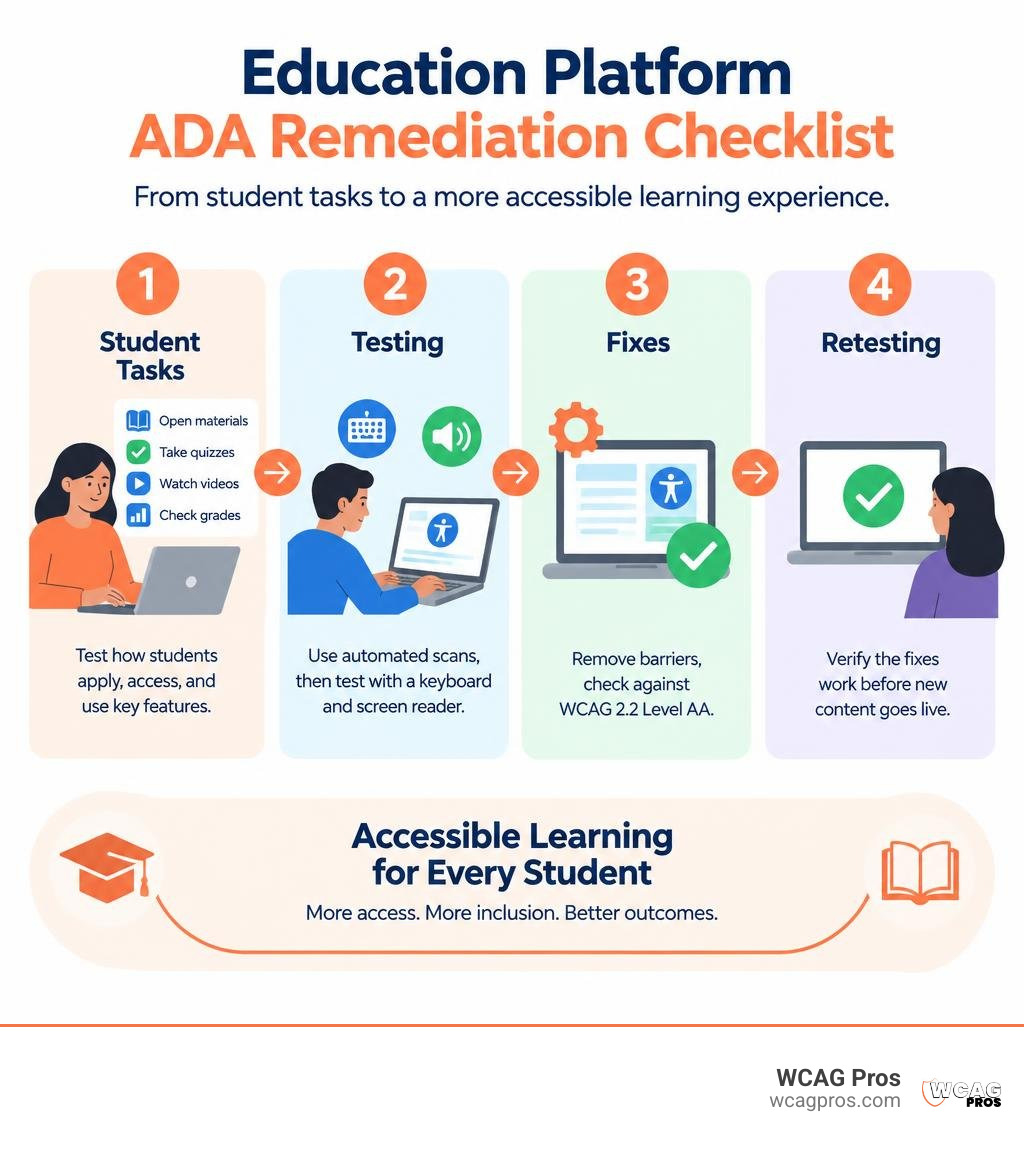
Education platform ADA remediation starts with the tasks students need to complete. Test how they apply, open course materials, take quizzes, watch videos, and check grades. Use automated scans to find common issues, then test those tasks with a keyboard and screen reader. Fix the barriers, check the changes against WCAG 2.2 Level AA, and retest before new content goes live.
For a public university, this work reaches beyond the main website. The learning platform, mobile apps, forms, and files students use all need attention. Start with barriers that block access now, while building a process that keeps new barriers out.
I’m Matthew Post, co-founder of WCAG Pros, and I’ve spent more than 20 years working in web development and digital technology, with a focus on accessibility audits and fixes. My approach to education platform ADA remediation is to find barriers in real student tasks and verify that the fixes work.
Quick look at education platform ADA remediation:
- Understanding what makes an ADA compliant website
- Partnering with a website accessibility remediation company
- Consulting with certified ADA compliance auditors
Legal Mandates and Compliance Deadlines Driving Higher Ed Remediation
The legal landscape for higher education digital accessibility has shifted dramatically. Under the Department of Justice Title II final rule, public educational institutions must ensure that their web content, mobile apps, and digital platforms conform strictly to WCAG 2.2 Level AA standards. Section 504 of the Rehabilitation Act enforces parallel requirements for any program receiving federal financial assistance.
For public colleges and universities, compliance deadlines depend directly on the population of the public entity:
| Entity Classification | Population Threshold | ADA Title II Compliance Deadline | Applicable Standard |
|---|---|---|---|
| Large Public Entities | 50,000 or more residents | April 26, 2027 | WCAG 2.2 Level AA |
| Small Public Entities | Fewer than 50,000 residents | April 26, 2028 | WCAG 2.2 Level AA |
| Special District Governments | Any population size | April 26, 2028 | WCAG 2.2 Level AA |
Private higher education institutions face equally urgent pressures under Title III of the ADA. With more than 16,000 Title III accessibility lawsuits filed between 2017 and 2023, courts nationwide continue to treat digital classrooms as places of public accommodation. You can learn more about federal expectations through our guide to Section 508 compliance for websites. Public regional institutions, such as those providing campus Accessibility programs, are actively mobilizing to meet these enforceable benchmarks before the statutory windows close.
Scope of Covered Digital Assets and Systems
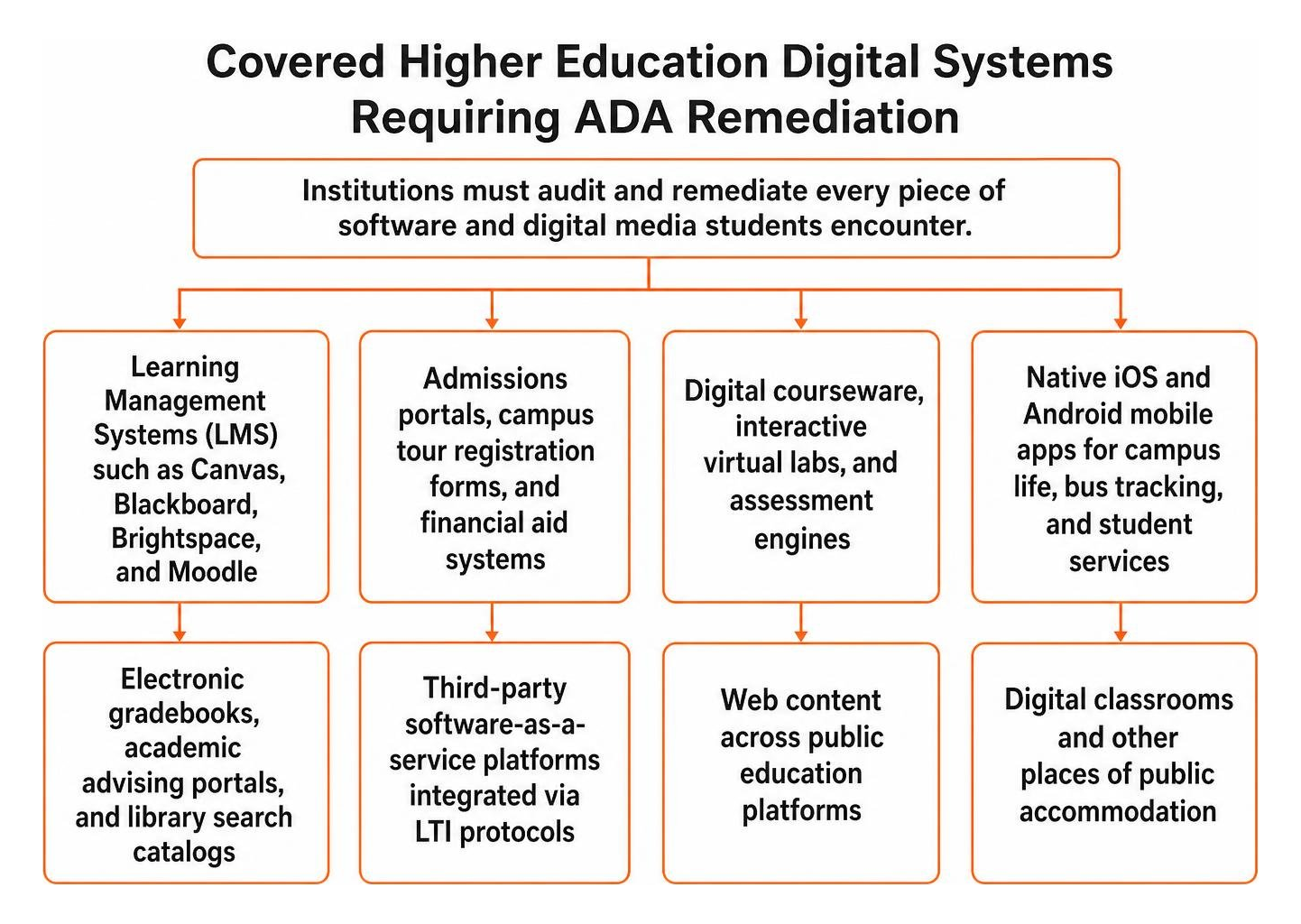
The Department of Justice rule leaves no digital corner untouched. Institutions must audit and remediate every piece of software and digital media students encounter. Covered digital assets include:
- Learning Management Systems (LMS) such as Canvas, Blackboard, Brightspace, and Moodle
- Admissions portals, campus tour registration forms, and financial aid systems
- Digital courseware, interactive virtual labs, and assessment engines
- Native iOS and Android mobile apps for campus life, bus tracking, and student services
- Electronic gradebooks, academic advising portals, and library search catalogs
- Third-party software-as-a-service platforms integrated via LTI protocols
Institutional Risks: OCR Complaints and Federal Funding
Ignoring digital barriers carries immediate institutional consequences. A quarter of every discrimination case investigated by the Department of Education Office for Civil Rights (OCR) involves web and digital accessibility. OCR investigations are exhaustive, frequently converting a single student complaint into a systemic review of an entire university digital ecosystem.
Beyond direct OCR scrutiny, non-compliance directly threatens federal research grants and capital funding. Many university consortia and state systems now implement strict procurement gatekeeping, blocking software renewals and contracts for EdTech platforms that lack verifiable compliance documentation.
Core Framework for Education Platform ADA Remediation
Achieving lasting digital accessibility across a sprawling university ecosystem requires a structured, multi-phase methodology. Remediation cannot be treated as a quick patch or a cosmetic overlay. It demands root-cause code modifications, rigorous testing, and structural document repair.

We guide institutions through comprehensive transformations outlined in our website accessibility remediation guide. The framework moves logically through baseline auditing, engineering remediation, verification, and procurement governance.
Audit Protocols for Education Platform ADA Remediation
A successful audit begins with an honest understanding of testing tools. Automated software scans catch approximately 30% of non-compliant issues. While automated scanners excel at identifying missing image alternative text or low-contrast color palettes, they cannot determine whether interactive gradebooks function via keyboard navigation, or if dynamic ARIA notifications announce correctly to a screen reader.
Our comprehensive evaluations combine automated scans with rigorous manual testing performed by experienced engineers. We examine every critical workflow, including registration, exam submission, and video lecture playback, across NVDA, JAWS, and VoiceOver. For a complete breakdown of this methodology, explore our comprehensive guide to WCAG website audits.
Code-Level Technical Remediation for Modern EdTech
True digital accessibility lives in the underlying codebase. Remediating complex EdTech platforms requires practical front-end engineering adjustments:
- Restructuring complex templates with semantic HTML5 elements to establish logical heading hierarchies
- Implementing ARIA live regions so dynamic grade updates and timed quiz warnings are announced to screen readers
- Replacing inaccessible date pickers with keyboard-operable controls and manual text input alternatives
- Correcting modal focus traps and managing keyboard focus states during slide transitions and popup dialogs
- Adjusting interactive visual elements to ensure a 4.5 to 1 contrast ratio for standard text and 3 to 1 for user interface controls
Following proven WCAG 2.2 website remediation steps allows developers to eliminate keyboard traps and make complex web components accessible for every enrolled learner.
Vendor Management and Procurement in Education Platform ADA Remediation
University systems rely heavily on third-party SaaS vendors. However, institutions cannot outsource their legal compliance liability. When purchasing external tools, university procurement teams must require an updated Voluntary Product Accessibility Template (VPAT) using the VPAT 2.5 INT edition to create an accurate Accessibility Conformance Report (ACR).
In conjunction with the Higher Education Community Vendor Assessment Tool (HECVAT), these reviews hold third-party EdTech vendors accountable. In one procurement case study, testing 45 core workflows across an EdTech platform identified 156 code-level issues. Once remediated, the platform secured approval across 12 public universities, closing a 1.8 million dollar contract. We provide detailed guidance on these procurement reviews through our professional ADA remediation services.
Tackling Course Content and Digital Document Backlogs at Scale
Digital documents present the single largest compliance vulnerability for modern colleges. Decades of decentralized course publishing have generated massive backlogs of inaccessible PDFs, scanned syllabi, untagged presentation decks, and complex STEM worksheets.

Remediating these files requires rebuilding the underlying document tag tree so assistive technology can parse headings, lists, tables, and mathematical formulas. Institutions looking to address historical archives can convert inaccessible PDFs into compliant digital documents through systematic structural conversion.
The Two-Track Strategy: Backlog Clearing and Prevention Governance
Attempting to fix millions of historical files simultaneously creates administrative paralysis. Leading institutions deploy a sustainable two-track strategy:
- Tier 1 High Exposure: Remediate public admissions forms, campus policies, degree catalogs, and financial aid applications immediately.
- Tier 2 Active Instruction: Remediate syllabi, required course readings, and assignments for high-enrollment general education courses.
- Tier 3 Archival on Demand: Establish rapid-response remediation workflows to convert older reference materials upon student request.
Navigating PDF/UA Versus WCAG 2.2 Level AA Standards
A frequent error in higher education remediation is treating PDF/UA (ISO 14289) and WCAG 2.2 Level AA as interchangeable standards. While PDF/UA provides technical specifications for document software developers, WCAG 2.2 Level AA represents the mandatory legal standard under Title II of the ADA.
A document can pass a basic PDF/UA syntax check while still violating WCAG 2.2 if color contrast is insufficient, link text is ambiguous, or complex data tables lack semantic headers. True digital inclusion requires validating tagged documents against WCAG success criteria to ensure full assistive technology compatibility.
Establishing Long-Term Accessibility Governance and Continuous Monitoring
Remediation is not a static milestone. Digital campus environments update daily as professors upload new assignments, developers ship code revisions, and departments publish news. Maintaining compliance requires structured digital governance supported by expert WCAG website remediation services.
Cross-Departmental Ownership and Faculty Enablement
Accessibility cannot rest entirely on the shoulders of the disability services office. Sustainable compliance requires a shared ownership matrix across leadership:
- IT and Web Development: Responsible for platform architecture, authentication gates, and core codebase compliance
- Instructional Designers: Tasked with auditing LMS course shells and assisting faculty with accessible media creation
- Academic Senate and Deans: Responsible for establishing departmental accessibility policies and curriculum guidelines
- Procurement Teams: Enforcing VPAT and ACR validation for all third-party software contracts
Continuous Regression Auditing and Reporting
To maintain legal resilience, institutions must implement continuous monitoring. Routine automated scans catch immediate code regressions across public sites, while scheduled manual audits verify complex student portals.
Publishing a clear accessibility statement with direct feedback channels allows students to report digital barriers before they lead to formal complaints. You can explore ongoing maintenance programs through our comprehensive guide to website remediation services.
Frequently Asked Questions About Education Platform Accessibility
What specific Title II compliance deadlines apply to higher education institutions?
Public institutions serving populations of 50,000 or more must meet WCAG 2.2 Level AA compliance by April 26, 2027. Public entities serving populations under 50,000, along with special district governments, have until April 26, 2028. Recipients of Department of Health and Human Services funding under Section 504 must meet compliance by May 11, 2027 for entities with 15 or more employees, or May 10, 2028 for smaller organizations.
Why are automated accessibility scanners insufficient for LMS compliance?
Automated accessibility tools detect only about 30% of WCAG violations. They cannot evaluate keyboard focus order, interactive quiz behaviors, video caption accuracy, or whether dynamic notifications announce properly to screen reader users. Comprehensive compliance requires expert manual testing.
What is the difference between PDF/UA and WCAG 2.2 AA for educational documents?
PDF/UA (ISO 14289) is an international technical standard focused on the internal structure and tagging of PDF files. WCAG 2.2 Level AA is the legal compliance standard established by the Department of Justice for digital content accessibility. Educational documents must meet WCAG 2.2 Level AA criteria to satisfy federal ADA requirements.
Conclusion
Remediating educational platforms is both a legal necessity and an institutional investment in student equity. Meeting the upcoming ADA Title II deadlines protects your university from civil rights complaints while ensuring that every student has an equal opportunity to learn, participate, and graduate.
At WCAG Pros, our team delivers comprehensive page-by-page audits across all WCAG 2.2 Level A and AA success criteria, backed by developer-ready code fixes and free re-audits for verifiable compliance badges. Reach out to our team today to schedule an education platform accessibility audit and safeguard your digital campus for the future.
Read more website accessibility articles
Get Help With Your Website
We'll follow up with info about:
- The process
- Cost
- Timeline
We promise to respect your privacy, and never abuse the information you provide. We will not sell or rent your information to any third party.
By submitting this form, you consent to receive SMS messages and/or emails from SEM Dynamics LLC, dba WCAG Pros. To unsubscribe, follow the instructions provided in our communications. Msg & data rates may apply for SMS. Your information is secure and will not be sold to third parties.