
Navigating the True Investment Behind Web Accessibility Certification
Navigating the True Investment Behind Web Accessibility Certification
Understanding Web Accessibility Certification and Validation Scope
WCAG certification cost typically ranges from $3,500 to $15,000 for small to mid-sized websites, while complex enterprise platforms and e-commerce sites can exceed $25,000. The final price depends on template diversity, interactive components, compliance level, and whether you need a formal Accessibility Conformance Report. Digital accessibility is no longer an optional enhancement or a minor design consideration. When organizations discuss compliance, they are evaluating their adherence to technical benchmarks that allow people with disabilities to perceive, understand, navigate, and interact with web content. Securing a formal statement of conformance requires an independent validation process.
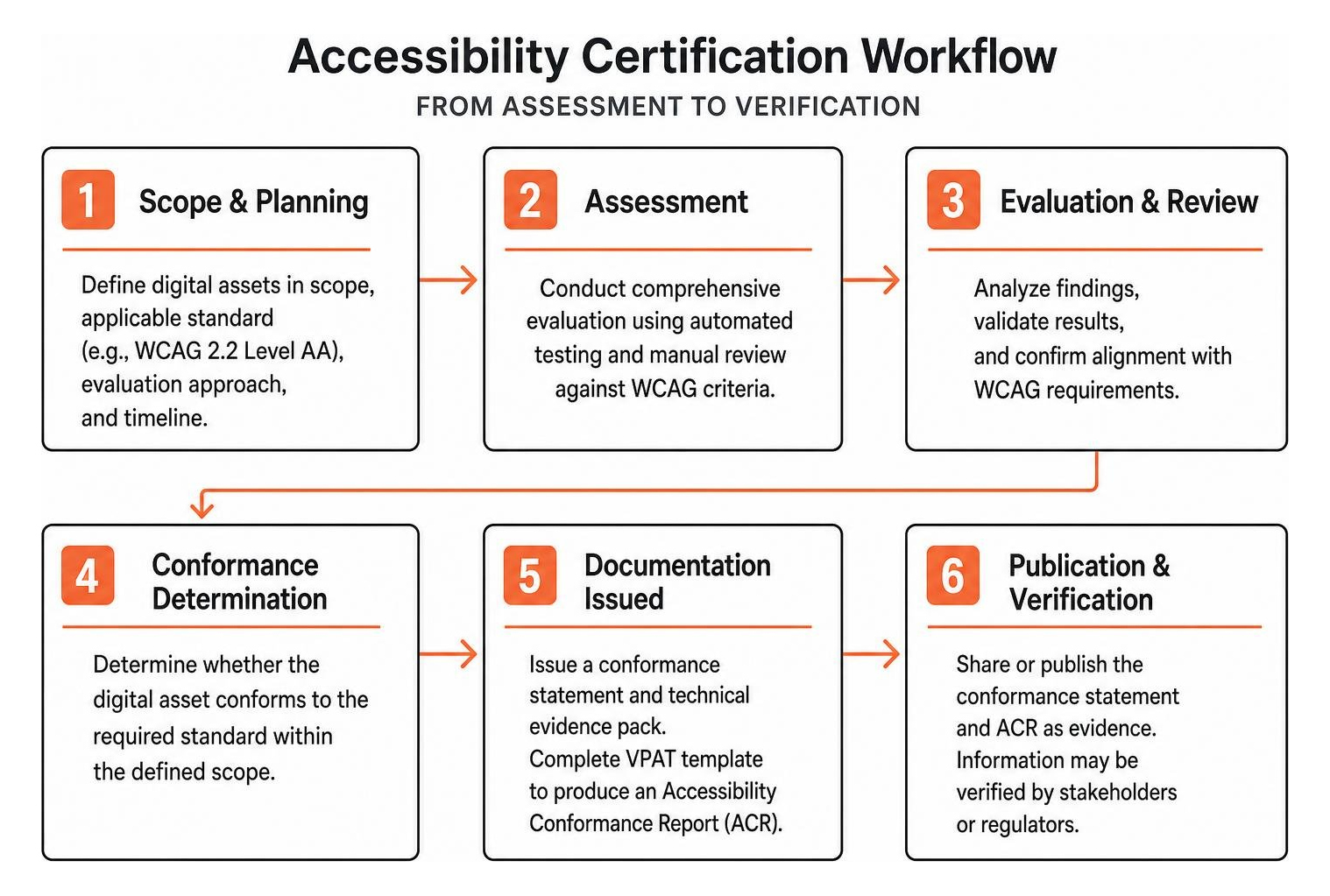
A common misconception is that the World Wide Web Consortium (W3C) provides official licensing or accreditation. In reality, the W3C authors the Web Content Accessibility Guidelines but does not audit websites, issue certificates, or endorse digital products. True validation comes from independent third-party evaluations. Reputable consulting firms conduct comprehensive manual and automated evaluations to confirm whether a digital property meets all required criteria. Once an asset satisfies these benchmarks, the auditor issues a formal conformance statement and technical evidence pack.
Understanding this distinction is critical for public sector bodies, municipal entities, and commercial organizations. Many regulatory environments reference these benchmarks, including public entities requiring a formal Website Accessibility Certification to prove nondiscrimination under state and federal mandates. Navigating this landscape requires following a structured, practical guide to website accessibility certification that aligns your technical infrastructure with regulations like Section 508 in the United States and the European Accessibility Act internationally.
Conformance Statement vs. VPAT Documentation
Organizations often confuse a general conformance statement with formal documentation templates. A conformance statement is a public-facing or internally archived declaration confirming that a specific set of digital pages adheres to standards like WCAG 2.2 Level AA. This statement outlines the scope of testing, evaluation dates, and technical methods used during the assessment.
A Voluntary Product Accessibility Template (VPAT) is a standardized document framework developed by the Information Technology Industry Council (ITI). When a technical auditor completes a VPAT by evaluating a product, the resulting document is called an Accessibility Conformance Report (ACR). An ACR provides a detailed, criterion-by-criterion assessment of how a digital asset supports accessibility standards.
Enterprise procurement officers and government purchasing agents routinely require ACRs before signing vendor contracts. If you want to supply software, web portals, or digital services to public agencies or corporate clients, providing an accurate ACR is mandatory. Reviewing a definitive website accessibility certification services guide can help you determine whether your organization needs a public conformance statement, an enterprise ACR, or both.
The Certification Workflow from Assessment to Verification
Achieving verified conformance is an iterative engineering process rather than a single event. It begins with establishing an initial technical baseline across all digital properties. Auditors review code architecture, templates, and interactive widgets against the technical success criteria.
Following the baseline scan, certified specialists perform deep manual evaluations using assistive technologies such as screen readers (JAWS, NVDA, and VoiceOver) and keyboard-only navigation. Once all barriers are documented in a prioritized remediation backlog, developers implement the necessary source code updates. Finally, the auditing team executes re-testing cycles to verify that every reported issue has been resolved without introducing new regressions. Following a step-by-step WCAG 2.2 certification process ensures your team avoids repeated testing cycles and maintains a direct path to compliance.
Breaking Down the WCAG Certification Cost: 2026 Price Benchmarks
Budgeting for accessibility requires looking at the total scope of work, including testing, remediation, documentation, and ongoing monitoring. Relying on superficial scans often leads to surprise costs during development. A comprehensive assessment begins with consulting a complete website WCAG full audit guide to scope your digital estate accurately.
Small informational websites with static layouts have different testing footprints than enterprise SaaS platforms or dynamic e-commerce portals. To understand where budgets are allocated, compare the standard evaluation approaches available across the industry:
| Testing Methodology | Issue Detection Rate | Assistive Tech Testing | Evaluation Reality |
|---|---|---|---|
| Automated Scans | ~25% to 57% | None | Catches syntax errors but misses critical functional barriers |
| Partial Sampling | ~70% to 80% | Limited manual sampling | Leaves dynamic user flows and checkout paths unverified |
| Full Manual Audit | 95%+ | Comprehensive (JAWS, NVDA, VoiceOver) | Complete verification required for verified compliance and legal defense |
Core Drivers That Influence Your Total WCAG Certification Cost
Evaluating accessibility costs is rarely based on total page count alone. Modern websites generate thousands of dynamic URLs from a small set of underlying page templates. Because of this architecture, auditors structure their evaluation around unique templates and interactive components.
The primary cost drivers include:
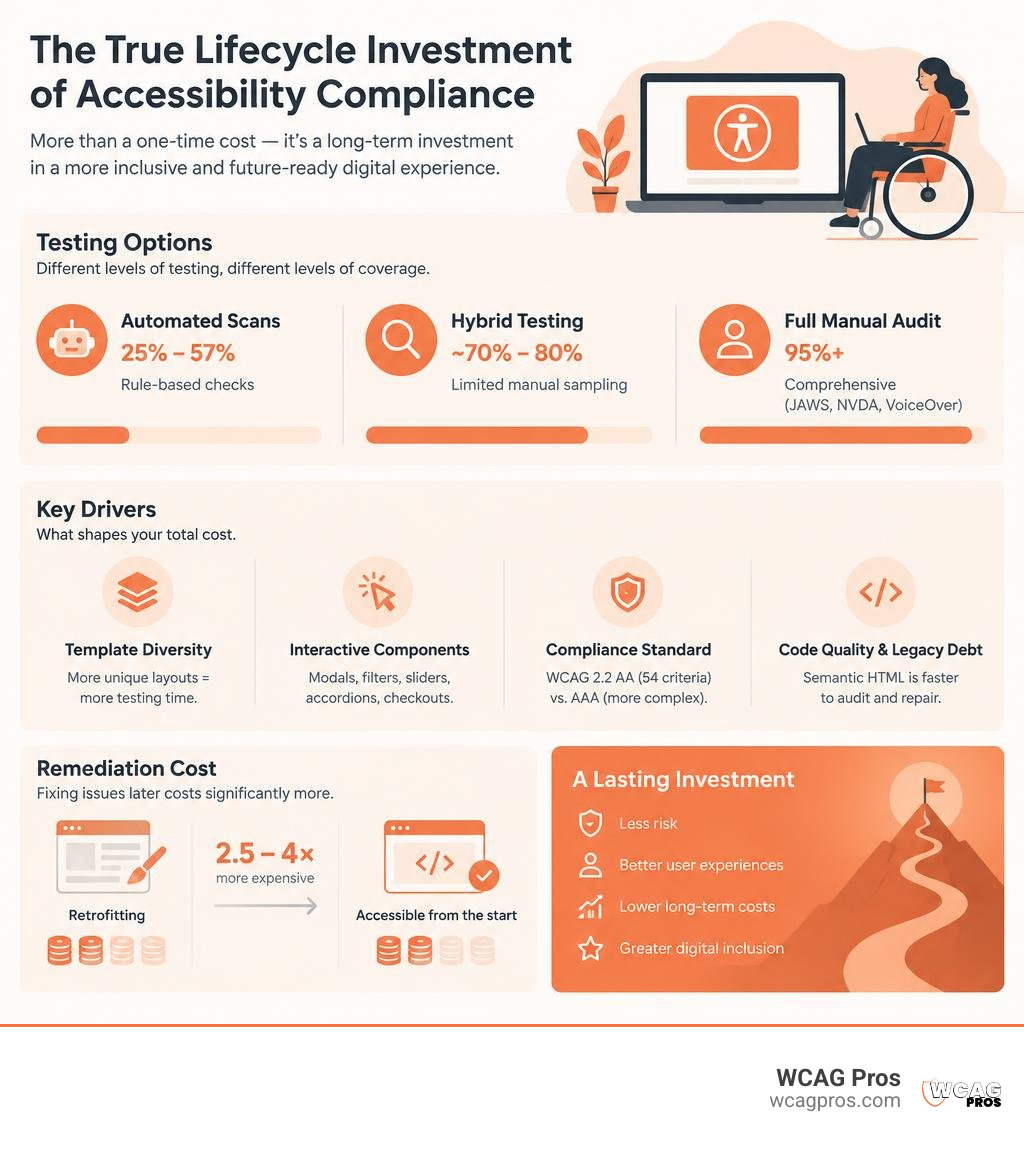
- Template Diversity: A site with five hundred articles built on a single layout requires less testing time than a thirty-page site with distinct layouts for every page.
- Interactive Components: Modals, dynamic filters, custom sliders, accordions, and checkout funnels require intensive manual script analysis and state testing.
- Compliance Standard: Auditing against WCAG 2.2 Level AA involves evaluating 54 distinct criteria. Expanding the scope to Level AAA introduces strict contrast, presentation, and comprehension requirements that add substantial engineering and evaluation overhead.
- Code Quality and Legacy Debt: Sites with semantic HTML are faster to audit and repair than those built with non-standard markup or nested third-party scripts.
Automated Scans vs. Hybrid Testing vs. Full Manual Audits
A frequent budgeting mistake is assuming automated tools provide complete compliance coverage. Industry benchmarks demonstrate that automated rules engines catch only 25% to 57% of accessibility errors. Algorithms can verify whether an image contains an alt attribute, but they cannot determine if the text alternative accurately describes the visual context. Similarly, automated checkers cannot evaluate keyboard focus order, dynamic ARIA live regions, or logical reading sequences for screen reader users.
Hybrid testing approaches combine automated scanning with manual sampling of representative pages. While this improves issue capture, it still leaves unreviewed flows vulnerable to legal challenges or usability barriers. Full manual audits conducted by certified accessibility engineers provide complete coverage by testing every interactive element across desktop and mobile assistive technologies.
Geographic Pricing Variations and Specialist Rates
Consulting rates reflect regional technical talent markets and certification credentials. In North America, accessibility consultants bring specialized legal knowledge surrounding ADA Title III and state-specific nondiscrimination laws. Rates vary across international markets based on local labor costs and regulatory complexity. However, selecting a specialist based entirely on lower hourly rates can increase overall expenses if their assessments miss critical criteria, forcing your internal team through multiple re-audits.
The True Lifecycle Investment: Remediation, VPAT, and Ongoing Maintenance
Achieving accessibility is an ongoing program rather than a one-time project. Organizations that budget exclusively for an initial evaluation often face unexpected hurdles during the remediation phase.
Remediation Cost vs. Building Accessible Architectures
Fixing an inaccessible website after it has been built costs significantly more than designing accessibly from the start. Industry data shows that retrofitting an existing digital asset costs 2.5 to 4 times more than building with accessible frameworks from day one.
When development teams integrate accessible design patterns into their initial wireframes and design systems, accessible components become standard building blocks. In contrast, retrofitting legacy systems requires untangling complex CSS stylesheets, refactoring custom JavaScript widgets, rewriting inaccessible form validations, and testing live transactional paths without breaking production functionality.
VPAT and Accessibility Conformance Report (ACR) Pricing
When clients or government entities request a formal ACR, the auditing team maps the empirical findings from the technical audit into an official VPAT template. The labor involved depends entirely on the specific edition required:
| VPAT Edition | Regulatory Target | Scope of Standards Evaluated |
|---|---|---|
| WCAG Edition | Commercial Enterprise & Web | Complete WCAG 2.2 Level A and AA Success Criteria |
| Revised Section 508 | US Federal Agencies & Contractors | WCAG criteria plus US federal functional performance rules |
| EN 301 549 Edition | European Union Public & Private Sector | WCAG criteria plus European non-web and mobile ICT standards |
| International (INT) | Global Enterprise Procurement | Harmonizes WCAG, Section 508, and EN 301 549 standards |
Completing an ACR requires detailed technical remarks that document how each criterion is supported, noting any temporary exceptions. Because the accessibility table accounts for almost the entire technical drafting effort, completing a comprehensive audit first is essential.
Preventing Compliance Decay with Ongoing Monitoring
A major challenge for digital accessibility is compliance decay. Studies show that approximately 70% of websites fall out of compliance within six months of an audit. Content creators upload untagged images, marketing teams add unvetted third-party widgets, and engineers deploy design updates that disrupt keyboard focus order.
Relying on one-time assessments leads to repeated full-scale remediation projects every few years. Implementing automated testing routines within your continuous deployment pipeline catches basic markup issues instantly, while scheduling a regular annual ADA compliance audit verifies complex interactive flows and protects your digital investments.
The Financial Stakes: Compliance Costs vs. Legal Penalties and Revenue Loss
Evaluating the business case for accessibility requires weighing the cost of compliance against the substantial financial risks of operating an inaccessible website.
Ignoring digital accessibility carries severe legal and commercial consequences that far outweigh the investment in proactive testing. Understanding the real costs of ignoring website accessibility makes it clear that accessibility is a strategic investment in risk mitigation and market growth.
Legal Defense Costs and Regulatory Fine Ceilings
Under Title III of the Americans with Disabilities Act, private businesses operating places of public accommodation (which federal courts widely interpret to include public commercial websites) are subject to civil lawsuits from plaintiffs who encounter digital barriers. Typical ADA website lawsuit settlements range from $25,000 to $75,000, excluding defense attorney fees, administrative overhead, and the mandatory cost of expedited remediation. Class action settlements in enterprise scenarios can reach hundreds of thousands of dollars.
International enforcement is similarly rigorous. Under Germany’s Accessibility Strengthening Act (BFSG), which implements the European Accessibility Act, regulatory fine ceilings reach up to 100,000 euros for serious non-compliance violations, with additional statutory fines for administrative infractions. Relying on a certified WCAG audit process as legal protection establishes documented evidence of proactive compliance, creating a strong defense against predatory demand letters.
Commercial Impact: Conversion Abandonment and Inclusive Market Reach
Legal risks represent only one side of the ledger. Inaccessible websites actively turn away paying customers. Independent user research shows that 80.7% of users with disabilities have abandoned a digital transaction or checkout flow after encountering a technical barrier.
When forms lack proper programmatic labels, error messages fail to notify screen readers, or mobile menus trap keyboard navigation, businesses lose revenue. Investing in accessible design expands your reachable market to the millions of people living with disabilities, while providing cleaner code structures that enhance organic search rankings, site speed, and overall user experience for every visitor.
How to Reduce Your Long-Term WCAG Certification Cost
Organizations can keep compliance costs manageable by adopting strategic engineering and procurement practices:
- Adopt Accessible Component Patterns: Build accessible design primitives into standard front-end libraries rather than coding non-standard elements from scratch.
- Shift Accessibility Left: Train UI/UX designers to specify color contrast ratios, focus indicators, and heading structures during the wireframing phase. Fixing a design flaw in wireframes takes minutes, while fixing it in production code takes hours.
- Integrate Automated Code Checks in CI/CD: Add automated accessibility checks to code repositories. This prevents developers from deploying simple markup errors like missing image descriptions or empty buttons.
- Coordinate Testing Scopes: Group similar page templates together during vendor audits to avoid paying for redundant reviews of identical layouts.
Frequently Asked Questions About Accessibility Audits and Conformance
Does the W3C provide official WCAG certification?
No. The W3C develops technical web standards through international working groups but does not evaluate individual websites, provide certification credentials, or issue compliance badges. Validated compliance is confirmed through comprehensive assessments performed by qualified third-party accessibility auditing firms that issue detailed conformance statements and evidence reports.
Are quick automated fixes enough for legal compliance?
No. Quick automated fixes alone do not achieve WCAG 2.2 Level AA compliance. Federal courts and regulatory agencies have repeatedly rejected surface-level automated fixes as an acceptable defense against ADA Title III claims. These shortcuts cannot modify underlying server-side code, cannot restructure inaccessible document hierarchies, and often create operational barriers for screen readers and user-installed assistive technologies. A full manual audit and native source code remediation remain essential for legal compliance.
How long does a full WCAG 2.2 audit and certification take?
The timeline for an accessibility audit depends on the size and complexity of the digital property. For standard commercial websites with 5 to 15 unique templates, a thorough manual and automated audit generally takes 1 to 2 weeks. Complex platforms, large e-commerce environments, or custom SaaS applications may require 3 to 4 weeks. After the audit, your development team handles remediation, followed by a final validation review that is typically completed in 3 to 5 business days.
Conclusion: Building a Sustainable Path to Digital Compliance
Planning an accessibility budget requires understanding that compliance is an ongoing operational commitment rather than a static expense. Attempting to cut corners with quick automated fixes or neglecting manual validation often leads to expensive retrofits, lost revenue from checkout abandonment, and significant legal exposure under the ADA.
By taking a proactive approach, your organization can build an inclusive digital presence that expands market reach, improves user satisfaction, and protects against regulatory liability. At WCAG Pros, our team specializes in comprehensive page-by-page audits evaluating all 54 WCAG 2.2 Level A and AA success criteria. We support your engineering team with actionable source code fixes and provide free re-audits to verify your repairs and award verified compliance badges. Explore our full suite of WCAG Pros digital accessibility and certification solutions to build a compliant, accessible, and high-performing digital future.
Read more website accessibility articles
Get Help With Your Website
We'll follow up with info about:
- The process
- Cost
- Timeline
We promise to respect your privacy, and never abuse the information you provide. We will not sell or rent your information to any third party.
By submitting this form, you consent to receive SMS messages and/or emails from SEM Dynamics LLC, dba WCAG Pros. To unsubscribe, follow the instructions provided in our communications. Msg & data rates may apply for SMS. Your information is secure and will not be sold to third parties.