
Why Your Business Needs an Official ADA Compliant Web Certification
Why Your Business Needs an Official ADA Compliant Web Certification
Why ADA Compliant Web Certification Matters
There is no official government-issued ADA certification for websites. To earn a credible accessibility badge, start with a WCAG 2.2 audit, fix the barriers found, complete manual verification and user testing, then keep a dated evidence package that supports your public conformance statement or provider certificate.
A badge by itself does not make a website accessible or protect a business from a claim. Its value comes from the work behind it: code-level remediation, documented testing, and regular reviews as your website changes.
That matters because website accessibility lawsuits continue to rise. In 2025, plaintiffs filed 3,117 federal website accessibility lawsuits, a 27% increase from 2024. A real certification process can reduce risk, improve usability for customers with disabilities, and show that your business takes digital inclusion seriously.
I am Matthew Post, co-founder of WCAG Pros and a programmer with more than 20 years of web development experience. I oversee ADA compliant web certification audits and remediation work, helping businesses document meaningful WCAG conformance and address accessibility barriers at their source.
Similar topics to ADA compliant web certification:
- Comprehensive accessibility consulting services
- How to check if your site is ADA compliant
- How to test website accessibility
What Is an ADA Compliant Web Certification and Does an Official One Exist?
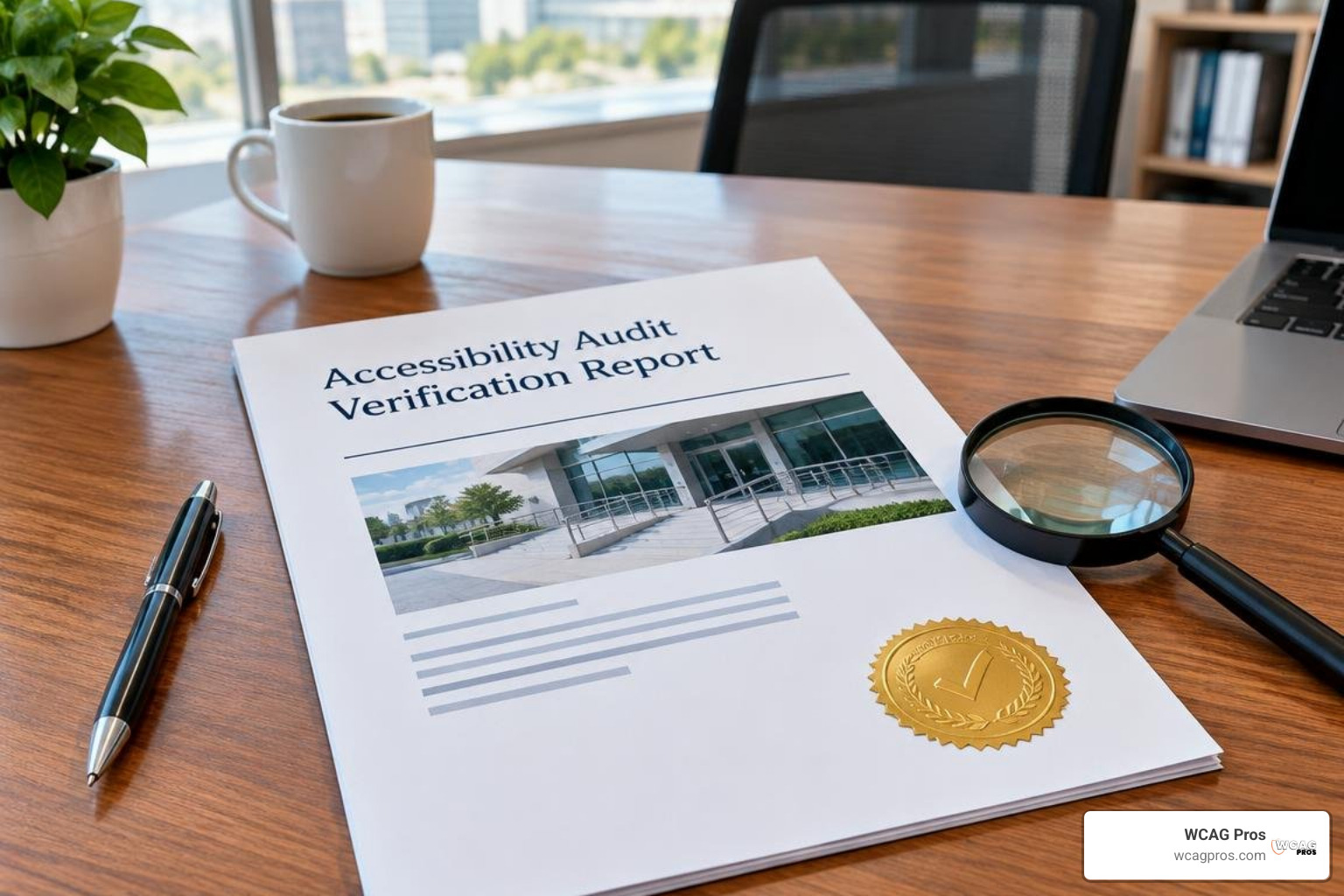
A common misconception among business owners is that the Department of Justice or another government agency issues a formal digital certificate of compliance. In reality, no government body provides an official stamp of approval or legal certificate for website accessibility. When organizations talk about certification, they are referring to a verifiable package of technical documentation, expert evaluation, and conformance reporting that proves a website meets established technical standards.
Third-party validation serves as the backbone of digital compliance. Because the legal landscape under Title III of the ADA relies on whether your public accommodation offers equal access, having structured proof from independent specialists demonstrates good-faith effort and technical compliance. Industry analysts confirm that ADA website compliance certification is built on transparent auditing, documented remediation, and verifiable reporting rather than a single government seal.
The Four Legitimate Types of ADA Compliant Web Certification Documentation
Rather than relying on an imaginary government stamp, businesses validate their accessibility posture through four recognized documentation formats. You can explore these formats in our comprehensive accessibility certification guide.
- Accessibility Conformance Statement: A public-facing declaration published directly on your website. It details the target standard (such as WCAG 2.2 Level AA), known limitations, alternative access pathways, and direct contact details for users requesting accommodations.
- Accessibility Conformance Report (ACR) via a VPAT: A standardized, detailed document based on the Voluntary Product Accessibility Template. It reviews each technical success criterion one by one, recording whether the platform supports, partially supports, or does not support that criterion.
- User Testing Documentation: Qualitative and quantitative testing reports generated by native assistive technology users, such as blind individuals using screen readers or individuals navigating exclusively via switch access.
- Provider-Issued Certificate: A formal verification issued by an independent accessibility consulting firm after full code remediation and validation testing, confirming that the scoped digital assets meet specified WCAG criteria on a given date.
Automated Checks vs Authentic Code-Level Certification
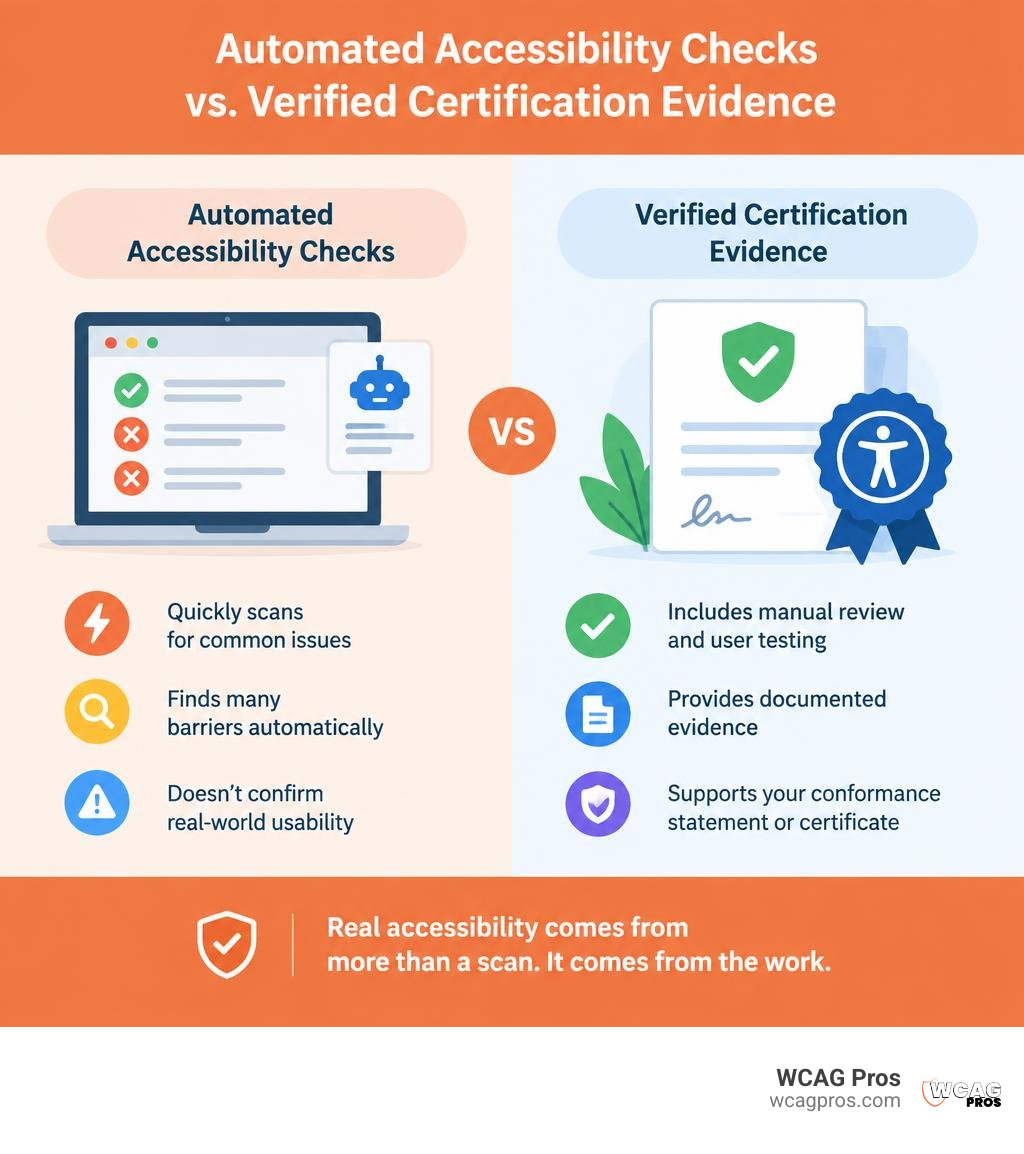
Automated scanning tools play an essential role in early testing, but they cannot certify a website. Studies show that automated scanners capture only 13% to 57% of accessibility barrier types across web platforms. That means more than 40% of real-world barriers remain undetected by algorithms alone.
Computers cannot judge whether alternative text conveys the true context of an image, whether a dynamic form modal traps a keyboard user, or whether content makes sense when read aloud by a screen reader. Relying purely on automated tools creates a dangerous false sense of security. Real certification requires source-code remediation and human verification that withstands rigorous technical and legal scrutiny.
Legal Frameworks, Standards, and Compliance Deadlines in 2026

Federal filings in 2026 are on track to surpass 6,000 cases, representing a nearly 20% jump over 2025. Website cases accounted for 36% of all federal ADA Title III filings in 2025, up from 28% the year before. With average settlement costs ranging from $25,000 to $97,000 before counting your own legal fees, understanding the legal landscape is vital for every organization.
Title III applies to private businesses operating places of public accommodation. Title II governs state and local public entities, while Section 508 regulates federal agencies and federally funded contractors. Internationally, the European Accessibility Act enforces harmonized accessibility standards for commercial products and services. State-level rules add another layer of accountability, such as the California web accessibility standards that guide public sector digital operations.
State and Local Government Rules Under Title II
The Department of Justice issued an updated Title II rule that explicitly ties public entity compliance to WCAG 2.2 Level AA standards. Under the current timeline, large public entities serving populations of 50,000 or more must achieve full digital compliance by April 26, 2027. Smaller public bodies and special districts have until April 26, 2028.
This mandate encompasses all public digital services, including municipal web portals, utility billing platforms, and downloadable PDF documents. Tagging and remediating document backlogs has become an immediate priority for public agencies preparing their compliance documentation.
Why WCAG 2.2 Level AA Is the Universal Benchmark
The Web Content Accessibility Guidelines establish the international baseline across four core principles:
- Perceivable: Users must be able to comprehend all presented information through sight, hearing, or touch.
- Operable: Interface components, menus, and controls must be entirely navigable via keyboards, switches, and voice commands.
- Understandable: Content and user interfaces must behave predictably and clearly.
- Robust: Code must interact reliably with assistive technologies and modern web browsers.
WCAG 2.2 Level AA includes 54 success criteria, introducing critical requirements such as Focus Appearance, Dragging Movements, and Target Size Minimum. We cover the entire roadmap in our step-by-step WCAG 2.2 certification process.
The Core Components of a Legally Defensible Accessibility Evidence Package

A compliance badge without a verifiable evidence archive carries minimal weight during a legal dispute. When a plaintiff attorney or corporate procurement auditor examines your accessibility status, you must be able to produce an organized evidence pack that demonstrates consistent technical rigor.
Legally defensible documentation includes dated raw audit logs, annotated code fixes, assistive technology testing logs, and a signed statement from an independent accessibility firm. Maintaining this evidence creates a clear audit trail that proves your site has undergone thorough, code-level remediation.
VPAT, ACR, and Conformance Statements Explained
Understanding which document to deploy depends on your audience and regulatory requirements.
| Documentation Type | Primary Purpose | Target Audience | Standard Validity Period |
|---|---|---|---|
| Accessibility Conformance Statement | Public declaration of accessibility commitment, site status, and feedback pathways | Website visitors, consumers, advocacy groups | 1 to 2 years, updated as features change |
| Accessibility Conformance Report (VPAT) | Itemized technical audit against federal or enterprise procurement standards | B2B buyers, government procurement officers | 1 to 2 years or until major platform update |
| Provider Certificate & Evidence Pack | Independent verification of technical WCAG conformance and manual testing | Legal counsel, corporate boards, stakeholders | 1 year, supported by continuous monitoring |
A conformance statement that has not been refreshed in more than two years loses credibility and may suggest that digital assets are no longer actively maintained.
User Testing with People with Disabilities as Irrefutable Proof
Automated tests and developer checklists can verify code syntax, but they cannot replicate lived experience. Engaging native assistive technology users provides definitive evidence of real-world usability.
Testing with native screen reader users on NVDA, JAWS, and VoiceOver uncovers complex navigation bottlenecks, unclear dynamic updates, and confusing keyboard focus loops. Capturing these sessions in your evidence file proves that your digital experience is functional for everyone. We explain how this fits into a broader defense strategy in our overview of the certified WCAG audit process.
Step-by-Step Roadmap to Earn an ADA Compliant Web Certification
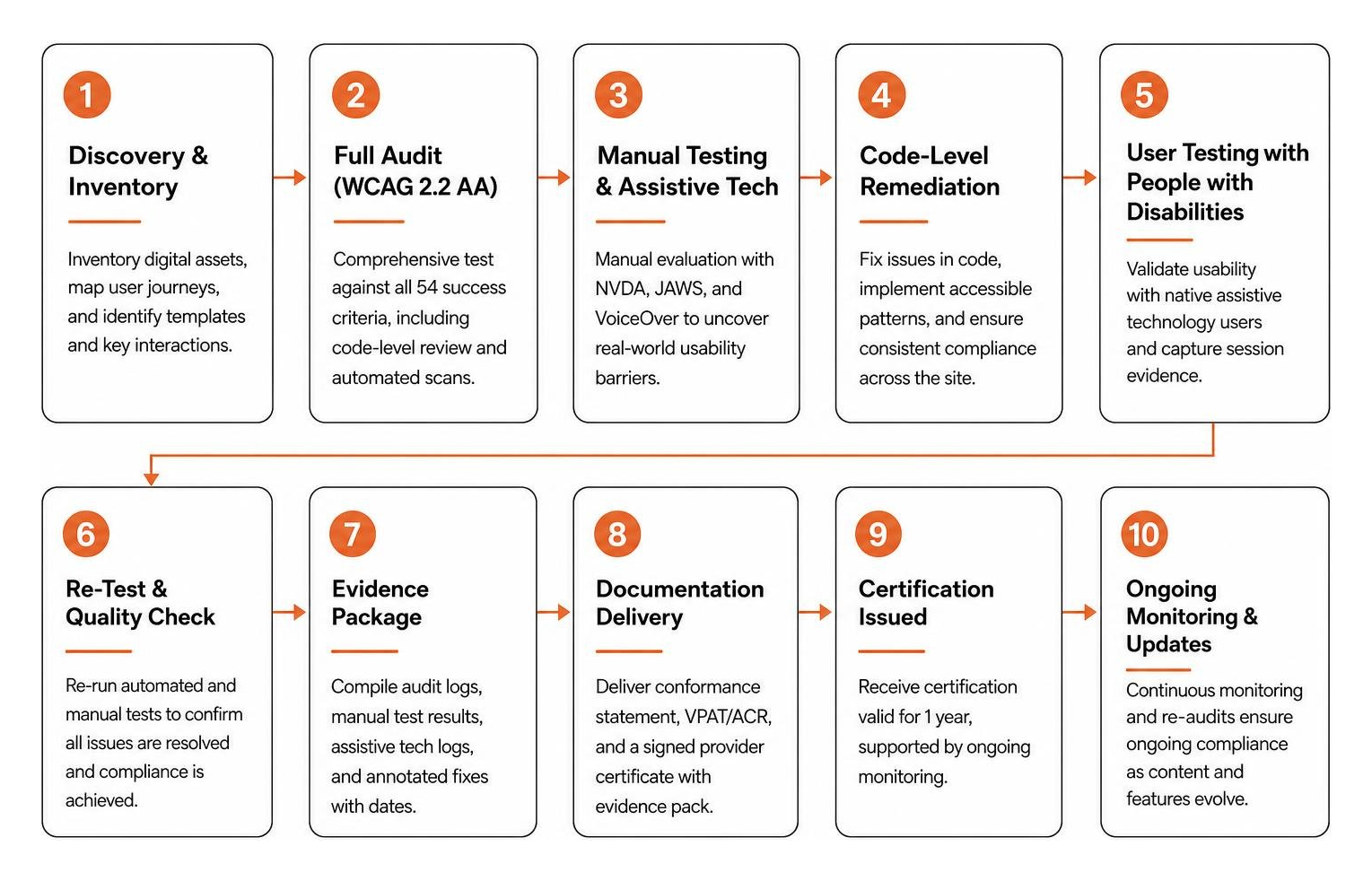
Earning a credible compliance badge requires a structured, multi-phase engineering process rather than an overnight patch. At WCAG Pros, based in Norco CA, we follow a comprehensive methodology that examines every page and code pattern across all 54 WCAG success criteria. You can learn more about this approach through our professional ADA audit services.
Discovery, Full Audit, and Code-Level Remediation
The certification journey begins with a complete inventory of your digital estate. We select representative templates, key user funnels, and critical interaction paths such as user registrations, product checkouts, and customer support portals.
Our specialists perform thorough manual and automated evaluations to identify common errors. In the wider web ecosystem, six error types account for 96% of all detected failures: low-contrast text (83.9%), missing alt text (53.1%), missing form labels (51%), empty links (46.3%), empty buttons (30.6%), and missing document language attributes (13.5%).
Remediation requires adjusting source code directly. We repair semantic HTML elements, update ARIA attributes, fix color contrast ratios, build keyboard focus traps where required for modal dialogues, and ensure custom components respond to standard keyboard controls. Once repairs are completed, validation testing confirms that all 54 WCAG criteria have been met.
Ongoing Monitoring, Documentation Storage, and Recertification
Websites are dynamic ecosystems. New blog posts, marketing landing pages, and third-party integrations can introduce new accessibility barriers overnight. To maintain your certification standing:
- Archive all audit records, test scripts, and remediation logs in a centralized, secure compliance folder.
- Schedule periodic automated and manual checks to catch code regressions.
- Plan an annual recertification cycle to account for platform updates and evolving guidelines.
Once your evidence package is verified, you can proudly display your compliance badge on your digital properties to demonstrate your ongoing dedication to equal access.
Frequently Asked Questions About Web Accessibility Badges and Compliance
Can automated accessibility checks certify my website?
No. Automated checks capture only a fraction of potential barriers and cannot evaluate subjective elements like alt text accuracy, logical reading orders, or complex user flows. True certification demands code-level remediation and manual expert validation.
How often should a website accessibility certification be renewed?
We recommend renewing your certification on an annual basis. Content updates, new features, and third-party scripts can introduce fresh accessibility issues. Any document older than two years is generally considered outdated by enterprise buyers and legal professionals.
What should you do immediately if you discover accessibility failures?
Prioritize barriers that completely block user interactions, such as keyboard traps, missing form labels on checkouts, or unlabelled interactive buttons. Update your public accessibility statement to acknowledge the issue and provide an alternative contact method, then engage experienced accessibility specialists to execute native code repairs.
Conclusion
Digital inclusion is both an operational necessity and a reflection of your company’s core values. In an environment where website lawsuits continue to climb and public scrutiny is high, relying on shortcuts or unverified claims puts your business at risk.
Earning a genuine compliance badge backed by code-level remediation, comprehensive testing, and an airtight evidence package safeguards your organization and opens your doors to millions of users with disabilities. At WCAG Pros, we audit all 54 WCAG success criteria, provide native code fixes, and supply free re-audits so you can operate with total confidence. Discover how our expert WCAG audit and certification can protect your business today.
Read more website accessibility articles
Get Help With Your Website
We'll follow up with info about:
- The process
- Cost
- Timeline
We promise to respect your privacy, and never abuse the information you provide. We will not sell or rent your information to any third party.
By submitting this form, you consent to receive SMS messages and/or emails from SEM Dynamics LLC, dba WCAG Pros. To unsubscribe, follow the instructions provided in our communications. Msg & data rates may apply for SMS. Your information is secure and will not be sold to third parties.