
The Complete Guide to Finding Qualified WCAG 2.2 Accessibility Auditors
The Complete Guide to Finding Qualified WCAG 2.2 Accessibility Auditors
The Limitations of Automated Scanning vs. Comprehensive Manual Testing
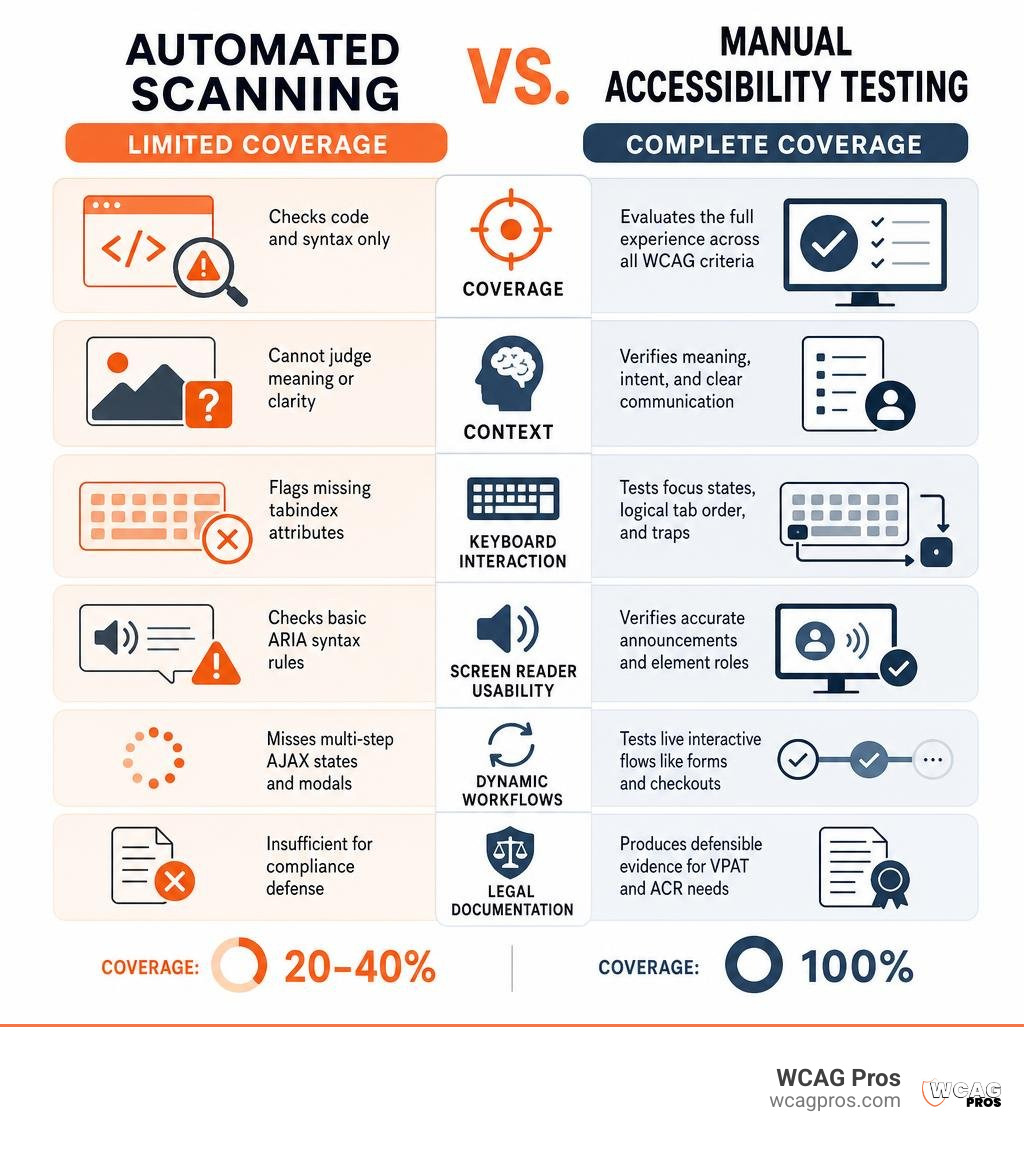
Finding a qualified WCAG 2.2 accessibility audit service requires selecting certified professionals who combine automated scanning with thorough manual testing across assistive technologies. A reliable auditing partner evaluates all success criteria, delivers code-level remediation guidance, and performs verification retesting to ensure complete ADA compliance. While automated scanning provides a helpful baseline for syntax and code errors, it creates a false sense of security when used alone. Automated tools look for predictable rules in static markup, but they cannot interpret human context, visual layout relationships, or interactive behaviors.
This technical limitation leads to high rates of false positives and dangerous false negatives. For example, an automated scanner can check whether an image contains an alt attribute, but it cannot determine if the text description makes sense or accurately conveys the image content to a blind user. When organizations rely solely on an automated tools audit, they often overlook critical usability roadblocks like unannounced dynamic updates, broken visual tab sequences, and severe keyboard traps.
| Evaluation Metric | Automated Scanning Tools | Expert Manual Testing |
|---|---|---|
| WCAG Coverage | Catches 20% to 40% of standard barriers | Evaluates 100% of applicable WCAG success criteria |
| Contextual Evaluation | Cannot judge meaning, intent, or clarity | Verifies accurate descriptions and clear instructions |
| Keyboard Interaction | Flags missing tabindex attributes | Tests actual focus states, logical tab order, and traps |
| Screen Reader Usability | Checks basic ARIA syntax rules | Verifies accurate announcements and element roles |
| Dynamic Workflows | Misses multi-step AJAX states and modals | Tests live interactive flows like forms and checkouts |
| Legal Documentation | Insufficient for formal compliance defense | Produces defensible evidence for VPAT and ACR needs |
Why Automated Tools Miss Over 70% of Real-User Barriers
Automated scanning tools identify roughly 30% of WCAG issues because they rely on binary rule-based testing. Real human interaction on modern websites is dynamic, complex, and full of interactive states that algorithms cannot properly evaluate.
A scanner cannot determine if a visible keyboard focus indicator meets contrast requirements against shifting background imagery. It cannot reliably determine whether custom ARIA attributes enhance or corrupt the experience of a screen reader user. In fact, research shows automated tools pass 87% of sites that fail real users during live testing.
When complex user journeys like shopping carts, customer portals, or interactive booking systems are deployed, automated scanners fail to validate focus order, error recovery announcements, or keyboard operability. Securing professional accessibility audit services ensures that every interactive component works properly in real-world scenarios rather than just passing basic automated code checks.
The Critical Role of Assistive Technology and Native Users
A thorough accessibility audit requires manual testing with the actual assistive technologies that individuals with disabilities rely on every day. Our certified specialists evaluate digital properties across standard screen readers, including JAWS and NVDA on Windows, VoiceOver on Apple devices, and TalkBack on Android.
Manual testing also involves navigating websites using only a physical keyboard, testing screen magnification tools, adjusting high-contrast display modes, and validating voice-recognition inputs. Combining certified technical auditors with native assistive technology users who have lived experience with disabilities provides authentic insight into digital barriers. This comprehensive human validation guarantees that your digital assets are genuinely usable for everyone, not just technically compliant on paper.
Core Standards and Legal Frameworks Every Audit Must Cover
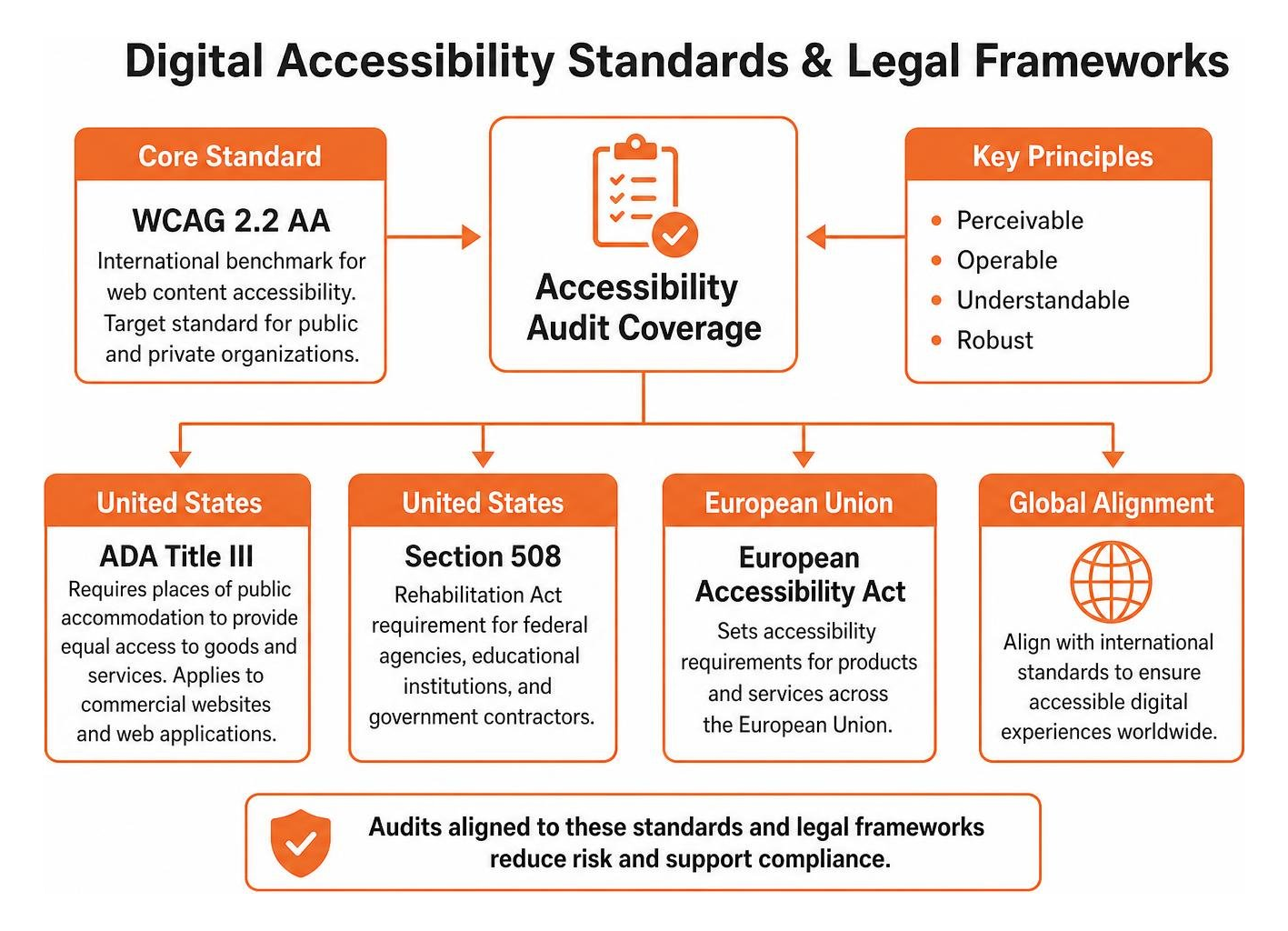
A complete accessibility evaluation must align with key global standards and statutory requirements. In the United States, ADA Title III requires places of public accommodation to provide equal access to goods and services, which courts consistently apply to commercial websites and web applications. With ADA lawsuits up 320% since 2018, conducting a rigorous audit is essential for risk reduction.
Public sector entities, educational institutions, and government contractors must also satisfy Section 508 of the Rehabilitation Act. Organizations operating internationally must adhere to standards like the European Accessibility Act across the European Union. Reviewing our website compliance audit 101 guide helps clarify how these international frameworks apply to digital products. You can also consult technical standards established by the W3C Web Accessibility Initiative to align your digital products with global benchmarks.
WCAG 2.2 AA Conformance Requirements
The international benchmark for digital accessibility compliance is the Web Content Accessibility Guidelines. You can learn more by reading everything you need to know about WCAG versions and audits across different regulatory tiers. WCAG 2.2 AA serves as the target standard for public organizations and private businesses aiming to maintain high digital accessibility standards.
WCAG 2.2 includes important success criteria designed to improve mobile usability and assist users with cognitive, motor, and visual impairments:
- Focus Appearance (Criterion 2.4.11): Requires keyboard focus indicators to have sufficient size and color contrast against surrounding backgrounds.
- Focus Not Obscured (Criteria 2.4.12 and 2.4.13): Ensures sticky headers, footers, or cookie banners do not completely hide interactive elements when a user tabs to them.
- Dragging Movements (Criterion 2.5.7): Mandates a single-pointer alternative for any interface action that relies on dragging motions, like kanban cards or sliders.
- Target Size Minimum (Criterion 2.5.8): Requires clickable buttons and interactive links to maintain an adequate touch target area to prevent accidental clicks.
- Redundant Entry (Criterion 3.3.7): Prevents forms from forcing users to re-enter previously provided information within the same session.
- Accessible Authentication (Criteria 3.3.8 and 3.3.9): Prohibits cognitive function tests like complex puzzles during login processes unless an accessible alternative or password manager auto-fill is supported.
Enterprise Compliance Documentation: VPAT and ACR
For enterprise software providers, SaaS businesses, and public vendors, proving accessibility is a vital commercial requirement. Enterprise buyers, procurement officers, and government agencies routinely require a completed Voluntary Product Accessibility Template before signing vendor contracts.
The audit output is translated into an official Accessibility Conformance Report that documents the exact level of conformance with WCAG 2.2 and Section 508 criteria. Reviewing the complete guide to website WCAG full audit provides a detailed roadmap for creating credible compliance documentation that satisfies strict enterprise procurement requirements.
Key Criteria for Selecting an Accessibility Audit Service
Selecting the right partner requires vetting the technical qualifications and methodology of prospective auditing firms. A superficial review that relies on overlay widgets or automated exports will fail to protect your business or improve user experience.
Businesses evaluating testing firms can reference our expert website WCAG audit guide for businesses to review important vendor criteria. Professional firms should demonstrate clear technical testing procedures, extensive experience with assistive software, and a structured auditing methodology.
Essential Qualifications of an Accessibility Audit Service Provider
When vetting audit providers, verify that their evaluation team holds recognized industry credentials. The International Association of Accessibility Professionals offers professional certifications that indicate deep technical competence:
- Certified Professional in Accessibility Core Competencies (CPACC): Demonstrates broad conceptual knowledge of disability types, accessibility legislation, and universal design principles.
- Web Accessibility Specialist (WAS): Confirms advanced technical capability in source-code evaluation, semantic markup review, and ARIA remediation.
- Certified Professional in Web Accessibility (CPWA): Represents senior practitioners who hold both CPACC and WAS designations.
- DHS Trusted Tester Certification: Confirms adherence to the standardized testing methodology established by the United States Department of Homeland Security.
Top-tier audit teams follow established evaluation frameworks like the Website Accessibility Conformance Evaluation Methodology. Reviewing the certified WCAG audit process your shield against lawsuits illustrates how accredited manual testing protects your business while building a more accessible web presence.
What to Expect from an Accessibility Audit Service Deliverable Package
A professional audit report must serve as an actionable, developer-ready blueprint rather than a generic pass or fail checklist. To understand what a complete deliverable package looks like, consult our WCAG audit report complete guide.
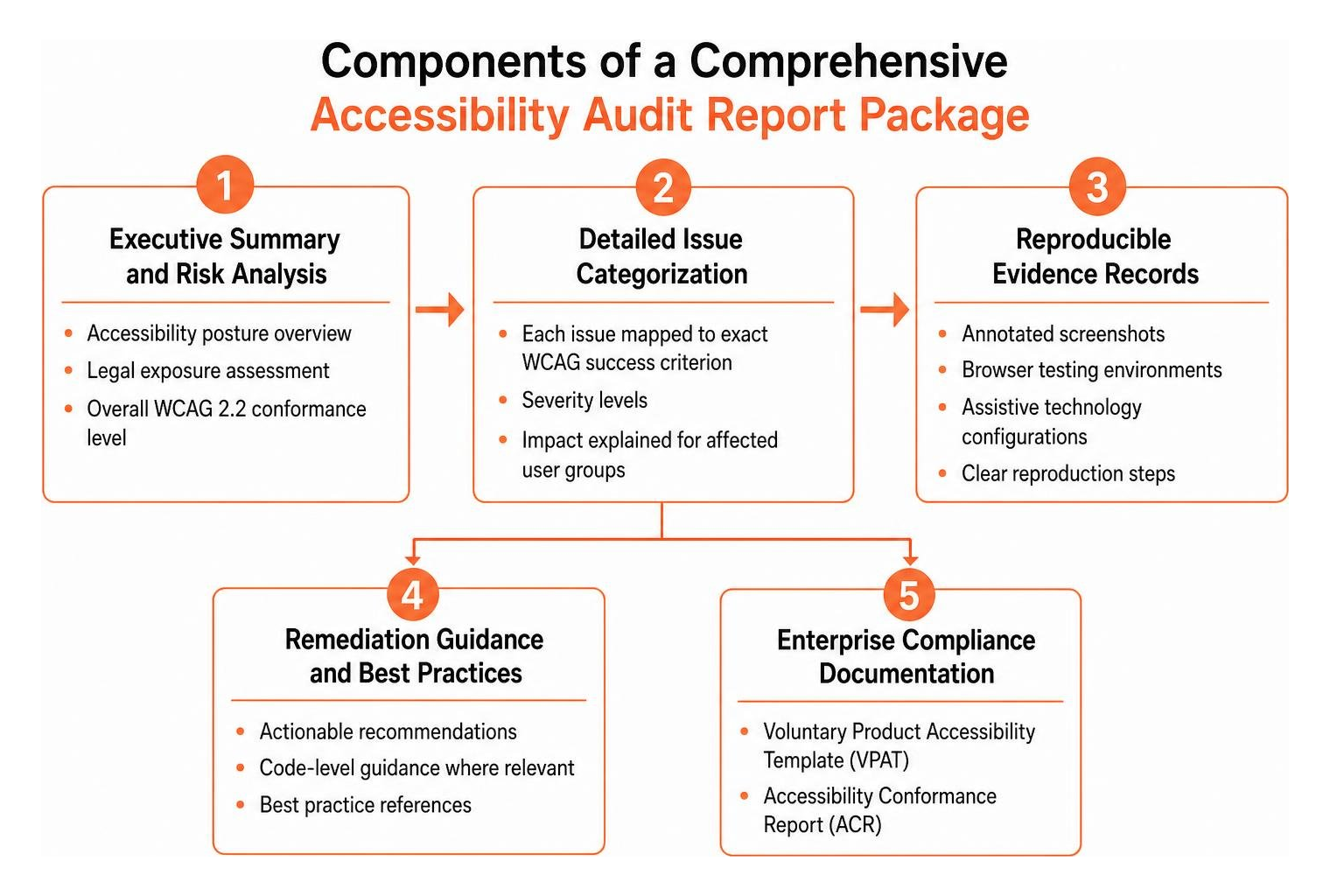
A comprehensive audit package must include:
- Executive Summary and Risk Analysis: A clear evaluation of your digital property’s current accessibility posture, legal exposure, and overall level of WCAG 2.2 conformance.
- Detailed Issue Categorization: Every identified defect mapped to its exact WCAG success criterion, complete with severity levels and an explanation of the impact on affected user groups.
- Reproducible Evidence Records: Annotated screenshots, browser testing environments, assistive technology configurations, and clear reproduction steps.
- Code-Level Remediation Guidance: Concrete HTML, CSS, and ARIA code snippets tailored directly to your engineering stack to guide developer implementation.
- Prioritized Task Backlog: Structured findings formatted for quick import into task management tools like Jira, categorized by risk and development effort.
Step-by-Step Methodology: From Scoping to Post-Audit Validation
A professional audit follows a systematic workflow designed to identify every digital barrier, support development teams through code fixes, and verify final compliance. To understand the practical steps involved, check out how to do an accessibility audit in 5 easy to follow steps.

Scoping, Sampling, and Baseline Analysis
Auditing every single URL across a large enterprise website containing thousands of dynamic pages is both inefficient and unnecessary. Most web applications share global templates, design system components, master layouts, headers, and footers. If a global navigation bar has a keyboard trap, that barrier repeats across every single URL on the website.
Our scoping process focuses on representative template sampling and high-priority conversion flows. We identify primary unique page layouts, account dashboards, contact forms, modal dialogues, checkout flows, and dynamic search filters. You can review our ADA site wide audit your roadmap to total compliance to see how systematic sampling uncovers systemic code defects across entire domains.
Remediation Support, Code Fixes, and Verification Retesting
Receiving an audit report is only the beginning of the accessibility journey. The real work happens when your engineering team begins updating the codebase. A quality audit partner provides ongoing technical consulting, developer walkthroughs, and clear code examples to resolve complex ARIA and keyboard management challenges.
Once your development team deploys code fixes, your audit partner must perform comprehensive verification retesting. This targeted re-audit verifies that updated components meet WCAG 2.2 AA criteria without introducing regressions. We provide comprehensive re-auditing as outlined in our ADA compliance retest guide free to ensure all fixes are thoroughly validated before issuing formal compliance certificates and public accessibility statements.
Understanding Pricing Models and Turnaround Timelines
Accessibility audit timelines and costs vary based on the scope and complexity of your digital assets. A simple brochure site with four static templates requires far less analysis than a complex SaaS platform with authenticated customer portals, interactive data tables, and dynamic user flows.
Audit pricing and timelines depend on several core factors:
- Total Component and Template Volume: The number of unique page templates, screen layouts, and reusable design components included in the audit scope.
- User Journey Complexity: Multi-step transactions like e-commerce checkout sequences, patient registration forms, and financial dashboards requiring authenticated state testing.
- Digital Asset Types: Audits spanning multiple properties like mobile applications on iOS and Android, customer portals, or downloadable PDF assets.
- Deliverable Requirements: Additional documentation needs, such as custom VPAT authoring, developer remediation training, or third-party vendor code assessments.
Simple websites can often be audited within one to two weeks, while large enterprise applications requiring custom user flow evaluations typically take between two and four weeks. Investing in regular reviews helps manage costs over time, as detailed in our guide on why your small business needs an annual ADA compliance audit.
Frequently Asked Questions About Accessibility Audits

How much does a professional accessibility audit cost and how long does it take?
Audit costs and timelines depend directly on the scope of unique page templates, technical complexity, and interactive user flows. A small website with a handful of static templates takes roughly one to two weeks to evaluate, while large web applications and e-commerce platforms with custom user journeys take two to four weeks. Turnaround times also account for manual screen reader testing, multi-browser evaluation, and developer report preparation.
Does completing an accessibility audit guarantee complete ADA lawsuit protection?
An accessibility audit alone does not protect your organization from legal liability. An audit functions as a diagnostic evaluation that uncovers existing technical barriers and accessibility defects.
Achieving true risk mitigation and ADA alignment requires your engineering team to remediate the identified code barriers, followed by technical verification retesting to confirm full conformance with WCAG 2.2. Sustained protection requires ongoing monitoring, regular code reviews, and an active commitment to digital accessibility.
How often should our organization conduct an accessibility audit?
Organizations should schedule a comprehensive manual accessibility audit at least once a year. Dynamic web environments with frequent release cycles, continuous feature rollouts, or major template redesigns should conduct audits more often. Incorporating automated testing into continuous integration pipelines helps catch basic errors early, while periodic expert manual audits ensure that major platform updates maintain full WCAG 2.2 conformance.
Conclusion
Digital accessibility is an essential operational standard for every modern organization. According to the World Health Organization, over 15% of the global population lives with some form of disability. Ensuring that your digital platforms are accessible expands your market reach, improves search engine optimization, boosts overall usability, and significantly reduces the legal risks associated with ADA Title III non-compliance.
Superficial fixes and automated scan tools cannot replace the thoroughness of human-led testing. Lasting digital accessibility requires manual evaluations conducted by certified professionals using real assistive technologies, combined with practical code-level remediation support.
At WCAG Pros, we help organizations navigate digital compliance with confidence. Our team delivers thorough page-by-page audits evaluating all 54 WCAG 2.2 A and AA success criteria, providing developer-ready code fixes and free verification re-audits for your official compliance badge. Explore our comprehensive WCAG audit solutions today to build a compliant and inclusive digital experience for every user.
Read more website accessibility articles
Get Help With Your Website
We'll follow up with info about:
- The process
- Cost
- Timeline
We promise to respect your privacy, and never abuse the information you provide. We will not sell or rent your information to any third party.
By submitting this form, you consent to receive SMS messages and/or emails from SEM Dynamics LLC, dba WCAG Pros. To unsubscribe, follow the instructions provided in our communications. Msg & data rates may apply for SMS. Your information is secure and will not be sold to third parties.