
A Plain English Guide to Government Website Accessibility Compliance
A Plain English Guide to Government Website Accessibility Compliance
What Government Website Accessibility Compliance Requires
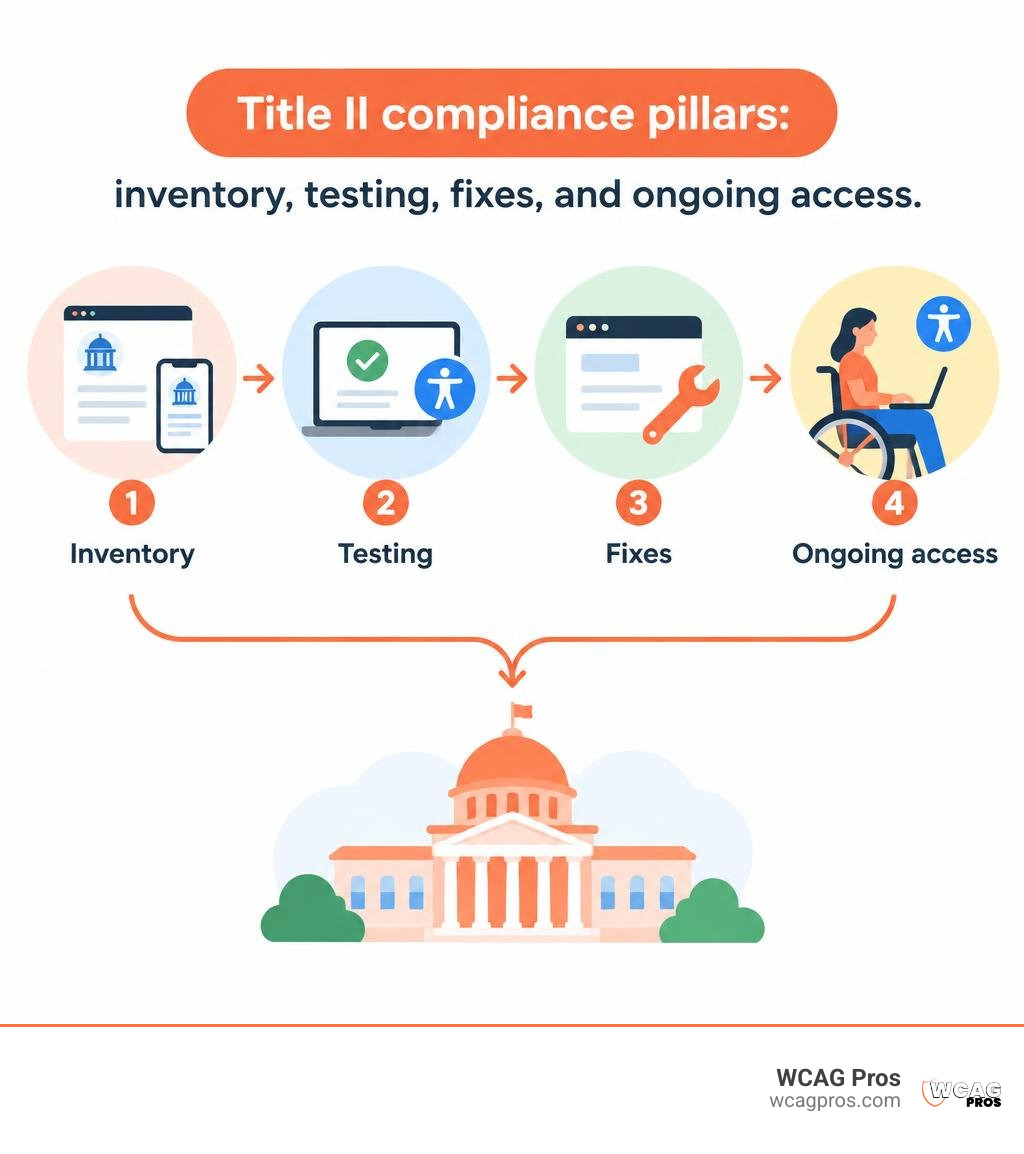
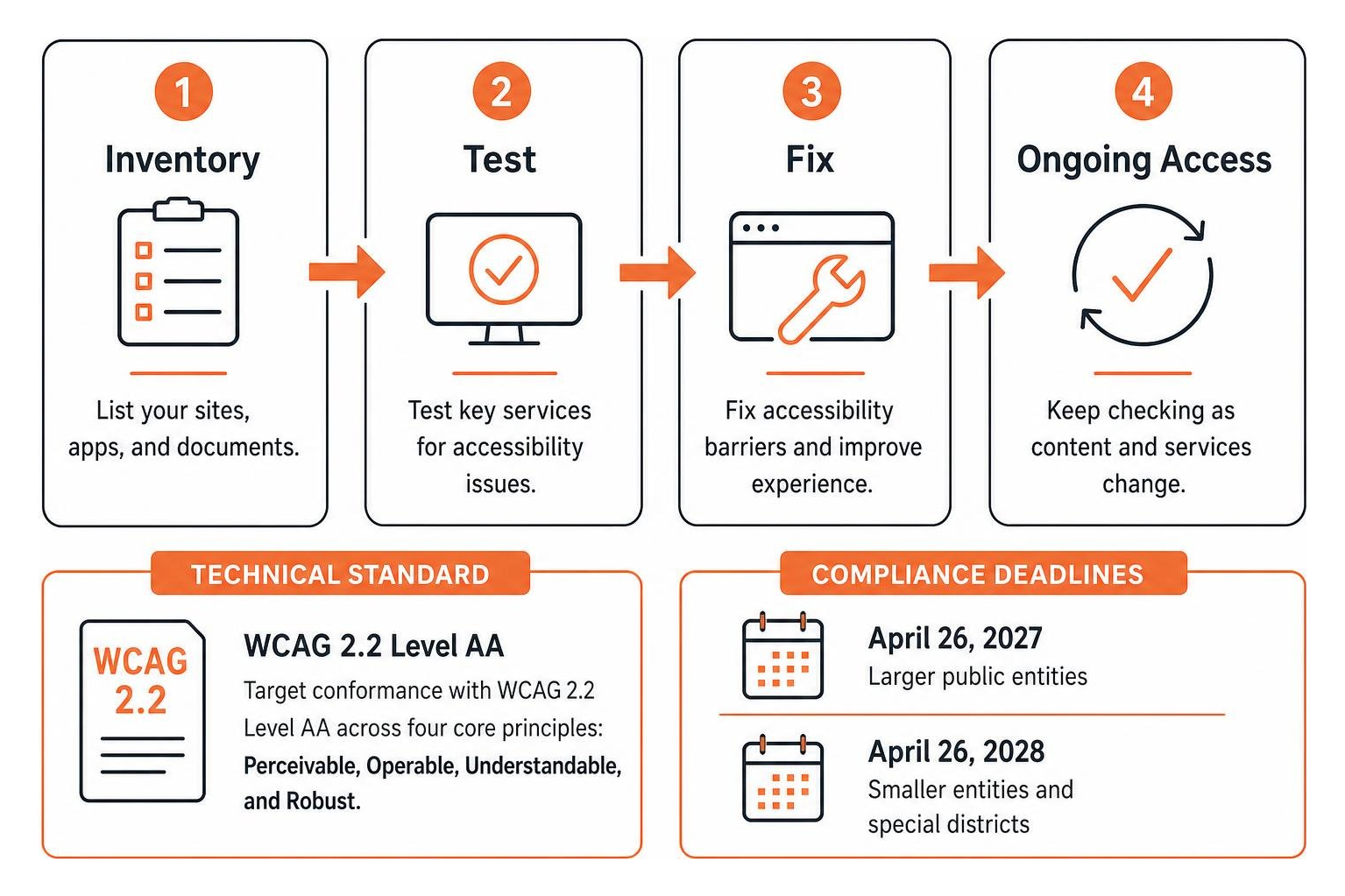
State and local governments must make their websites and mobile apps accessible under the ADA’s Title II rule. Start by listing your sites, apps, and documents. Then test key services, fix barriers, and keep checking as content changes. WCAG 2.2 Level AA is a useful target for that work, though the DOJ rule names an earlier technical standard. As of October 2026, the compliance deadlines are April 26, 2027, for larger public entities and April 26, 2028, for smaller entities and special districts.
I’m Matthew Post, co-founder of WCAG Pros. I have more than 20 years of web development experience, and I oversee accessibility audits and fixes that can help teams working toward government website accessibility compliance.
Government website accessibility compliance word roundup:
Understanding the DOJ Rule on Government Website Accessibility Compliance
Public agencies provide essential services every day. Residents rely on local government websites to pay water bills, register to vote, apply for building permits, check bus schedules, and view emergency weather alerts. When those digital portals block screen readers or prevent keyboard navigation, citizens with disabilities lose equal access to public life.
The Department of Justice established clear digital accessibility rules under Title II of the Americans with Disabilities Act. The Nondiscrimination on the Basis of Disability: Accessibility of Web Information and Services of State and Local Government Entities publication created binding benchmarks for state agencies, counties, municipalities, and public universities. Understanding these requirements is central to building a practical website ADA compliance strategy that protects civil rights and serves all constituents equally.
Title II ADA Mandates and the WCAG 2.2 Level AA Technical Standard
Title II of the ADA prohibits disability discrimination across all state and local government services, programs, and activities. The modern regulation clarifies that digital services stand on the same legal footing as physical town halls. Just as physical stairs without a ramp block a person using a wheelchair, poorly labeled code blocks a person using assistive technology.
The rule anchors its requirements to the Web Content Accessibility Guidelines established by the World Wide Web Consortium. Public sector teams must align their websites and applications with WCAG 2.2 Level AA standards across four core principles:
- Perceivable: Information and user interface components must be presentable to users in ways they can perceive, such as text alternatives for images and captions for public hearing videos.
- Operable: Interface components and navigation must be operable by keyboard alone, without requiring a mouse or triggering focus traps.
- Understandable: Text must be readable, pages must behave predictably, and online forms must provide clear instructions and error recovery prompts.
- Robust: Code must be clean and compatible with current and future user agents, including diverse screen readers and braille displays.
Regional frameworks, including the Minnesota State Accessibility Standard, reinforce these benchmarks by requiring public agencies to keep their digital infrastructure accessible over time.
Population Thresholds and Staggered Compliance Timelines
The regulation recognizes that larger cities and small rural towns operate with different resources. Compliance deadlines are tiered based on population size.
| Public Entity Category | Population Threshold | Mandatory Compliance Deadline | Affected Entity Types |
|---|---|---|---|
| Large Public Entities | 50,000 or more residents | April 26, 2027 | State agencies, major cities, large counties, state university systems |
| Small Public Entities | Under 50,000 residents | April 26, 2028 | Small towns, rural municipalities, local school districts |
| Special Purpose Districts | Any population size | April 26, 2028 | Transit authorities, water districts, library systems, regional utilities |
The economic analysis supporting the federal rule projects average annualized public compliance costs between $3.3 billion using a 3 percent discount rate and $3.5 billion using a 7 percent discount rate. The estimated annualized benefits reach $5.2 billion and $5.0 billion respectively, delivering net annual public benefits between $1.5 billion and $1.9 billion. For almost all public organizations, total costs remain well below 1 percent of annual revenues, making digital inclusion both a legal necessity and an economically sound investment.
The Five Regulatory Exceptions and Continuing ADA Obligations
While the mandate covers public web portals, the regulation outlines five specific exceptions where agencies do not need to rewrite every historical digital asset to meet WCAG 2.2 Level AA. These exceptions exist to keep public teams focused on active, high priority citizen services rather than decades of untouched files.
Policy frameworks such as the NYS Accessibility of Information Communication Technology Policy emphasize that these exceptions have strict boundaries.

Scope of Exempt Content: Archived Files, Third-Party Posts, and Documents
The five statutory exceptions apply only under specific circumstances:
- Archived web content: Content maintained exclusively for historical research, stored in a dedicated archive area, clearly labeled as archived, and never altered after archiving.
- Preexisting conventional electronic documents: Static PDFs, Word documents, and spreadsheets published prior to the statutory compliance date, provided they are not actively used by the public to apply for, participate in, or access current government services.
- Content posted by third parties: Unsolicited public comments, community forum posts, or message board uploads where the agency has no licensing, contractual, or operational relationship with the poster.
- Password-protected individualized documents: Account-specific files, such as an individual resident’s historic water utility bill or PDF paystub, provided the underlying portal and interactive account controls are fully accessible.
- Preexisting social media posts: Social media updates posted to third-party platforms prior to the statutory compliance date.
Agencies may only use conforming alternate versions when direct accessibility on the primary page is technically or legally impossible. Creating a separate, secondary website just for people with disabilities is strictly prohibited when the main site can be remediated directly.
Requirements for Internal Employee Tools and Effective Communication
Exceptions do not excuse an agency from baseline ADA duties. Under Title II, public employers must ensure equal opportunity in their digital workspaces. Internal intranets, human resources portals, benefit enrollment tools, and training modules used by public workers must be fully accessible.
Furthermore, the duty of effective communication remains active at all times. If a resident with low vision requests an archived town council resolution from 1998, the agency cannot refuse simply because the PDF is exempt from automatic web remediation. Staff must provide an accessible alternative format, such as an accessible text document or large-print copy, upon request within a reasonable timeframe.
Actionable Strategies: Auditing, Remediation, and Procurement
Meeting compliance deadlines requires a structured transition away from reactive patches toward sustainable digital governance. Federal guidance such as OMB Memorandum M-23-22 directs public bodies to design, build, and maintain accessible platforms from day one.
Public entities should also overhaul their vendor acquisition standards. Demanding clear VPAT and ACR procurement documentation holds third-party software vendors accountable before contracts are signed, preventing inaccessible off-the-shelf software from entering municipal systems.
Actionable Roadmap for Government Website Accessibility Compliance
Achieving long-term accessibility involves five sequential operational steps:
- Digital Asset Inventory: Catalog every public URL, sub-domain, resident portal, mobile application, and electronic document library owned by the agency.
- Prioritization Matrix: Rank digital assets by constituent traffic and critical public impact, placing voting registration, tax payments, emergency updates, and public safety announcements at the top.
- Diagnostic Baseline Audit: Conduct a comprehensive site-wide ADA compliance audit to map existing WCAG 2.2 barriers.
- Systematic Remediation: Partner with professional ADA remediation services to correct underlying templates, form labels, color contrast ratios, focus states, and PDF structures.
- Continuous Maintenance: Integrate automated linting tools and manual checkpoints into daily development sprints, keeping content accessible as staff make updates.
Balancing Automated Scans with Manual Assistive Technology Testing
A common misconception among municipal administrators is that buying an automated scanning tool solves website accessibility. While automated scanners are valuable for catching missing alternative text and obvious contrast errors, automated scans catch barely 40 percent of WCAG issues.
Automated tools cannot evaluate whether alternative text conveys meaningful context, whether keyboard focus moves in a logical order through a modal window, or whether dynamic screen reader announcements fire properly during an online checkout. That is why comprehensive manual WCAG testing protocols using real screen readers, keyboard navigation checks, and assistive devices are essential.
When the City and County of Denver upgraded its accessibility infrastructure, two administrators originally managed 6,000 web pages and 12,000 PDFs. By pairing structured automated checks with targeted manual fixes and author training, Denver achieved a 32 percent increase in its accessibility score. Its overall quality assurance score improved from failing to 94 out of 100, its digital presence score rose by 25 percent, and its web team saved eight hours every month. Combining automation with expert human review provides the speed and depth needed to maintain reliable civic platforms.
Frequently Asked Questions About State and Local Digital Access
What Happens if an Agency Fails Government Website Accessibility Compliance?
Failing to meet digital accessibility standards exposes public agencies to significant legal and financial consequences. The Department of Justice conducts formal compliance reviews and initiates administrative enforcement actions against non-compliant entities. Agencies may be compelled to sign binding settlement agreements, undergo multi-year federal oversight, and commit substantial public funds to emergency vendor remediation.
Beyond federal enforcement, inaccessible portals invite private civil rights lawsuits and administrative complaints. The costs of ignoring website accessibility extend far beyond legal fees, damaging constituent trust and preventing vulnerable residents from accessing critical public benefits.
Does Title II Apply to Mobile Apps and Password-Protected Portals?
Yes. The DOJ rule explicitly covers municipal mobile applications, citizen reporting apps, utility billing portals, permit application systems, and public school student information systems. Any digital interface where citizens check service statuses, make payments, or interact with public programs must satisfy WCAG 2.2 Level AA requirements.
How Does Section 508 Differ from ADA Title II Regulations?
Section 508 of the Rehabilitation Act applies directly to federal departments and agencies, mandating accessible information and communication technology across the federal government. Title II of the ADA applies to state and local governments, special districts, public school systems, and commuter transit authorities. Both frameworks share technical harmonization around WCAG standards, ensuring consistent accessibility whether a citizen interacts with a local city council or a federal agency.
Conclusion
Digital public services are now the front door for civic participation. As statutory deadlines approach, state and local agencies must treat web and mobile accessibility not as a temporary IT project, but as a permanent standard of good governance. Proactive audits, structured PDF remediation, and sound procurement practices ensure that every resident can participate fully in community life.
At WCAG Pros, our specialists conduct comprehensive page-by-page audits evaluating all 54 WCAG points. We deliver clear code fixes, guide your developers through complex remediation, and provide free re-audits to issue trusted compliance badges. To begin evaluating your public portals and applications, explore our practical guide on choosing the right web accessibility evaluation tools or reach out to our team today.
Read more website accessibility articles
Get Help With Your Website
We'll follow up with info about:
- The process
- Cost
- Timeline
We promise to respect your privacy, and never abuse the information you provide. We will not sell or rent your information to any third party.
By submitting this form, you consent to receive SMS messages and/or emails from SEM Dynamics LLC, dba WCAG Pros. To unsubscribe, follow the instructions provided in our communications. Msg & data rates may apply for SMS. Your information is secure and will not be sold to third parties.