
Step-by-Step WCAG Conformance Testing Strategies That Ensure Accessibility
Step-by-Step WCAG Conformance Testing Strategies That Ensure Accessibility
How to Evaluate WCAG 2.2 Conformance
WCAG conformance testing helps you find and fix barriers that can block people from using your website. To evaluate your site, set a target such as WCAG 2.2 Level AA, test key pages and user journeys, combine automated scans with manual checks, and document every result.
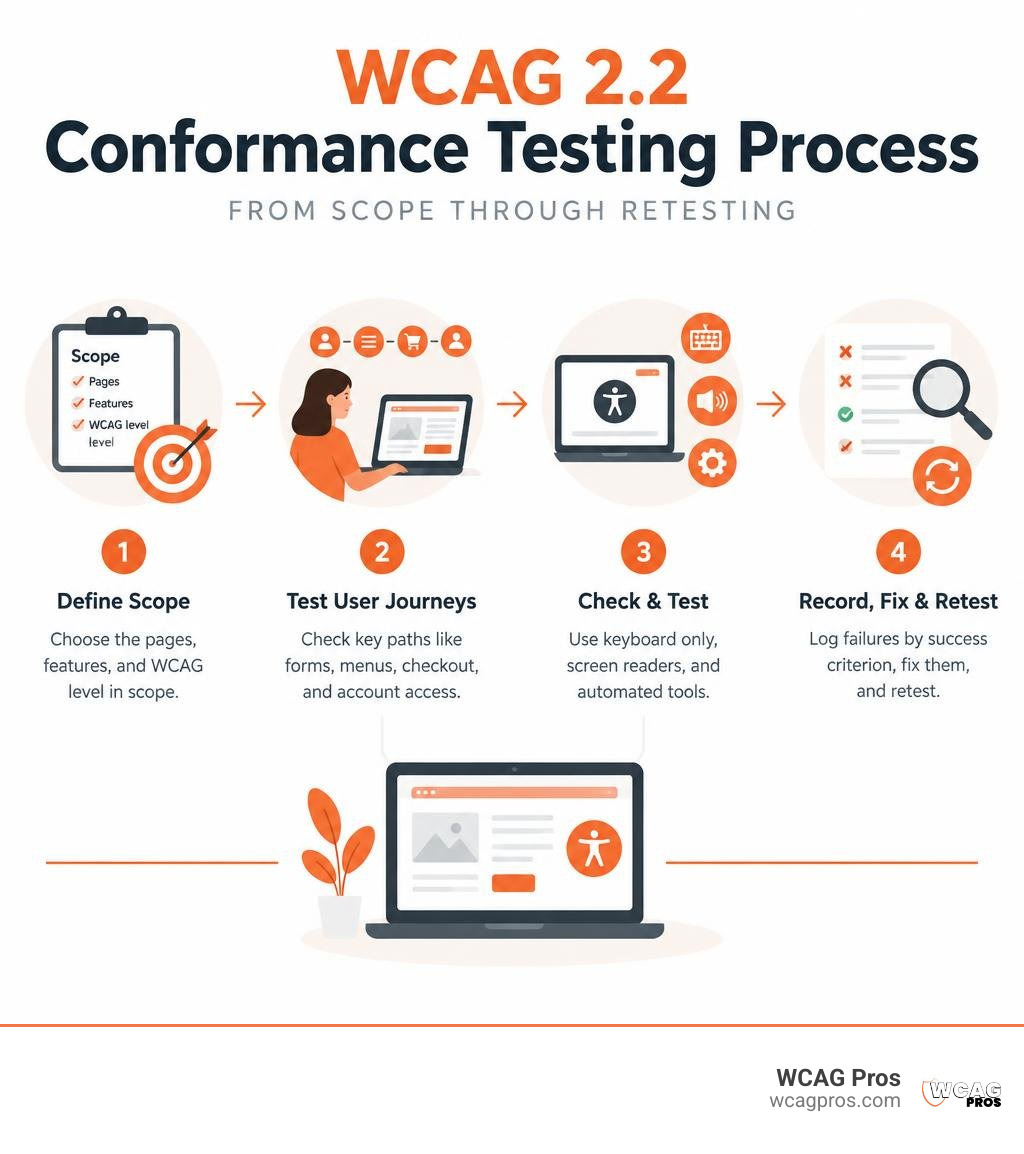
- Define the pages, features, and WCAG level in scope.
- Test representative user journeys, including forms, menus, checkout, and account access.
- Check with keyboard only, screen readers, and automated tools.
- Record failures by WCAG success criterion, fix them, and retest.
A strong evaluation is more than a scan score. Automated tools can spot many code based problems, such as missing labels or low contrast. They cannot reliably judge whether alt text is useful, focus order makes sense, or a screen reader user can complete a task. For meaningful accessibility and lower ADA risk, your process needs both expert review and feedback from people with disabilities.
I am Matthew Post, co founder of WCAG Pros and a web development professional with more than 20 years of experience. I oversee WCAG conformance testing, audits, and remediation work that helps organizations identify real accessibility barriers and make practical fixes.
Basic WCAG conformance testing vocab:
What Is WCAG Conformance Evaluation and Why Does It Matter?
A conformance evaluation is a systematic inspection that determines whether digital content satisfies the success criteria of the Web Content Accessibility Guidelines. Published by the World Wide Web Consortium through the Web Accessibility Initiative, WCAG establishes technical specifications built around four core principles. Content must be Perceivable, Operable, Understandable, and Robust. These principles ensure that visitors can receive digital information through their senses, navigate interactive elements using their preferred input devices, comprehend layouts and messaging without confusion, and rely on stable experiences across modern browsers and assistive technologies.
Conforming to these standards is organized into three progressive tiers: Level A, Level AA, and Level AAA. Level A represents the essential baseline, addressing fundamental barriers such as alternative text for non-text content and basic keyboard access. Level AA broadens these protections to encompass color contrast, visible keyboard focus indicators, target sizes, and consistent navigation patterns. Because Level AA balances rigorous accessibility with technical feasibility, it serves as the benchmark adopted across global regulations and civil rights frameworks. Level AAA offers specialized enhancements for dedicated audiences, though the W3C does not recommend it as a blanket requirement for entire websites.
Evaluating your website against these levels is vital for business health, user equity, and legal protection. Inaccessible digital experiences expose businesses to substantial legal liability under Title III of the ADA. Regulatory frameworks like the European Accessibility Act also establish strict digital accessibility mandates across international markets. Relying on superficial scores or automated overlays provides zero protection in legal disputes because courts assess whether real people encounter actual barriers during essential tasks.
Following a comprehensive website audit guide ensures your digital assets welcome every customer while eliminating legal exposure. Clear guidance outlined in W3C conformance evaluation and reports reinforces that true accessibility requires methodical verification, thorough remediation, and ongoing vigilance.
The 5 Steps of the WCAG Evaluation Methodology (WCAG-EM)
To achieve repeatable, trustworthy results, auditors rely on the official Website Accessibility Conformance Evaluation Methodology. Released as a formal W3C note, WCAG-EM establishes a standardized, five-stage framework for assessing digital content against WCAG benchmarks. Following a clear five-step accessibility testing guide helps teams eliminate guesswork, structure testing schedules, and avoid missing hidden technical flaws.
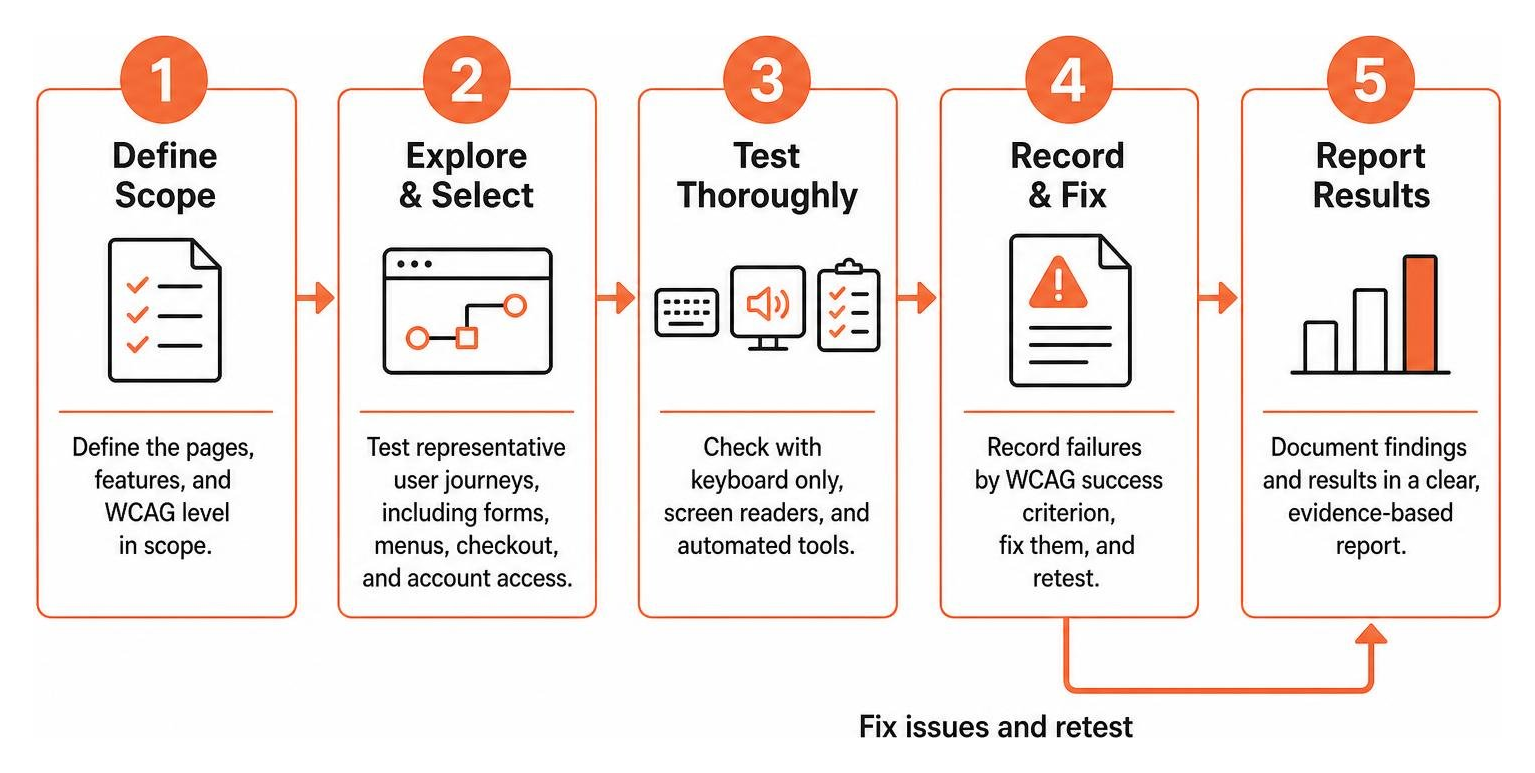
The methodology guides evaluators from the initial scoping phase through product exploration, sample selection, hands-on testing, and final documentation. Reviewing the official WCAG-EM overview and methodology shows that structured testing turns subjective opinions into objective, evidence-based assessments that guide successful development work.
Essential Prerequisites for WCAG Conformance Testing
Before testing begins, organizations must establish clear parameters across Step 1 and Step 2 of WCAG-EM. In Step 1, you define the evaluation scope, which includes specifying the exact base domain, subdomains, web applications, or digital documents under review. You must also designate your target conformance baseline, such as WCAG 2.2 Level AA, and record any environmental constraints.
Step 2 requires exploring the target digital product. Evaluators examine the technology stack, identifying HTML5 structures, CSS styling approaches, client-side JavaScript frameworks, dynamic single-page application behaviors, and multimedia assets. This phase inventories essential user tasks, including account registration, search filtering, media playback, checkout funnels, and form submissions.
Conducting this foundational work requires seasoned accessibility expertise. Evaluators must thoroughly understand assistive technology interactions, semantic markup, and the technical criteria detailed in our complete guide to WCAG AA compliance.
Sample Selection, Evaluation, and Reporting
Once the target environment is understood, evaluators proceed through the remaining three steps of the methodology:
- Step 3: Select a Representative Sample. Testing every single URL on a large website is often impractical. WCAG-EM establishes criteria for selecting a structured sample that captures the full diversity of the site. This includes core templates, common page types, critical transaction paths, dynamic dialogs, error states, and specialized functionality.
- Step 4: Evaluate the Selected Sample. Every page in the sample is tested against all applicable WCAG 2.2 Level A and Level AA success criteria. Evaluators execute manual checks, automated rule validations, and assistive technology inspections, recording explicit pass or fail determinations alongside reproduction steps.
- Step 5: Report Evaluation Findings. The final stage aggregates all findings into an actionable audit report. Evaluators calculate conformance outcomes, summarize aggregate metrics, outline systemic issues, and deliver clear code remediation guidance.
Evaluators frequently leverage specialized tools to organize their findings. The W3C WCAG-EM Report Tool provides a step-by-step documentation workflow that tracks criteria evaluations and exports structured reports. Integrating resources from the W3C web accessibility evaluation tools catalog helps testing teams maintain efficiency while capturing the detailed technical evidence needed by software engineers.
Standardization and Frameworks in WCAG Conformance Testing

Consistency is the foundation of dependable accessibility testing. When different auditors examine the same interface, they should arrive at identical conclusions regarding its conformance status. To achieve this level of repeatability, public institutions and private enterprises turn to established testing frameworks.
A prominent example is the Trusted Tester process developed by the United States Department of Homeland Security. Designed to evaluate web content against Section 508 requirements and WCAG criteria, this process establishes a standardized test environment. It specifies 63 distinct Test Conditions mapped to 41 core web requirements, combining 38 WCAG success criteria with 3 unique Section 508 mandates. The process emphasizes non-interference checks and the proper evaluation of Conforming Alternate Versions, which must offer equivalent information and functionality through accessible paths.
Organizations seeking federal procurement compliance can study the formal Section 508 conformance test process to align their internal testing protocols. Adopting standardized approaches ensures your team masters the core mechanics explained in our WCAG 2.2 manual testing essentials guide.
Standardizing Rules for Automated and Manual WCAG Conformance Testing
To harmonize automated scanning engines and manual auditing techniques across the global industry, the W3C published the Accessibility Conformance Testing Rules Format 1.1. ACT Rules establish an open, standardized schema for writing accessibility tests. By defining test logic in an unambiguous format, tool developers and testing agencies ensure their software engines evaluate code identically.
Every standardized ACT Rule contains essential structural components:
- Descriptive Title and Identifier: Unique keys that pinpoint the exact check.
- Accessibility Requirements Mapping: Explicit links identifying whether the test validates a direct WCAG conformance requirement or an informative secondary requirement.
- Applicability: The precise DOM elements, ARIA attributes, or CSS states that trigger the rule.
- Expectations: The conditions the target element must satisfy to receive a passing outcome.
- Test Cases: Code samples demonstrating both valid passes and non-conforming failures.
Reviewing the official Accessibility Conformance Testing Rules specification reveals how shared test logic eliminates false positives across test engines. Combining standardized rules with insights from our automated accessibility testing tools guide empowers technical teams to catch structural errors before releasing software.
Atomic Rules vs Composite Rules in ACT
ACT Rules Format 1.1 divides testing logic into two distinct classifications: atomic rules and composite rules. Understanding the division between these rule types clarifies how test suites process individual elements versus complex user interfaces.
| Rule Feature | Atomic Rules | Composite Rules |
|---|---|---|
| Core Definition | Tests a single, specific condition on an isolated element or attribute | Combines the results of multiple atomic rules to determine overall outcome |
| Testing Scope | Narrow, individual check (such as verifying an image has an alt attribute) | Broad, multi-factor evaluation (such as validating accessible video alternatives) |
| Logic Structure | Direct assertion without nested rule dependencies | Boolean logic (AND, OR) evaluating underlying atomic results |
| Failure Resolution | Pinpoints exact code defect on a specific DOM node | Identifies which combination of alternative approaches failed to meet criteria |
| Primary Advantage | Simplicity, high execution speed, and modular reusability across tools | Accurate assessment of complex accessibility techniques with multiple valid paths |
Atomic rules focus strictly on one programmatic fact. For instance, an atomic rule might check whether an image tag has an alt attribute. However, WCAG 2.2 allows for multiple techniques to fulfill certain requirements. A video element might satisfy accessibility criteria through closed captions, a descriptive audio track, or a complete text transcript. A composite rule evaluates each corresponding atomic rule and applies boolean logic, ensuring that if any acceptable method is valid, the overall component passes.
Combining Automated Scans, Manual Audits, and Assistive Technology

Relying on a single testing method creates blind spots. Automated testing engines are indispensable for scanning thousands of URLs in minutes, catching high-volume programmatic errors like color contrast shortfalls, missing structural tags, and malformed ARIA syntax. Yet, even advanced AI-assisted scanning engines face hard limits. Independent research demonstrates that traditional automated rule engines detect between 20% and 40% of WCAG criteria, while modern visual-AI platforms can identify up to roughly 63% of issues found during expert manual audits.
The remaining criteria demand human judgment and manual exploration. Automated tools cannot determine whether alternative text conveys the intended mood and context of a photo, whether dynamic focus order follows visual changes, or whether custom interactive widgets trap keyboard navigation. Following our full website WCAG audit blueprint ensures your engineering team bridges this gap.
Developers can also examine hands-on implementations within the interactive WCAG conformance testing model repository, which demonstrates both broken failure states and valid code fixes across real web components.
Involving Users with Disabilities in the Conformance Lifecycle
Technical conformance against WCAG success criteria provides the necessary foundation for access, but real-world usability determines whether customers succeed on your website. Engaging individuals with lived experience of disabilities uncovers barriers that formal checklists might overlook.
Assistive technology users interact with websites in unique ways:
- Screen reader users relying on NVDA, JAWS, or VoiceOver test heading navigation, live announcements, and dynamic forms.
- Keyboard-only users navigate without a mouse, verifying that dropdowns, modals, and sliders do not trap focus.
- Individuals with low vision utilize screen magnification software, checking for responsive layout stability and horizontal scroll avoidance.
- Neurodivergent users and individuals with cognitive differences evaluate clear language, consistent layouts, and distraction-free layouts.
Incorporating real user feedback into your testing lifecycle creates practical digital equity. Exploring our guide on testing website accessibility with real users helps your organization design inclusive feedback channels that elevate your overall customer experience.
Frequently Asked Questions About WCAG Conformance Testing
What is the difference between WCAG-EM 1.0 and WCAG-EM 2.0?
WCAG-EM 1.0 was designed primarily to evaluate traditional, desktop-oriented websites and standalone web pages. As modern technology evolved toward mobile devices, single-page architectures, and native applications, the W3C published WCAG-EM 2.0. This updated version broadens the evaluation scope to cover mobile software, web applications, cross-platform enterprise tools, and varied digital content, providing modern sampling and exploration steps suited for today’s dynamic software environments.
How does the Trusted Tester process align with WCAG and Section 508?
The Department of Homeland Security Trusted Tester process directly aligns with Section 508 standards, which incorporate WCAG 2.0 Level A and AA criteria as their core technical baseline. The framework specifies 63 standardized Test Conditions that evaluate 41 web requirements. This includes 38 WCAG success criteria alongside 3 Section 508-specific mandates. Testing results are documented within the Accessibility Conformance Reporting Tool to produce standardized Voluntary Product Accessibility Templates for procurement review.
Can automated accessibility testing tools guarantee WCAG compliance?
Automated accessibility testing tools cannot guarantee complete WCAG compliance on their own. Automated engines evaluate programmatic code structures, but roughly half of all WCAG success criteria require human interpretation. Automated scanners cannot verify if audio descriptions accurately match video action, if error suggestions are meaningful, or if keyboard focus sequences match logical reading order. A complete conformance strategy requires both automated scans and expert manual testing.
Conclusion
Building an accessible digital ecosystem is an ongoing journey that requires technical precision, proven evaluation frameworks, and sustained dedication. By combining the structured steps of WCAG-EM, standardized ACT test logic, rigorous manual reviews, and feedback from people with disabilities, your organization can deliver outstanding experiences to every customer while safeguarding against ADA legal claims.
At WCAG Pros, we specialize in helping businesses achieve lasting digital equity. Our team conducts comprehensive, page-by-page audits covering all 54 WCAG 2.2 Level A and AA checkpoints. We provide precise code remediation guidance and free re-audits to deliver complete peace of mind. Explore our professional WCAG audit and remediation services to start your path toward verified, sustainable web accessibility today.
Read more website accessibility articles
Get Help With Your Website
We'll follow up with info about:
- The process
- Cost
- Timeline
We promise to respect your privacy, and never abuse the information you provide. We will not sell or rent your information to any third party.
By submitting this form, you consent to receive SMS messages and/or emails from SEM Dynamics LLC, dba WCAG Pros. To unsubscribe, follow the instructions provided in our communications. Msg & data rates may apply for SMS. Your information is secure and will not be sold to third parties.