
Achieve Full Legal Peace of Mind with Verified ADA Certification
What ADA Accessibility Certification Services Should Give You
ADA accessibility certification services should give you more than a badge. Look for a WCAG 2.2 audit, fixes for the barriers it finds, a re-audit, and a dated document that says what was tested. There is no government certificate that makes a website ADA compliant, and no provider can promise protection from a lawsuit.
WCAG Pros offers page-by-page audits, code fixes, free re-audits, and compliance badges. The goal is a website people can use, backed by clear records of the work done.
I’m Matthew Post, co-founder of WCAG Pros. I’ve spent more than 20 years in web development, and I now oversee audits and remediation for businesses seeking ADA accessibility certification services.
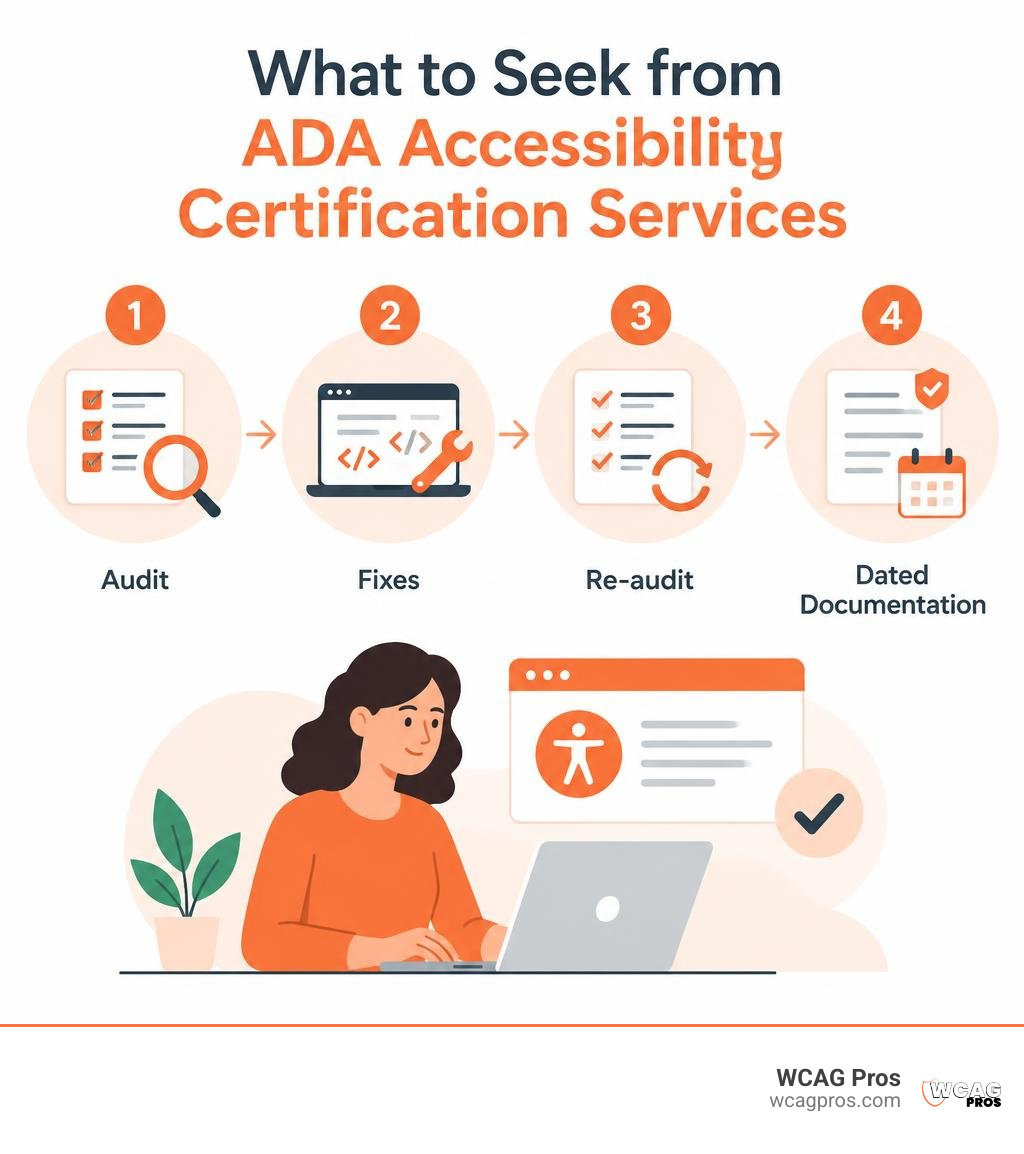
ADA accessibility certification services word guide:
The Reality of ADA Compliance: Documentation Over Government Seals
Many business owners search for an official government seal to guarantee digital protection. The reality is straightforward: no federal agency or court issues an official certificate of ADA compliance for websites. The Department of Justice (DOJ) enforces ADA Title III requirements for public accommodations, yet it does not hand out pass-or-fail stamps.
Instead, legal defensibility comes down to verifiable documentation. Having transparent records that detail your audit methodology, remediation history, and re-testing proofs proves that you are committed to equal digital access. You can explore official website accessibility resources to see how state commissions emphasize structured, measurable standards over quick fixes. When creating an accessible digital presence, aligning your platform with our comprehensive guide to WCAG 2.2 Level AA standards provides the strongest benchmark for real-world usability and risk mitigation.
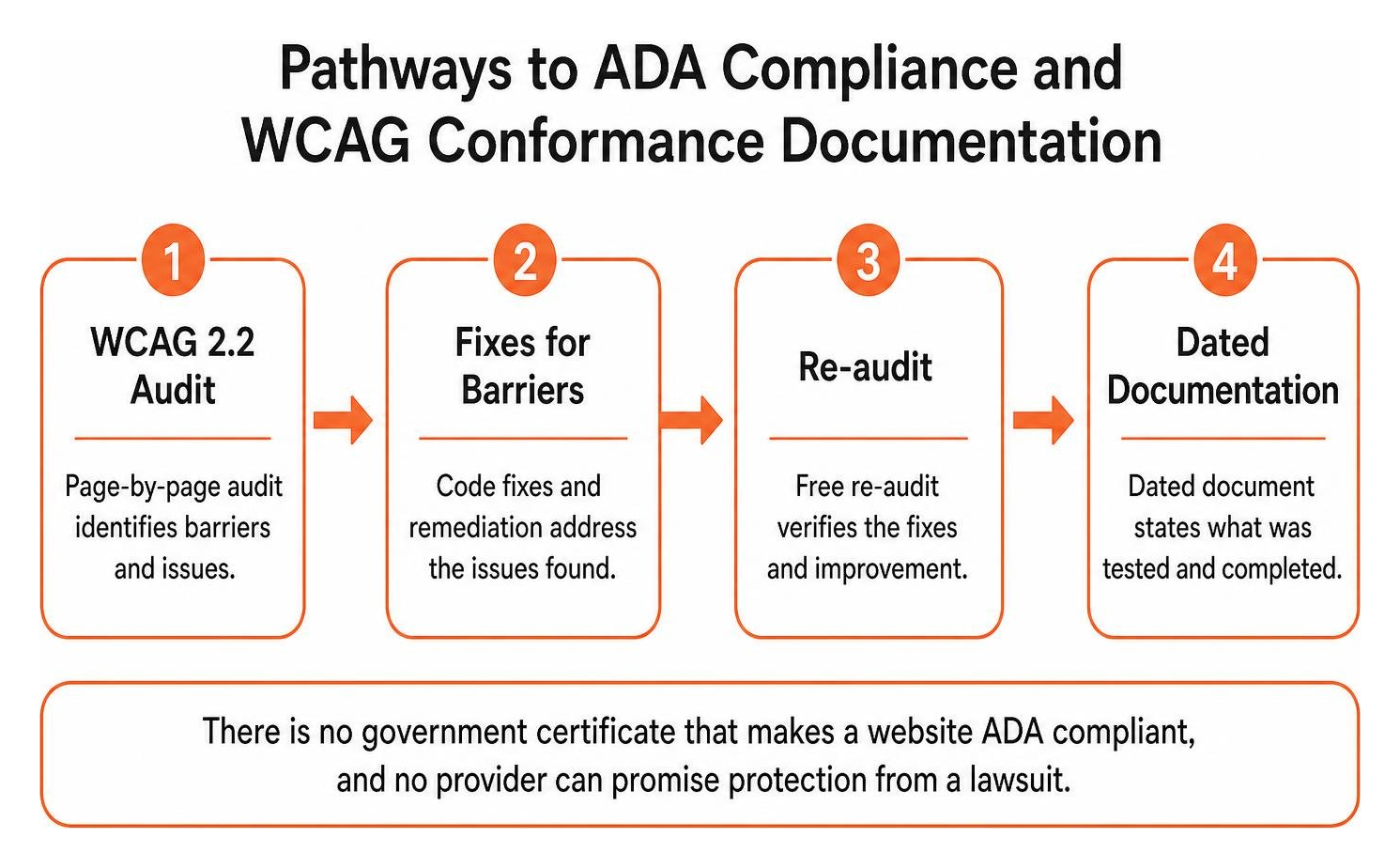
Key Types of Compliance Documentation
When securing professional verification, different business needs call for distinct types of accessibility records. Understanding these documents helps you choose the right deliverables for your team:
- Accessibility Conformance Statement: A public-facing declaration hosted on your website that details your current level of WCAG 2.2 conformance, known limitations, and direct contact details for users who need assistance.
- Voluntary Product Accessibility Template (VPAT): A standardized reporting template created by the Information Technology Industry Council (ITI).
- Accessibility Conformance Report (ACR): The completed, technical report generated from a VPAT. This document outlines how every single component of your digital product meets each applicable accessibility standard.
- Provider Certification Letters: Formal, dated attestations signed by qualified auditors confirming that your platform underwent an exhaustive audit and remediation cycle.
Selecting the right documentation depends on whether you are defending against public litigation or fulfilling enterprise procurement requirements. Reviewing the top professional certifications for ADA and WCAG conformance will help you confirm that your documentation carries real weight with legal teams and corporate buyers.
Regulatory Convergence: ADA, Section 508, and the EAA
Accessibility regulations around the world are increasingly harmonized. In the United States, ADA Title II governs state and local government entities, while ADA Title III applies to private businesses operating places of public accommodation. For public sector procurement, Section 508 sets the legal bar for electronic and information technology.
Across the Atlantic, the European Accessibility Act (EAA) requires digital products and e-commerce services to meet strict accessibility baselines outlined in EN 301 549. The unifying core behind every single one of these laws is the Web Content Accessibility Guidelines. By achieving WCAG 2.2 Level AA conformance, your business simultaneously satisfies federal requirements, international mandates, and public accommodation expectations.
Evaluating Top ADA Accessibility Certification Services for Digital Compliance
Choosing the right service provider requires looking past superficial marketing claims. A credible partner conducts deep technical work instead of relying on automated scripts.
| Evaluation Criteria | Automated Scanning Alone | Overlay Widgets | Full-Service Audit and Remediation |
|---|---|---|---|
| Error Detection Rate | Catches roughly 30% to 40% of barriers | Fails to detect or fix underlying code flaws | Uncovers up to 100% of WCAG 2.2 success criteria issues |
| Code-Level Remediation | None (reports issues only) | Temporary visual injection without backend fixes | Permanent, semantic HTML, CSS, and ARIA remediation |
| Assistive Tech Verification | None | Often interferes with screen reader software | Complete keyboard, NVDA, JAWS, and VoiceOver validation |
| Documentation Defensibility | Basic automated score | Generic badge with minimal legal weight | Signed ACR, Conformance Statement, and re-audit log |
When evaluating potential partners, our ultimate guide to website accessibility certification services outlines the exact operational models you should expect from industry leaders.
Essential Capabilities of Credible ADA Accessibility Certification Services
A reputable certification firm relies on credentialed experts who understand the nuances of accessible web architecture. Look for teams holding certifications from the International Association of Accessibility Professionals (IAAP), such as the Certified Professional in Web Accessibility (CPWA) credential. Federal alignments like the Department of Homeland Security (DHS) Trusted Tester program also signal rigorous testing proficiencies.

True accessibility expertise requires hands-on evaluation of interactive elements, semantic page structures, and keyboard traps. Automated tools miss dynamic states, modal focus loops, and descriptive image context. Expert engineers evaluate every line of markup to ensure that users navigating with screen readers or alternative input hardware experience smooth, barrier-free interactions.
How Modern ADA Accessibility Certification Services Safeguard Your Business
Federal ADA lawsuits under Title III have surged, climbing from 2,722 filings in 2013 to over 4,000 cases annually by 2024. For businesses caught unprepared, statutory non-compliance carries severe financial exposure. Civil penalties under the ADA can reach up to $92,383 for a first violation, climbing to as much as $184,767 for subsequent violations.
Relying on quick overlay widgets creates substantial vulnerabilities. In fact, approximately 25% of digital accessibility lawsuits were filed against websites utilizing overlay tools that promised instant fixes. Real risk mitigation demands robust technical work. Implementing our certified WCAG audit process to shield against lawsuits ensures that you possess concrete, tamper-proof testing histories to counter predatory legal demand letters.
The Proven Path: From Initial Audit to Formal Certification
Achieving verified accessibility is a clear, structured sequence. Following our step-by-step guide to the WCAG 2.2 certification process takes your organization from baseline discovery to full verification.
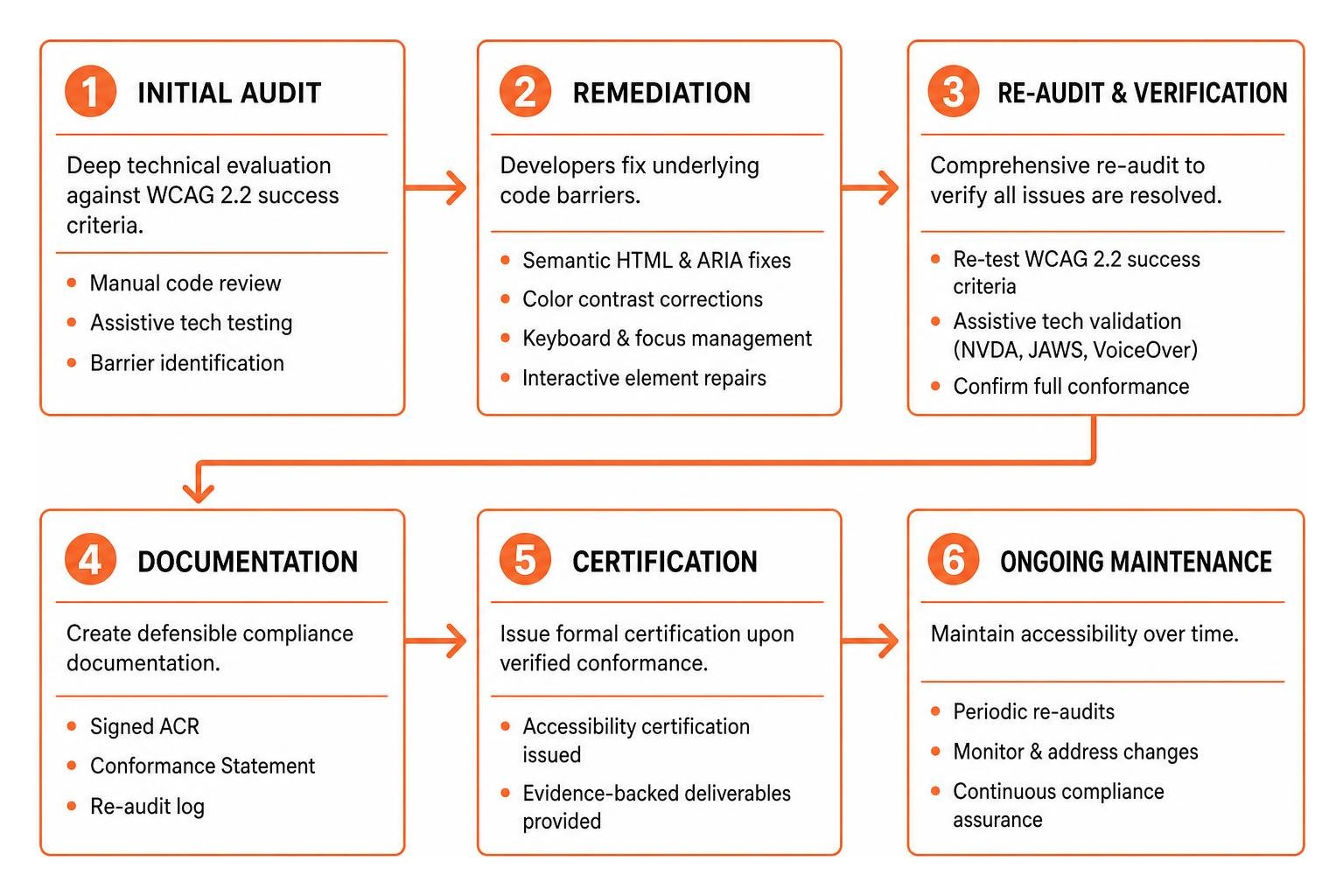
The Core Difference: Audit, Remediation, and Verification
Organizations often confuse audits with full compliance. An accessibility audit simply catalogs the barriers present on your digital asset. It produces an issue backlog identifying non-conforming elements across your pages.
Remediation is the active phase where developers repair underlying code. This includes restructuring HTML headers, defining accurate ARIA live regions, correcting color contrast ratios, and re-engineering keyboard focus managers. Once these fixes are implemented, a comprehensive re-audit verifies that every identified barrier is resolved before any formal badge or certificate is issued.
Testing Methodologies: Automated vs. Manual vs. Real-User Validation
Automated testing tools are helpful for rapid baseline checks, but they only detect approximately 30% to 40% of all accessibility issues. They easily overlook dynamic interactions, missing form context, logical reading order, and video caption accuracy.

Achieving complete WCAG 2.2 conformance requires pairing automated diagnostics with expert manual testing and real-user evaluations. Manual engineers navigate pages using only keyboards and screen readers, validating that every menu, button, and checkout flow functions properly. Testing alongside individuals with lived disabilities provides the final proof of authentic digital usability.
Maintaining Freshness: Re-Certification Schedules
Websites are never static. Every new marketing banner, blog post, plugin update, or template redesign introduces the risk of code regressions. A certification document that is older than two years carries diminished legal freshness.
To maintain continuous protection, businesses should schedule annual full-scope re-certifications supported by quarterly automated sweeps. Archiving past testing logs and maintaining an active revision history proves to regulators that your organization treats digital accessibility as an ongoing responsibility rather than a one-time project.
Frequently Asked Questions About Digital ADA Certification
Is there an official government body that certifies website ADA compliance?
No federal government body or agency issues official ADA compliance certificates for websites. The Department of Justice enforces accessibility requirements under Title III, but it does not run a public certification program. Defensible compliance is demonstrated through third-party audits, verifiable remediation logs, and comprehensive WCAG 2.2 Level AA conformance documentation.
How often does a website need to be re-certified for accessibility?
Websites should undergo full professional re-certification annually. Because routine software updates, new digital assets, and third-party integrations can introduce unintended barriers, supplementing your annual certification with quarterly audits ensures your site remains accessible and legally resilient over time.
Can automated scans alone provide valid ADA certification?
No. Automated scanning software only catches about 30% to 40% of accessibility errors, leaving 60% or more undetected. Automated scans cannot evaluate complex context, screen reader audio clarity, or intricate keyboard navigation workflows. A valid certification requires hands-on manual code review and assistive technology testing.
Conclusion
Building an accessible website protects your business against costly litigation, broadens your audience reach, and strengthens digital brand trust. Achieving real legal peace of mind requires verified code-level remediation and clear documentation rather than superficial widget solutions.
At WCAG Pros, our team delivers comprehensive page-by-page audits across all 54 WCAG 2.2 points, complete with code-level fixes, free re-audits, and verifiable compliance badges. Ready to make your digital platform accessible to all users? Schedule a comprehensive WCAG audit and certification with our specialists today.
Read more website accessibility articles
Get Help With Your Website
We'll follow up with info about:
- The process
- Cost
- Timeline
We promise to respect your privacy, and never abuse the information you provide. We will not sell or rent your information to any third party.
By submitting this form, you consent to receive SMS messages and/or emails from SEM Dynamics LLC, dba WCAG Pros. To unsubscribe, follow the instructions provided in our communications. Msg & data rates may apply for SMS. Your information is secure and will not be sold to third parties.