
How ADA WCAG Consultants Can Help You to Stay Compliant
How ADA WCAG Consultants Can Help You to Stay Compliant
Why ADA WCAG Non-Compliance Is Putting Your Business at Risk Right Now
Compliance consulting ADA WCAG is the process of working with accessibility experts to audit your website, fix accessibility barriers, and document your conformance with the Web Content Accessibility Guidelines (WCAG 2.2) to meet ADA legal requirements.
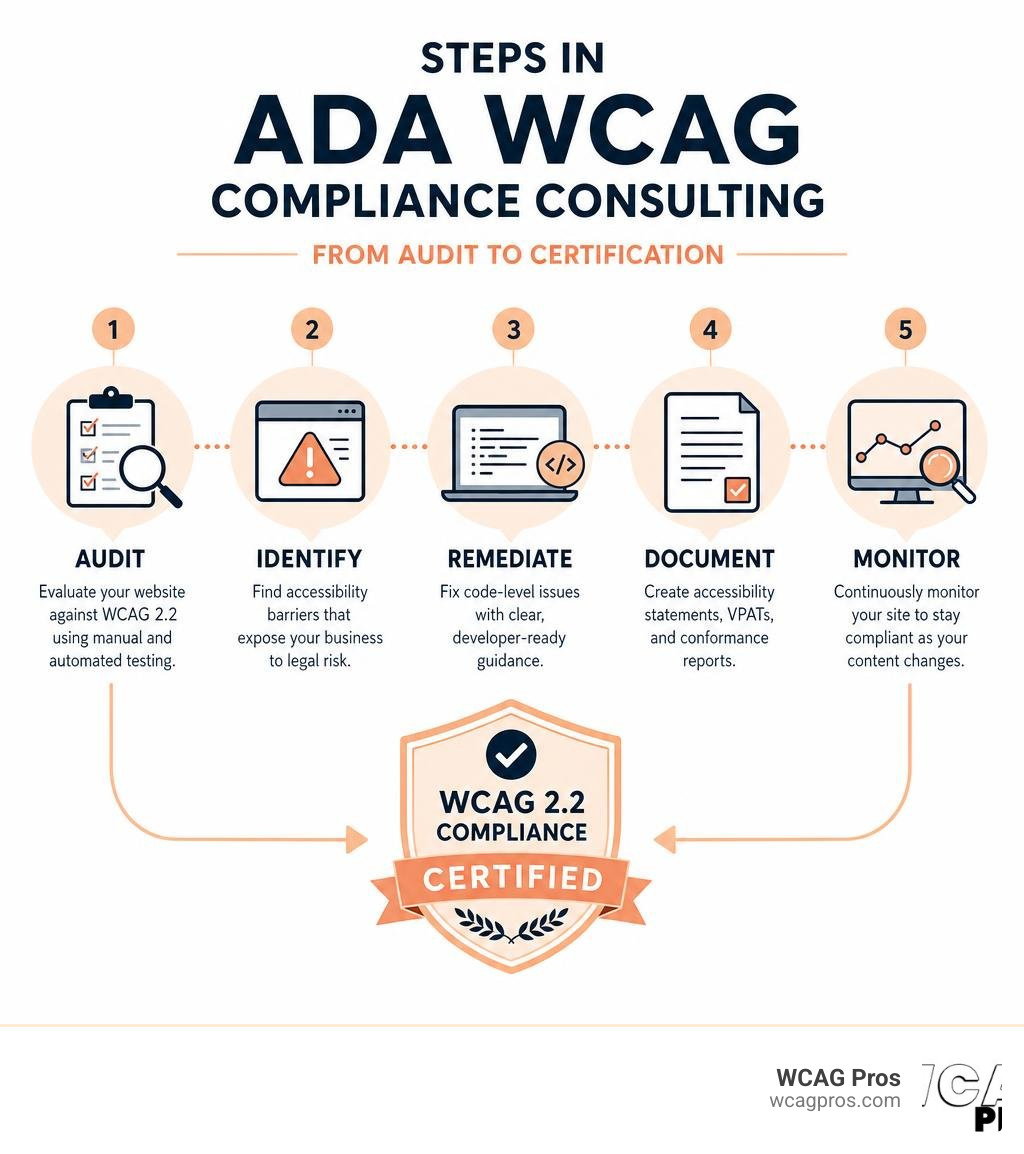
Here is what a compliance consultant typically helps you do:
- Audit your website against WCAG 2.2 success criteria using both manual and automated testing
- Identify accessibility barriers that expose your business to legal risk
- Remediate code-level issues with clear, developer-ready guidance
- Document your compliance with accessibility statements, VPATs, and conformance reports
- Monitor your site on an ongoing basis to stay compliant as your content changes
Over 61 million Americans live with a disability. In 2024 alone, 2,452 website accessibility lawsuits were filed in federal court, accounting for 28% of all ADA Title III cases. Even a quiet settlement can cost between $20,000 and $50,000. In 2025, Fashion Nova agreed to a $5.15 million class-action settlement over claims its website was inaccessible to blind users.
The risk is real. And it is growing every year.
Many business owners assume their website is fine, or that a quick-fix overlay widget will protect them. It will not. Accessibility lawsuits are filed against companies of all sizes, including those that have already been sued before. In 2024, 961 lawsuits were filed against companies that had already faced a previous claim.
The good news is that working with the right consultant can protect your business, improve your user experience, and put documented evidence in your corner.
I’m Matthew Post, co-founder of WCAG Pros and a web developer with over 20 years of experience specializing in compliance consulting for ADA WCAG requirements across businesses of all sizes. I personally supervise every audit and remediation project we take on, so you get practical solutions that reduce legal risk and make your site genuinely accessible.
In this guide, we will walk you through everything you need to know, from legal frameworks and audit methodologies to choosing the right consultant and maintaining long-term compliance.
Compliance consulting ADA WCAG word list:
Understanding Compliance Consulting ADA WCAG and Legal Frameworks
Digital accessibility is no longer a luxury or a minor design consideration. It is a strict legal requirement. Federal courts have consistently ruled that websites operated by businesses serving the public qualify as places of public accommodation under Title III of the Americans with Disabilities Act.
To navigate this landscape, businesses often turn to specialized firms. This is where Why Your Business Needs an ADA Compliance Consultant Right Now becomes clear. A dedicated consultant helps you decode complex legal standards and translate them into actionable development tasks.
When we discuss digital accessibility, we look at several distinct legal frameworks. Each framework has its own scope and target audience.
- ADA Title III: This applies to private businesses and commercial entities. If you sell products, offer services, or interact with the public online, your digital presence must be accessible.
- ADA Title II: This applies to state and local government entities. This includes school districts, public libraries, and municipal services. The Department of Justice has established strict compliance deadlines for Title II. State and local government organizations must meet WCAG 2.2 Level AA standards.
- Section 508: This is part of the Rehabilitation Act. It requires federal agencies and any vendors selling to the federal government to make their information technology accessible. If you bid on government contracts, you must provide documented proof of compliance.
- European Accessibility Act: If you do business in Europe, this law establishes mandatory accessibility requirements for a wide range of digital products and services.
The technical foundation for almost all of these laws is WCAG. Created by the World Wide Web Consortium, WCAG provides the global standard for digital inclusion. The guidelines are organized under four core principles. Your website content must be perceivable, operable, understandable, and robust. You can review the source standard directly in the W3C Web Content Accessibility Guidelines WCAG 2.2.
The current standard is WCAG 2.2. This update introduced new success criteria to address mobile device interactions, cognitive accessibility, and keyboard navigation.
Let us look at how these frameworks compare.
| Legal Framework | Target Audience | Technical Standard | Primary Enforcement Mechanism |
|---|---|---|---|
| ADA Title III | Private businesses and public accommodations | WCAG 2.2 Level AA | Private civil litigation and DOJ enforcement |
| ADA Title II | State and local governments and public schools | WCAG 2.2 Level AA | Department of Justice mandates and civil rights lawsuits |
| Section 508 | Federal agencies and government vendors | WCAG 2.2 Level AA | Federal procurement rules and administrative complaints |
| European Accessibility Act | Products and services sold in the EU market | EN 301 549, which is aligned with WCAG | Market surveillance and member state penalties |
Ignoring these frameworks can lead to devastating financial consequences. Many businesses do not realize the true scale of their exposure until they receive a formal demand letter. To understand the financial impact of ignoring these rules, you can read about The Real Costs of Ignoring Website Accessibility.
If you are already facing legal pressure, you need to act quickly. There are proven strategies to protect your business, which you can explore in Five Ways to Stop an ADA Lawsuit in Its Tracks.
Core Services and Choosing the Right Consultant
When you hire a firm for compliance consulting ADA WCAG services, you are not just buying a report. You are partnering with experts who will guide your team through a complete transformation. Comprehensive consulting covers several core areas.
First, a consultant conducts an in-depth audit of your digital assets. This includes your website, mobile applications, SaaS platforms, and digital documents like PDFs. Second, they provide detailed remediation guidance. This means giving your developers exact code snippets to fix the issues. Third, they offer role-based training. Your content creators, designers, and developers need to learn how to keep new content accessible.
To learn more about what these engagements look like, read Everything You Need to Know About Comprehensive Accessibility Consulting Services.
Choosing the right consultant is a critical business decision. You should avoid general web agencies that claim they can handle accessibility on the side. True accessibility work requires certified specialists.
When evaluating potential partners, look for credentials from the International Association of Accessibility Professionals. These include the Certified Professional in Accessibility Core Competencies and the Web Accessibility Specialist credentials.
To help you make an informed choice, we recommend reading How to Choose the Right Web Accessibility Consultant for 2025.

You can also read The Ultimate Guide to ADA Audit Services to understand the exact scope of a professional review.
Here is a quick checklist of what to look for when choosing your consultant.
- Manual Testing Methodology: Ensure they use real human testers, including people with disabilities who use assistive technologies.
- Clear Deliverables: They should provide page-by-page audit reports with specific code-level remediation instructions.
- Post-Remediation Verification: They must offer retesting to verify that your fixes were implemented correctly.
- No Overlay Shortcuts: They should openly reject automated overlay widgets and focus on real code fixes.
- Industry Experience: They should have a proven track record of helping businesses in your specific sector.
Working with an independent expert is always the safest path to ensure your digital assets are fully accessible.
Key Deliverables in Compliance Consulting ADA WCAG
A professional consulting engagement produces specific deliverables that protect your organization and support your business goals. These documents are essential for legal defense, procurement processes, and public transparency.
The first key deliverable is a Voluntary Product Accessibility Template, which is used to generate an Accessibility Conformance Report. If you sell software to corporate clients or government agencies, they will require this report before signing a contract. It proves that your product has been evaluated against WCAG 2.2 standards.
The second deliverable is a public accessibility statement. This is a page on your website that outlines your commitment to accessibility, the standards you target, and a clear way for users to report any barriers they encounter.
The third deliverable is a formal compliance certificate and digital badge. Once your site has been fully remediated and verified, we provide a certificate that you can share with stakeholders. For a deep dive into this process, read A Practical Guide to Website Accessibility Certification. You can also explore The Ultimate Guide to Website Accessibility Certification Services to see how certification builds credibility.
Auditing Methodologies and Common Accessibility Failures
To build a secure and inclusive website, you must understand how audits are conducted and where most websites fail. A reliable audit cannot rely on automated software alone. It requires a balanced combination of automated scanning and manual human evaluation.
Manual testing is the gold standard of digital accessibility. It involves trained engineers navigating your site using keyboard-only controls and screen readers like JAWS, NVDA, and VoiceOver. This is the only way to verify that your interactive elements, dynamic content, and user journeys actually work for real people.
To learn more about the structure of a professional review, read The Certified WCAG Audit Process: Your Shield Against Lawsuits.

When we conduct an audit, we frequently find the same common accessibility failures. These are the barriers that most often trigger demand letters and lawsuits.
- Missing or Incorrect Alternative Text: Images without alternative text are invisible to screen reader users. If an image contains important information or acts as a link, it must have descriptive alternative text.
- Low Color Contrast: Text must stand out clearly against its background. Low contrast makes content unreadable for users with low vision or color blindness.
- Keyboard Traps: Users who cannot use a mouse rely on the Tab key to navigate. A keyboard trap occurs when a user can navigate into an element, like a pop-up modal, but cannot navigate back out without a mouse.
- Unlabeled Form Fields: If your input fields and buttons lack clear labels, screen readers cannot tell users what information to enter. This makes checkouts and contact forms completely unusable.
- Inaccessible Videos: Videos without captions exclude deaf users, while videos without transcripts or audio descriptions exclude blind users.
Why Automated Scans Fail to Detect Most WCAG 2.2 Issues
Many businesses buy automated scanning tools and assume they are fully protected. This is a dangerous mistake. Automated tools, even those powered by modern artificial intelligence, can only detect about 40% of WCAG 2.2 issues. Some basic scanners only catch 25% of failures.
An automated tool can tell you if an image has an alt attribute, but it cannot tell you if the text inside that attribute actually makes sense. It cannot verify if a complex checkout flow is logical, if a screen reader announces dynamic updates correctly, or if a modal window manages keyboard focus safely.
For a comprehensive breakdown of why human testing is irreplaceable, read our Expert Website WCAG Audit Guide for Businesses.
How Compliance Consulting ADA WCAG Resolves Common Code Barriers
When you work with us at WCAG Pros, we do not just hand you a list of errors. We provide your development team with the exact code fixes they need to resolve every failure. We test all 54 points of WCAG 2.2 Levels A and AA for every single page in your audit scope.
We help your team implement semantic HTML, which establishes a clear document structure for assistive technologies. We show your developers how to design visible focus indicators so keyboard users can see where they are on the page. We also guide them in using Accessible Rich Internet Applications labels correctly to handle complex interactive elements.
To see how we document and resolve these issues, read The Ultimate Guide to a WCAG Comprehensive Website Audit. You can also review The No-Nonsense Guide to ADA Audit and Certification for a straightforward look at the process.
Frequently Asked Questions about Digital Accessibility
Navigating digital accessibility can feel overwhelming. Here are the answers to the most common questions we hear from business owners and IT leaders.
Do accessibility overlay widgets provide legal protection under the ADA?
No. Overlay widgets and automated scripts do not provide legal protection. In fact, they often make your website more of a target for lawsuits.
Overlays are temporary software layers that sit on top of your website code. They attempt to modify the user interface on the fly, but they do not fix the underlying code.
These widgets frequently interfere with the personal screen readers and assistive devices that disabled users already have installed on their computers. Advocacy groups, accessibility experts, and federal courts have widely rejected overlays.
To understand the truth about these quick fixes and how they impact your legal safety, read The Truth About ADA Reaudit Guarantees and Legal Safety.
How long does a comprehensive WCAG 2.2 audit typically take?
The timeline for a digital accessibility audit depends entirely on the size and complexity of your digital asset.
For a standard marketing website with a limited number of unique page templates, a comprehensive audit typically takes five to ten business days. For complex web applications, SaaS platforms, or large e-commerce websites with interactive checkout flows, the process can take two to four weeks.
Once the initial audit is complete, your team will receive the remediation report. The time required for your developers to implement the fixes will vary based on their resources.
After your team completes the remediation, we perform a verification re-audit to confirm that every issue has been resolved. You can learn more about planning your compliance timeline by reading The ADA Web Consultation: Your Roadmap to Digital Inclusion.
What is the business ROI of investing in professional accessibility consulting?
While avoiding lawsuits is a major motivator, investing in digital accessibility offers massive business benefits.
First, accessibility directly improves your search engine optimization. Search engine crawlers navigate websites in a very similar way to screen readers. By using semantic HTML, adding descriptive alt text, and building a clean heading structure, you make it easier for search engines to index your site, which boosts your organic rankings.
Second, an accessible website expands your market reach. By making your site usable for the 61 million Americans with disabilities, you open your business to an underserved market with immense purchasing power.
Third, prioritizing inclusion builds brand trust and customer loyalty. To explore the financial and marketing advantages of digital inclusion, read The Business Benefits of an Accessible Website.
You can also read The ROI of Accessibility for Small Businesses to see how small investments yield big returns. For more details on revenue growth, read How Having an ADA Compliant Website Can Increase Your Revenue.
Finally, you can check out The Link Between Accessibility and Brand Trust and learn Why Website Accessibility Is a Competitive Advantage for Businesses in 2025.
Conclusion
Achieving digital compliance is not a one-time project. It is an ongoing commitment to inclusion, usability, and risk mitigation. In the modern legal landscape, relying on automated scans or cosmetic overlays is a recipe for legal trouble.
By partnering with WCAG Pros, you get a dedicated team of accessibility experts who understand the code, the standards, and the law. We do not take shortcuts. We provide comprehensive, page-by-page audits of all 54 WCAG A and AA success points, deliver developer-ready code fixes, and perform free re-audits to award your compliance badge.
If you want to protect your business, improve your user experience, and make your digital products accessible to everyone, we are here to help.
Are you ready to secure your digital presence? Get Started with a Certified WCAG Audit today and let our team guide you to complete compliance.
Read more website accessibility articles
Get Help With Your Website
We'll follow up with info about:
- The process
- Cost
- Timeline
We promise to respect your privacy, and never abuse the information you provide. We will not sell or rent your information to any third party.
By submitting this form, you consent to receive SMS messages and/or emails from SEM Dynamics LLC, dba WCAG Pros. To unsubscribe, follow the instructions provided in our communications. Msg & data rates may apply for SMS. Your information is secure and will not be sold to third parties.