
Top Web Accessibility and Remediation Certifications to Advance Your Career
Top Web Accessibility and Remediation Certifications to Advance Your Career
Which Web Accessibility Certification Fits Your Career?
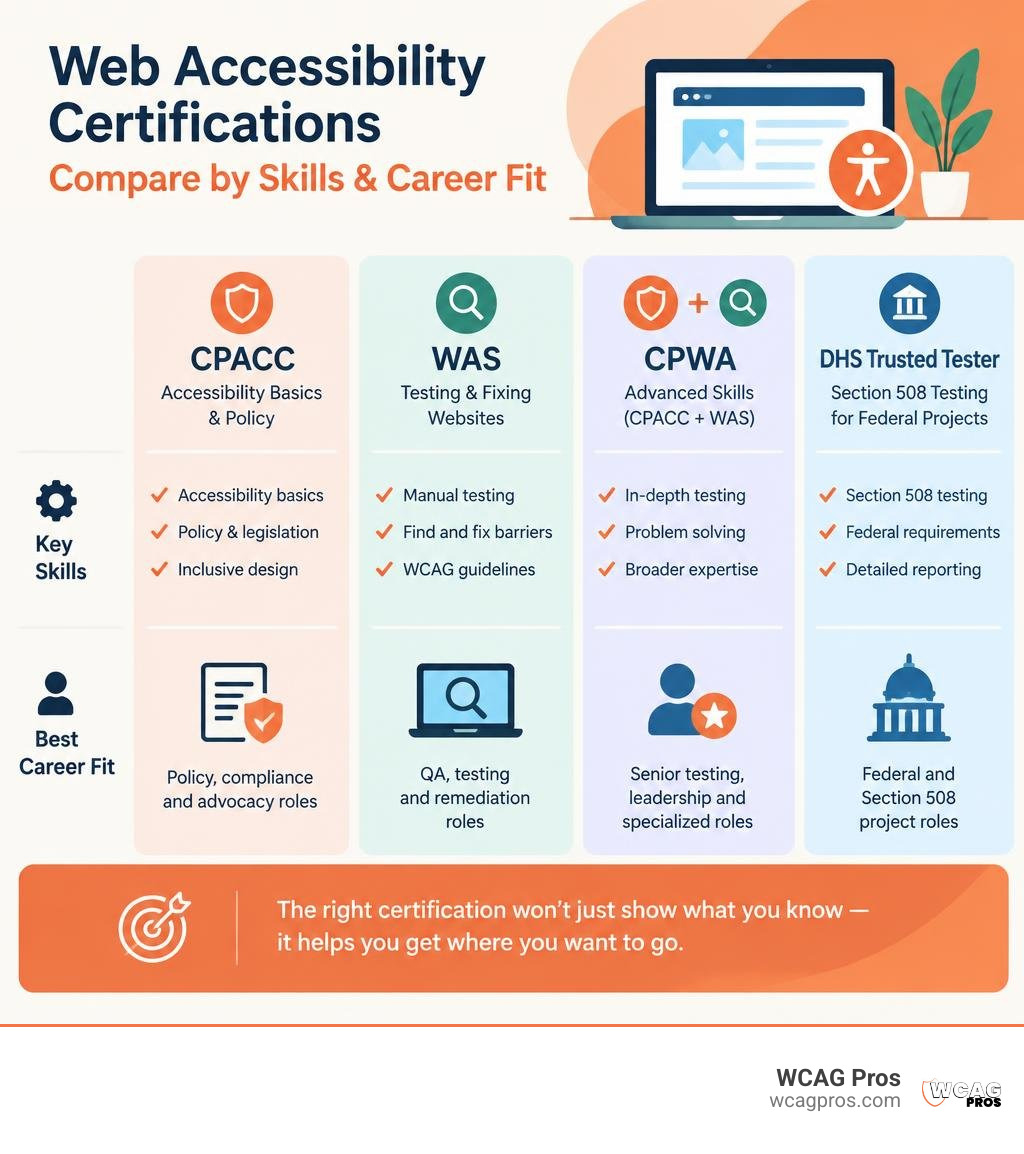
Choose a credential based on the work you want to do. IAAP’s CPACC covers accessibility basics and policy. WAS focuses on testing and fixing websites. Earning both qualifies you for the CPWA designation. DHS Trusted Tester is a strong fit if you work on Section 508 testing for federal projects.
These credentials certify people, not websites. If you manage a site, look for professionals who can test it against WCAG 2.2, fix barriers, and document the results. A credential may show skill, but it does not make a site ADA compliant.
I’m Matthew Post, co-founder of WCAG Pros and a web developer with more than 20 years of experience. I supervise audits and remediation projects, where web accessibility compliance certification means backing a claim with careful testing and clear records.
Easy web accessibility compliance certification word list:
Understanding Web Accessibility Compliance Certification Pathways
The demand for certified digital accessibility experts has grown rapidly as legal benchmarks and international standards evolve. Today, organizations face strict regulatory requirements across global jurisdictions. Understanding how technical guidelines align with legal mandates is the first step toward building a successful career or establishing an organizational compliance posture.
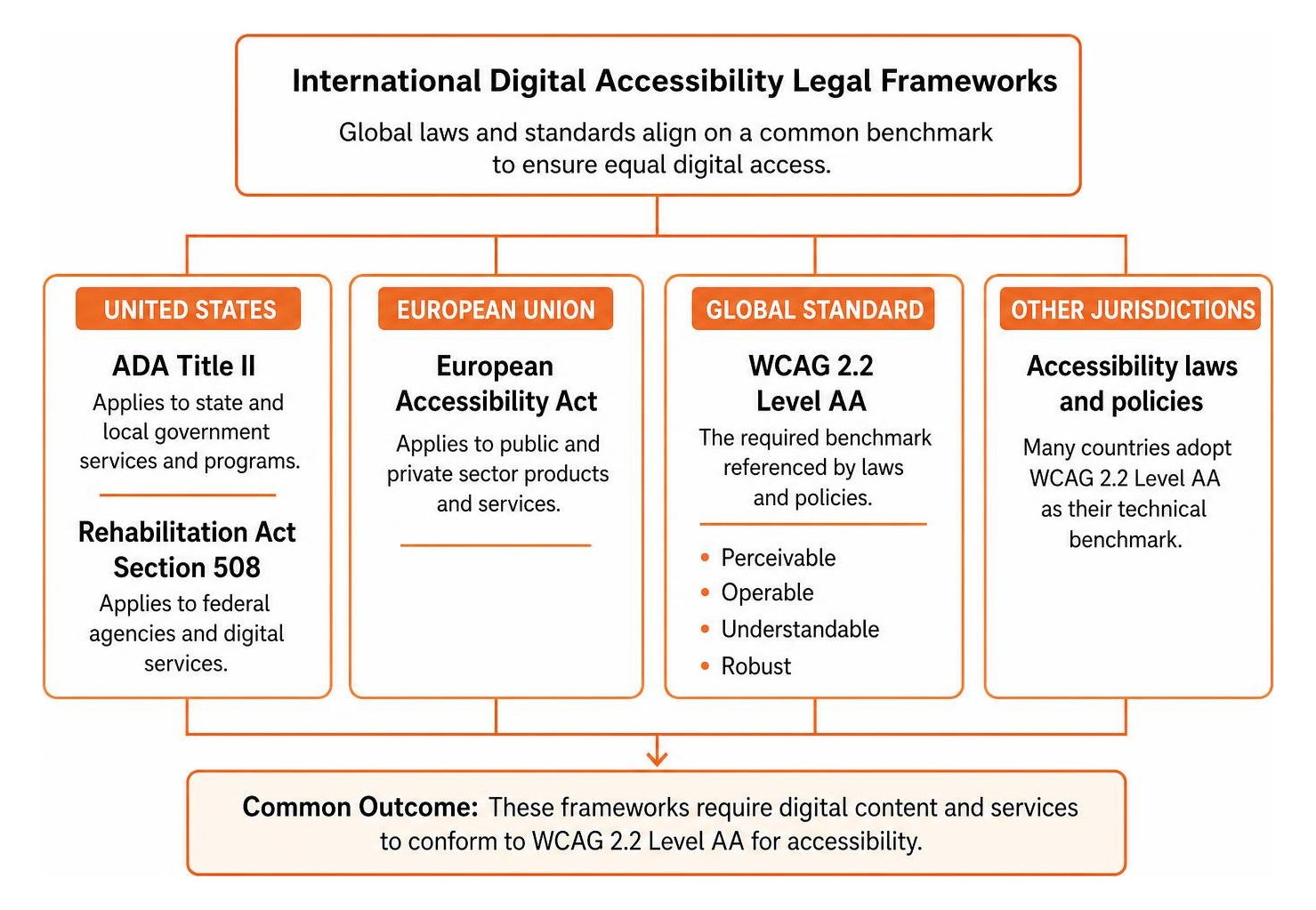
The definitive technical foundation for digital accessibility is the Web Content Accessibility Guidelines established by the World Wide Web Consortium. Most statutory regulations, including ADA Title II updates, Section 508 of the Rehabilitation Act, and the European Accessibility Act, explicitly point to Web Content Accessibility Guidelines Level AA Conformance as the required benchmark.
Level AA conformance includes critical technical requirements such as minimum color contrast ratios, full keyboard operability, clear focus indication, descriptive form labels, and robust screen reader compatibility. To navigate these requirements, many teams refer to our practical guide to website accessibility certification to structure their internal evaluation roadmaps.
Individual Credentials vs. Organizational Web Accessibility Compliance Certification
A frequent source of confusion in the market is the difference between certifying an individual professional and certifying a digital property.
Individual credentials demonstrate that an auditor, developer, or program manager possesses the technical competence to evaluate digital interfaces, write accessible code, and author compliance documentation. These credentials include professional designations awarded by international industry bodies, which validate expertise in disability models, universal design principles, and technical code inspection.
Organizational certification refers to the formal process of validating that a specific website, web application, or digital portal meets established WCAG success criteria on a specific date. As outlined in the W3C guidance on Understanding Conformance in WCAG, formal conformance claims apply to full web pages and complete user processes rather than isolated interface components.
When organizations seek third-party validation, they often turn to professional website accessibility certification services that combine human manual testing with detailed technical documentation to produce formal statements of conformance and Voluntary Product Accessibility Templates.
Why Certified Specialists Are Essential for Accessibility Reviews
Organizations may begin accessibility work with preliminary checks, but those checks cannot replace a full review by qualified specialists.
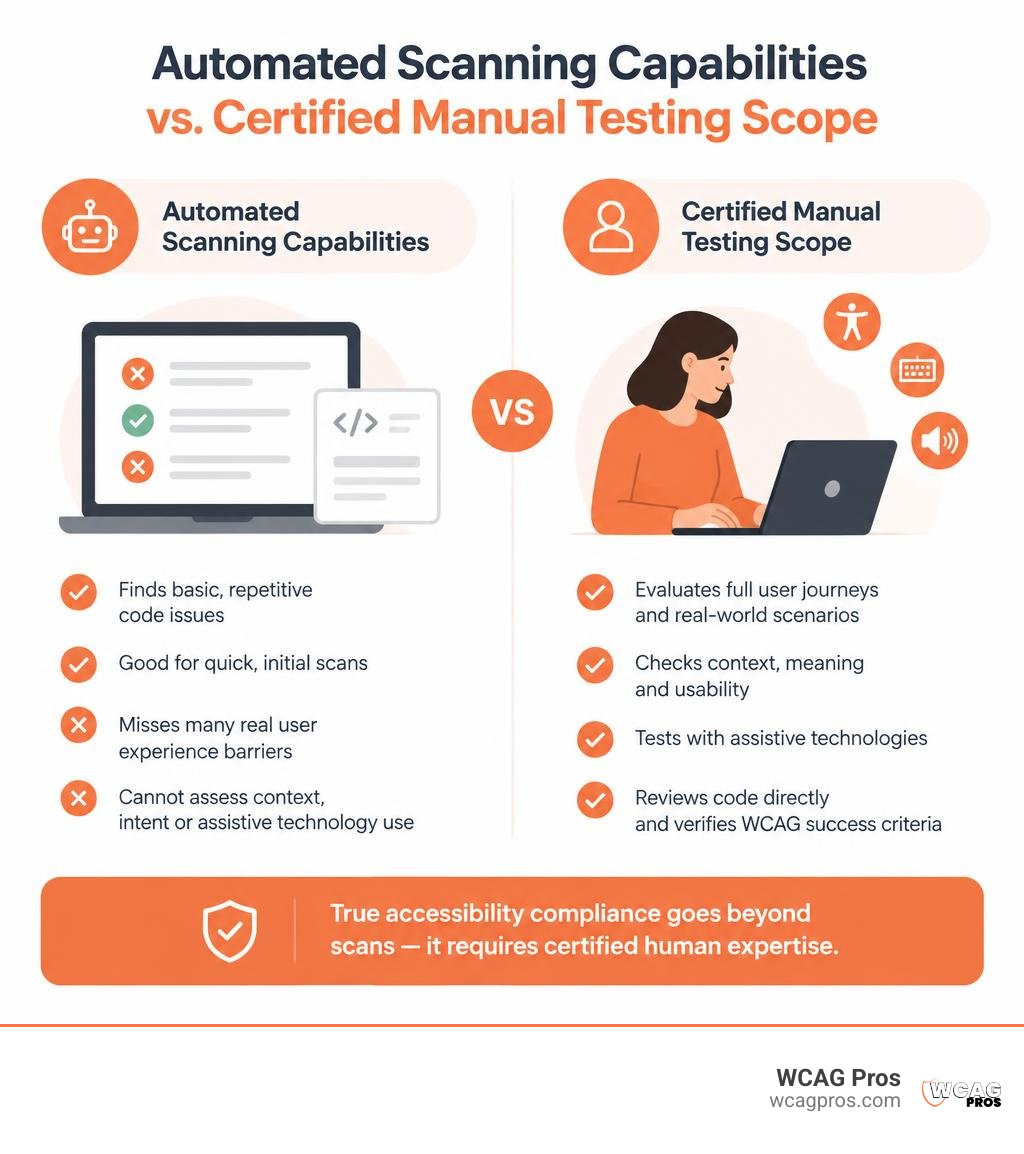
A thorough accessibility review requires human context, cognitive evaluation, and manual assistive technology testing. Specialists assess whether alternative text is contextually accurate, keyboard focus movement is logical, and interactive components work reliably with screen readers.
Incomplete accessibility reviews can leave structural barriers unresolved and may expose organizations to legal risk. Achieving true, defensible compliance requires relying on a proven certified WCAG audit process led by trained specialists who inspect code directly.
Top Professional Accessibility and Remediation Certifications Compared
Navigating the professional certification landscape requires understanding the specific focus of each program. The International Association of Accessibility Professionals offers the primary global standard credentials, while government bodies provide specialized programs for public sector procurement.
Selecting the right program depends on your current role, technical background, and career aspirations. Below is a detailed comparison of the top professional certifications available for digital accessibility practitioners.
| Certification | Administering Body | Core Focus | Target Audience | Primary Prerequisites | Exam Format |
|---|---|---|---|---|---|
| CPACC | IAAP | Conceptual foundations, disability models, universal design, accessibility laws | Program managers, designers, policy officers, educators | Broad exposure to accessibility concepts | 100 multiple-choice questions |
| WAS | IAAP | Technical code remediation, DOM structure, ARIA patterns, manual assistive technology testing | Frontend developers, QA engineers, technical accessibility auditors | 1-2 years technical web accessibility experience | Multiple-choice scenario-based questions |
| CPWA | IAAP | Comprehensive program governance and full-stack technical remediation | Enterprise accessibility directors, senior consultants | Successful completion of both CPACC and WAS | Dual-credential designation |
| DHS Trusted Tester | US Dept of Homeland Security | Federal Section 508 compliance, standardized test processes, test automation tools | Federal contractors, government accessibility specialists | Completion of official DHS training track | Practical test and multiple-choice examination |
Choosing the right credential helps you build credibility with employers and clients seeking verifiable expertise. You can explore our detailed overview of top professional certifications for ADA and WCAG conformance to see how these credentials apply to real-world remediation projects.

Certified Professional in Accessibility Core Competencies (CPACC)
The Certified Professional in Accessibility Core Competencies is the foundational credential administered by the IAAP. It focuses on the broad principles of accessibility rather than deep code-level remediation.
The CPACC curriculum covers three primary domains:
- Disabilities, challenges, and assistive technologies
- Accessibility and universal design principles
- International accessibility laws, standards, and management strategies
This credential is ideal for product owners, user experience designers, compliance managers, and human resources professionals who need to embed accessibility principles into organizational Governance, Risk, and Compliance frameworks. It provides the legal, ethical, and practical vocabulary needed to advocate for accessible design across an enterprise.
Web Accessibility Specialist (WAS)
The Web Accessibility Specialist credential is the gold standard for technical accessibility practitioners. Unlike the CPACC, the WAS exam tests hands-on technical knowledge of web technologies and code remediation.
Candidates must demonstrate deep mastery of:
- Semantic HTML5 and Document Object Model structure
- Accessible Rich Internet Applications (ARIA) design patterns and roles
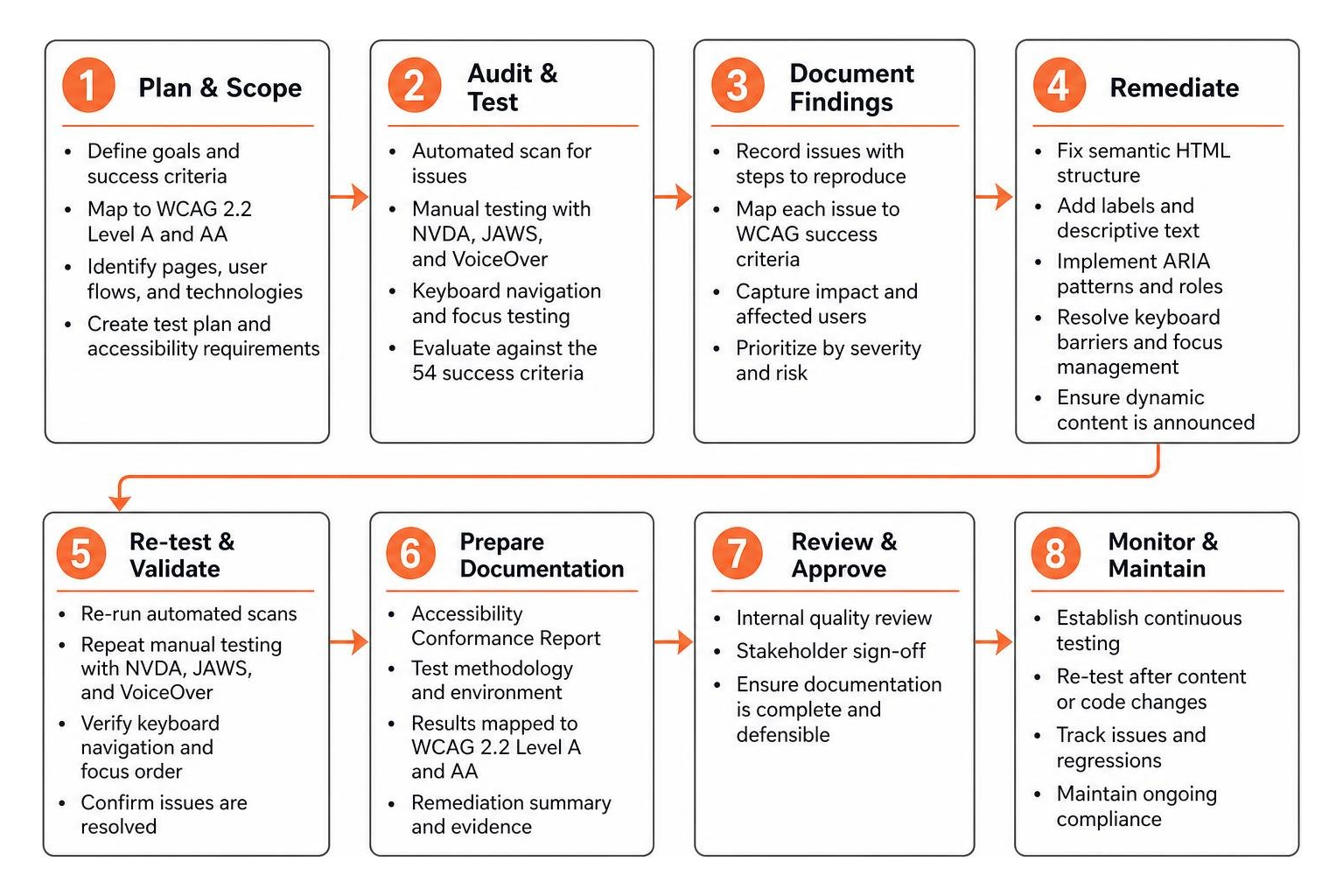
- Manual testing methodologies using screen readers like NVDA, JAWS, and VoiceOver
- Resolving keyboard navigation barriers, dynamic content announcements, and focus management
- Evaluating digital content directly against the 54 success criteria of WCAG 2.2 Level A and AA
The WAS designation proves to employers and clients that a developer or QA specialist can identify, document, and remediate technical code barriers within complex web applications.
Certified Professional in Web Accessibility (CPWA)
The Certified Professional in Web Accessibility is not a separate examination. Instead, it is an advanced master credential awarded automatically to professionals who successfully pass both the CPACC and the WAS examinations.
Holding the CPWA designation signals complete mastery of both organizational policy and deep technical execution. CPWA-certified professionals are uniquely equipped to lead enterprise-wide digital accessibility initiatives, author defensible Accessibility Conformance Reports, and establish continuous testing protocols across large engineering departments.
DHS Trusted Tester Certification
The Department of Homeland Security Trusted Tester program is a specialized certification designed for professionals working within the United States federal government and defense contracting ecosystem.
This program trains testers to use a standardized, repeatable test process to evaluate web applications for compliance with Section 508 of the Rehabilitation Act. The Trusted Tester training focuses heavily on structured manual testing methods, code inspection techniques, and specific testing toolbars. For contractors bidding on federal public sector proposals, holding a Trusted Tester certification is often a mandatory qualification for digital compliance roles.
Core Technical Domains and Defensible Documentation
Achieving professional competency or certifying an enterprise web property requires mastering core technical testing domains and understanding how to produce legally defensible documentation.
Essential Technical Skills for Web Accessibility Compliance Certification
Certified practitioners must understand how common digital barriers impact real users and how to remediate them at the source code level. According to web accessibility industry metrics, approximately 83 percent of website homepages exhibit color contrast failures, and an overwhelming majority present missing form labels or broken keyboard paths.
Practitioners must master the following technical competencies:
- Color Contrast and Visual Presentation: Ensuring text meets the minimum 4.5:1 contrast ratio against background colors (3:1 for large text) and verifying that interactive interface components have distinct visual focus states.
- Keyboard Operability: Guaranteeing that every interactive link, button, modal dialog, and dropdown can be fully navigated, opened, and closed using only a standard keyboard, avoiding focus traps.
- Semantic Structure and Programmatic Association: Using appropriate HTML heading hierarchies, landmarks, table headers, and form field
associations so assistive technologies can interpret page layouts accurately. - Accessible Rich Internet Applications: Applying ARIA attributes correctly when standard HTML is insufficient, while avoiding improper ARIA overrides that confuse screen readers.
- Universal Non-Interference: Ensuring that third-party plugins and non-supported content do not violate critical safety criteria, including Audio Control, No Keyboard Trap, Three Flashes or Below Threshold, and Pause, Stop, Hide.
For a detailed breakdown of the complete technical auditing roadmap, review our step-by-step guide to WCAG 2.2 certification process.

Documenting Defensible Proof: VPATs, ACRs, and Conformance Reports
Technical remediation is only half of the compliance equation. Organizations must also maintain clear, defensible documentation to satisfy procurement requirements and mitigate litigation risks.
When selling software or digital services to enterprises or government agencies, organizations are routinely asked to provide a formal Voluntary Product Accessibility Template. Once completed by a certified auditor, the VPAT becomes an Accessibility Conformance Report that documents exactly how the digital product supports each WCAG success criterion.
The VPAT template is available in several editions:
- VPAT 2.5 WCAG: Aligns specifically with WCAG guidelines for private enterprise procurement.
- VPAT 2.5 508: Evaluates products against United States federal Section 508 standards.
- VPAT 2.5 EU: Maps conformance directly to European Standard EN 301 549 and the European Accessibility Act.
- VPAT 2.5 INT: A comprehensive international document incorporating US, European, and global standards.
Maintaining up-to-date ACR documentation alongside continuous regression monitoring ensures that organizations can defend against legal demand letters and pass formal compliance audits. To understand how to organize your compliance evidence, consult our ADA audit and certification guide.
Frequently Asked Questions About Accessibility Certification
What is the most recognized certification for web accessibility professionals?
The Certified Professional in Web Accessibility designation from the IAAP is widely recognized as the premier global credential for digital accessibility specialists. Earning the CPWA requires passing both the conceptual CPACC exam and the technical WAS exam, demonstrating complete proficiency in both accessibility governance and technical code remediation.
Which WCAG level is legally required for compliance certification?
WCAG 2.2 Level AA is the universally recognized legal and regulatory standard. Level AA is referenced directly or used as the de facto compliance benchmark by the United States Department of Justice for ADA Title II and Title III enforcement, federal Section 508 standards, and the European Union under EN 301 549 and the European Accessibility Act. Level A represents only minimal accessibility, while Level AAA is generally considered too restrictive to be applied across entire complex websites.
How long does it take to prepare for and achieve accessibility certification?
Preparation timelines vary depending on professional background. For candidates with prior web development or quality assurance experience, preparing for the IAAP CPACC or WAS exam typically takes between four to eight weeks of dedicated study. Earning the credential requires reviewing official IAAP bodies of knowledge, practicing with screen readers, evaluating real-world code repositories, and completing mock examination modules. Maintaining IAAP credentials requires earning continuing education units over a three-year renewal cycle.
Conclusion: Accelerating Your Accessibility Career and Organizational Compliance
Digital accessibility is no longer an afterthought or an optional technical enhancement. In today’s digital economy, building accessible digital experiences is a fundamental engineering discipline, a vital civil rights mandate, and a core component of enterprise risk management.
For individual professionals, obtaining credentials such as the CPACC, WAS, CPWA, or DHS Trusted Tester opens doors to high-impact career opportunities in software engineering, user experience design, and compliance governance. For organizations, working with certified accessibility specialists and maintaining thorough documentation protects your brand against litigation while ensuring your digital products are usable by the broadest possible audience.
At WCAG Pros, our team of certified specialists helps organizations achieve complete digital compliance through comprehensive page-by-page audits, direct code remediation, and defensible conformance certification. When your team is ready to validate its digital properties, you can schedule a comprehensive WCAG audit with our team to secure your digital presence.
Read more website accessibility articles
Get Help With Your Website
We'll follow up with info about:
- The process
- Cost
- Timeline
We promise to respect your privacy, and never abuse the information you provide. We will not sell or rent your information to any third party.
By submitting this form, you consent to receive SMS messages and/or emails from SEM Dynamics LLC, dba WCAG Pros. To unsubscribe, follow the instructions provided in our communications. Msg & data rates may apply for SMS. Your information is secure and will not be sold to third parties.